Ken Scheel talks KEVA Planks, Foros and his journey from veterinarian to toy inventor
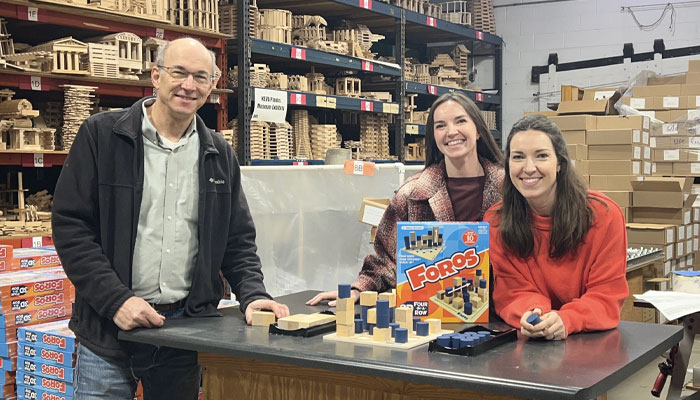
Ken, it’s great to catch up. How did you get started in toys? Was it always the plan?
No, it was never on the cards! I wanted to be a veterinarian since I was in second grade, and that was my whole life trajectory. I became a veterinarian. While I was in vet school, I worked at a summer camp and that’s where I invented my first toy. I ended up patenting and licensing it. Once you succeed on your first one, it’s addictive, so for my entire veterinary career, there was a parallel in the toy world.
Amazing, and what was that first idea?
It’s called a FlingSock. A lot more people have heard of a Foxtail, but it’s similar to that. It’s basically a bean bag with a fabric tail and a knob at the end of the tail. You swing it at your side and you play catch with it. The bean bag sinks in your hand when you go to catch it – it doesn’t bounce out of your hand – so it’s very easy to catch. And without much strength, you can throw it a long way.
How did that come about?
I was making them at camp. I took a bread wrapper and put dirt in the bread wrapper and then put that in the end of a long athletic sock. So I’d made them at camp, and then somebody sent me a Foxtail and said: “Ken! They took your idea!” But I threw it and thought that it didn’t work anywhere near as well as mine.
I decided I don’t want to be 80 years old saying I had this idea for a great toy and I never did anything with it. When I was growing up, I learned how to sew and I made my own backpack and coat and things like that because I didn’t have any money, but I had time and my mom was willing to teach me. So I would make prototypes, iterate and get it perfect.
Then I went to Toy Fair for the very first time, walking the show looking for any company that I thought might want anything like this. I actually started with the company that made Foxtail but FlingSock was too close to what they had. Then I found a company called Saturnian 1 based in Michigan. I reached out to them at just the right time and they thought it looked like a good fit. It’s still licensed to them today.

Great!
There are very few toys that 25 years later are still being manufactured – and FlingSock still is – so I call it a classic toy… I’m the only one that calls it that.
Ha! Well, I’ll start calling it that too – it might catch on and soon it’ll be in the Toy Hall of Fame! And post-FlingSock, how did the idea for KEVA Planks come about?
Well, I was at toy conference in California and I came across some blocks that were made in Europe. I got involved with those because I could see both the play potential and educational potential – so I started working with them. Eventually, when I couldn’t get those blocks anymore, I decided to make my own – and that’s how KEVA Planks started.
And what went into that, because you’ve designed a system here. You’re giving people the tools to build, rather than telling them exactly what to build, is that right?
Yes, that’s one of the things that differentiates KEVA planks from something like LEGO. With LEGO, you tend to be creating a specific set – you buy it, follow the instructions and build it. We try to do the opposite of that. All of our blocks are exactly the same. There’s no big ones, small ones, curved ones… There are no connectors… The entire experience is picking up a block and stacking it – so we try to encourage people to design their own things. They think of something, and then they make it happen.
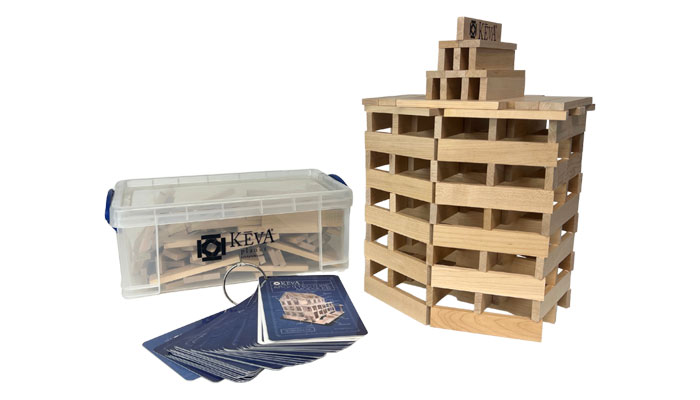
Almost everybody wants to build a tower at first, but we show people the tools and some of the core patterns for building. Like the different ways you might make a roof, or doorway, or window. Once you know how to do that, then you can design so many different buildings with different types of roofs and windows. So we provide some of the basic core structures and allow you to innovate and expand from there.
And I imagine the shape of these planks was important to this aim?
Yes, having blocks with this specific plank shape – long and thin – gives a lot more opportunity than if you’re using cubes. With KEVA Planks, you can build almost anything – from an Addams Family house to very simple structures.
And why KEVA?
We say it’s an acronym for Knowledge, Exploration, and Visual Arts. But in reality, it’s a retroactive acronym. We came up with a name just by trying to come up with a fun, easy name to say. I really wanted them to call them DaVinci blocks, but thankfully the person we hired to help with the branding talked me out of that.
I made a list of the things that I thought KEVA Planks stood for, like innovation, creativity, invention, art, sculptures… I put those into Google Translate and I would choose different languages to see different words for these things. But I don’t remember the exact language that KEVA came from because it was a very messy process! I asked some friends what they preferred out of a list and we narrowed it down to KEVA.

You mention these are all the same shape to preserve the open-ended nature of the play here – but did that also make KEVA Planks make it a tough sell? Because of the themes and various ways that construction toys are usually sold to consumers?
KEVA Planks work very well on word of mouth because almost anybody that plays with them find that it’s a really compelling experience. It’s different than anything else. It’s an artistic, peaceful thing to do.
But we made sure to show some of the different things you can build on our packaging – a car, a bird, a house… All of these different things. And people seem to get it. But we’ve grown by word of mouth, and through schools, libraries and museums. That became our core outreach and important to how we grew.
And more recently you’ve launched a wooden 3D four-in-a-row game – Foros. What’s the story behind this one?
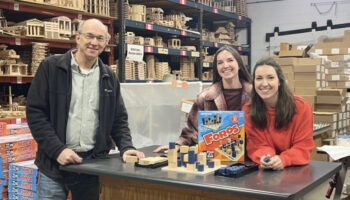
Foros uses cubes and cylindrical pieces of wood and, put simply, you’re trying to get four in a row. Up, across or diagonal. It’s like Connect 4 but in three dimensions. That’s all you need to know. It doesn’t have any quirky rules. And I made this game because I love the beauty of it and it’s so quick to learn – it’s a coffee table game.
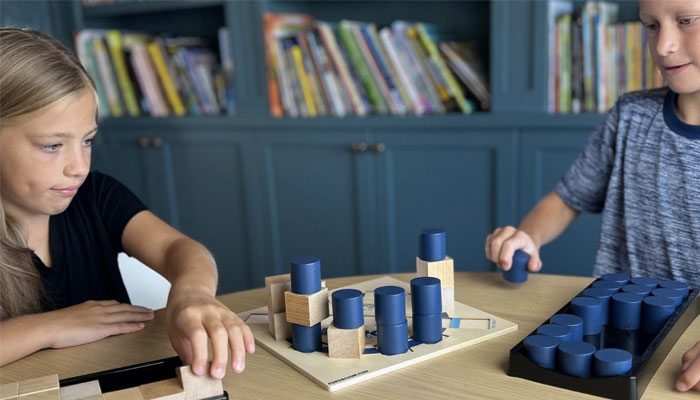
So a coffee table game you’d display was the inspiration?
Yes – and I’ve gotten many coffee table games over the years and they look great, but I didn’t want to play any of them! But this is so simple, anyone can play it fast – and it’s beautiful. And you can do other things with this set of blocks… We have puzzles and 3D challenges… So it’s a game that’s attractive enough to be on your coffee table, but there’s so many ways you can play with it that it engages anyone. A young child might have no interest at all in playing a four-in-a-row game, so they’ll just start building patterns and other things out of the blocks. So it’s engaging and works for people of all ages. It’s similar to KEVA Planks in that way. I think it earns its place on the coffee table.
And we’ve won some of the biggest awards in the US with Oppenheim Toy Portfolio Platinum Award, Good Housekeeping, Parents Best Toys and Recommended by Mensa. Every time we sent it out for awards, people absolutely loved it. And I think that’s because just like with KEVA Planks, we didn’t compromise on materials in order to give the best tactile experience. These aren’t lightweight plastic pieces, they’re made from solid, hard wood and intentionally larger than most coffee table game pieces, giving them a delightful, satisfying weight. When you pick up a block, you instantly recognise the premium quality. It feels good in your hand. Playing Foros is a high-quality, memorable experience.

Last question! What fuels your creativity? What helps you have ideas?
Inspiration seems to happen for me in the phase when I’m about to wake up… If I have an idea, I’ll sketch it or write it down as soon as I can, before it fades away. I’ll also usually try to make an ugly prototype of it as fast as possible so I can play the game. Then if that’s starting to work, I’ll make a better prototype. I’ll keep doing that and progress up from playing with family to our core set of friends who will give me honest feedback. And that’s key! I’ll tell them: “Don’t try to be nice to me I need you to be as honest as you can possibly be.” And they’re great and happy to that! Sometimes they’ve even been models on our boxes!
Ha, Ken, huge thanks for this. Congrats on everything you’ve built so far and let’s tie-in again soon!
–
To stay in the loop with the latest news, interviews and features from the world of toy and game design, sign up to our weekly newsletter here
More Recent Interview


David Albert of schleich North America on design, US growth and the company’s 90th anniversary
“Research shows that more than 90% of schleich’s figurines are never thrown away”: In conversation with David Albert, President of schleich North America.

Jigsaws of distinction: Rewa Walters and Sophie Morrison on Piece House’s stunning puzzles
“We make a premium product that puzzlers love…” Piece House Co-Founders Rewa Walters and Sophie Morrison on Piece House’s stunning puzzles.

Creating chaos and designing destruction: James Yuen discusses development of HTI’s Robo Wreckerz
“It was about creating an entirely new play pattern within the vehicle category”: In conversation with Fab Design’s James Yuen.
“Fans care about detail, so we care about detail”: Oliver Chang and Gurdeep Bains discuss development of YuMe Toys’ latest Stranger Things capsules
YuMe’s Global Creative Director Gurdeep Bains and Senior Art Director Oliver Chang talk poses, puzzles and pushing the boat out for this latest set of Stranger Things capsules.
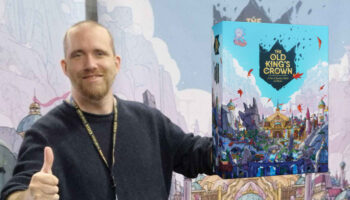
Pablo Clark discusses the six-year development journey behind the game design – and art – of The Old King’s Crown
“Don’t rush, don’t skip, don’t use AI”: Pablo Clark on the game’s origins – and his advice for new designers.

The Lumistella Company’s Christa Pitts and Chanda A. Bell on the story behind The Elf on the Shelf – and what’s next for the Santaverse
“We had no money, no experience, no connections and no one that believed in us – yet we did it anyway!”: In conversation with The Lumistella Company’s Christa Pitts and Chanda A. Bell.


Popular Articles

McMiLLER to appear on Shark Tank next month
TOTY Awards 2026 finalists revealed
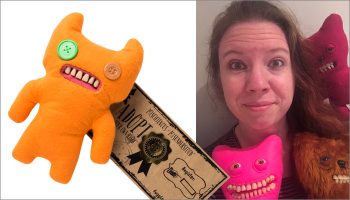
Fugglers creator Louise McGettrick on how an eBay listing for a bag of false teeth inspired her line of plush monsters

Funko readies KPop Demon Hunters Pop! vinyl figures
Ken Scheel talks KEVA Planks, Foros and his journey from veterinarian to toy inventor

Upcoming Events
-

- 31st January 2025
- Spielwarenmesse, Nuremberg
International Game Inventors Convention
-

- 20th - 22nd May 2025
- Mandalay Bay Convention Center, Las Vegas
Las Vegas Licensing Expo
-

- 24th - 26th June 2025
- Stamford Bridge Stadium, Chelsea, London
Play Creators Festival
-

- Tuesday, June 24th, 2025
- Stamford Bridge Stadium, Chelsea, London
Play Creators Awards
-
- Wednesday, June 25th, 2025
- Stamford Bridge Stadium, Chelsea, London
Play Creators Conference
-

- Thursday, June 26th, 2025
- Stamford Bridge Stadium, Chelsea, London
Mojo Pitch
-

- 7th - 9th October 2025
- Excel London
Brand Licensing Europe