Game designer Stephen Wilson talks optimism, persistence – and You Read My Mind!
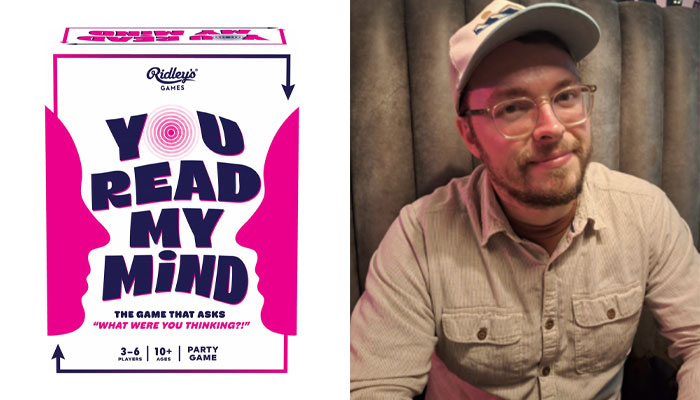
Stephen, it’s always great to catch up. Your latest game has landed on shelves – You Read My Mind! published by Ridley’s Games. How would you pitch it?
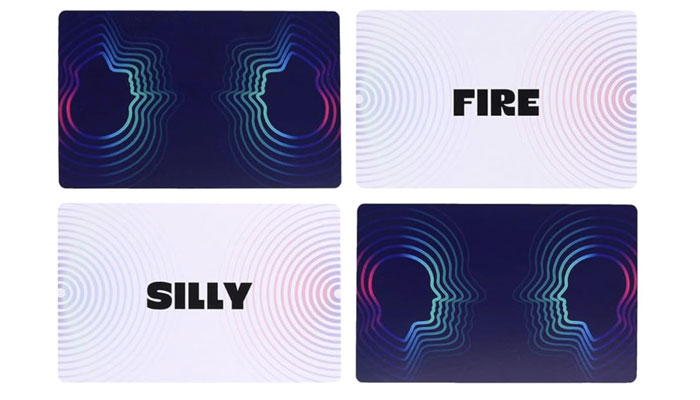
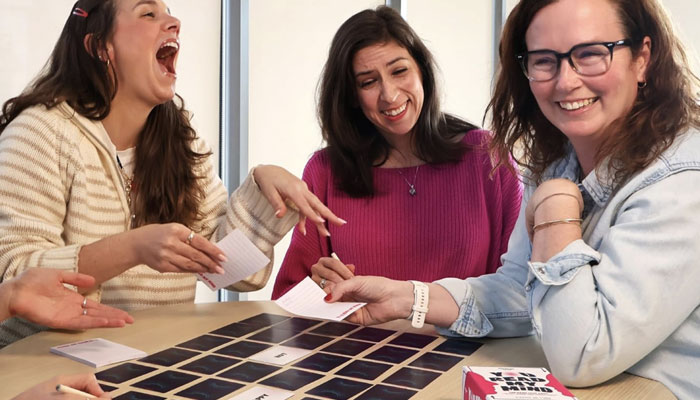
My original pitch was that it’s a game of pairs, but you can claim that anything is a pair. So the cards are face down in a 6×6 grid – and any two cards you turn over can be a pair, if you’re able to find a connection in some way.
The challenge is on the active players to say why they are a pair. The way they do that is by writing down a word or a short phrase that connects those two words. If both players in that round write the same thing, they score points.
So we’re playing – I turn over the word ‘Silly’, you turn over the word ‘Man’. I write down ‘Clown’, you write down ‘Clown’, we match and both score points.
Exactly! At the time I was obsessed with the pairs mechanism because mass market publishers are looking for really simple rules and it doesn’t get simpler than pairs.
Lovely idea! And I suppose there’s a fun tension there where one player in the pair might be super confident about a connection, but their partner might not have a clue what to write!
Absolutely! And one of the really satisfying things about it Billy, is that memory comes into it. So during the gameplay, you select a partner each round and you’re turning over cards each round. So if another player turns over ‘Flower’ one round but they don’t make a connection, you might want to remember where ‘Flower’ is so you can pair it with a word that has a more obvious connection.
Right! You turn over ‘Luck’ this round, and I’ll want to remember where ‘Flower’ is so I can turn that over and we can both write ‘Four Leaf Clover’.
Exactly! And that memory element leads to some funny moments because you might think ‘Flower’ was in one position, but you turn it over and it says something totally different! And suddenly your pair is trying to connect ‘Luck’ and ‘Banker’.
Great! And is there a method to the sorts of words you put in the game?
Half of the deck is categories – or words that describe a collection of things. Like ‘Insect’. And we also included 15 colours in the deck, so that can throw up some nice matches. If you pick ‘Red’ and I pick ‘Blue’, then obviously we’ll both write down ‘Purple’.
I appreciate the confidence you had in me there.
Ha!
And was it always called You Read My Mind?
No, the name of the game changed so many times. For a long time it was called Pairs? And then it became Syncing Feeling.
Both good!
Well, I actually have another game concept called Sinking Feeling, so it lives on!
We last caught up to chat about another game of yours with a great name – Bish Bash Bosh published by Ginger Fox – and You Read My Mind is game number two. How easy have you found this industry to navigate and get your bearings?
I’ve had some fortunate happenstances where I’ve met certain people at certain things who have given me good advice. I went to AireCon in Harrogate about four or five years ago and I was playtesting a game of mine. A gentleman said: “Oh this is quite mass market, you should speak to Ellie Dix!” So he introduced me, we had a chat and she said: “You should go to the Mojo Pitch”. I’m very thankful for that moment because it put me on a different trajectory than perhaps I would’ve otherwise been on. It really accelerated me getting started and building these relationships with publishers.
I think every time you show a game that Inventor Relations people are interested in, you gain a little bit of credibility with them – regardless of whether it ends up being signed. And with a number of publishers, I’m hopefully approaching that kind of place, but it takes time. I think the key is to keep turning up.
You’re based in the North of England – is there a good network of game designers there for you to playtest with?
Leeds Playtest UK network is very supportive and very helpful. It was actually down to them that I first went to AireCon. That said, the guys there are mostly focused on designing quite heavy games – and they’re not really for me. So my feedback often revolves around simplifying their games, and then conversely, when I take my mass market family party games, often the feedback is to add more complexity. But it’s nice to be part of that community.
You’ve pitched a lot now – what makes someone good at the role of Inventor Relations? What do you respond well to?
Openness. Where I’ve had really productive pitches has come from the Inventor Relations exec being able to give lots of detail beyond what’s in a written wish list. I’ve had pitches where we’ve spent some time getting to know each other, chatting about their strategy and that’s informed how I pitch to them down the road. That’s led to some fruitful conversations around a few games, and had these publishers not been as transparent about the direction they were heading, I wouldn’t have even showed them certain games. So the more open a conversation can be, the better for both parties.
Is there any advice you would give to a budding game designer that might be reading?
In terms of mindset, keep going. There will be an insurmountable amount of rejection but have some self-belief and if it’s really what you want to do, keep turning up. I’d also say be open to pivoting with a game – especially when you get some good feedback. But yes – be optimistic and be persistent. And speak to people in the industry as they’ll be generous with their advice.
Great stuff, thanks again Stephen.
–
To stay in the loop with the latest news, interviews and features from the world of toy and game design, sign up to our weekly newsletter here
More Recent Interview

Designers Adrien Pédron and Thomas Favrelière on the origins of Archeo – and why Gigamic proved the perfect publisher
“We’d wanted to work with Gigamic for a long time…”: In conversation with designers Thomas Favrelière and Adrien Pédron.

BOTI’s Nico Blauw talks Pembe the Pink Cat, innovation – and the International Toy Board
“The look, the design, the audience, the messaging… It all appealed”: Nico Blauw reveals what made Pembe the Pink Cat a winner for BOTI.
“This was the missing piece…”: Rubber Road’s Jack Fox on TUBBZ’s move into blind collectibles with Mystery Eggs
Jack Fox, Sales & Marketing Director at Rubber Road, talks TUBBZ Mystery Eggs – and why Minions were a perfect fit.

Educational Insights’ Lisa Guili on TikTok, 20 years of Kanoodle – and ten million units sold
Lisa Guili reveals how one addictive brain teaser found its audience and became a phenomenon.

“I want people to bet on themselves”: Spin Master Co-Founder Ronnen Harary discusses his new book, No Experience Necessary
Spin Master Co-Founder Ronnen Harary talks to us about his exciting new book, working with inventors – and Spin’s most underrated launch.

David Norman of Stormin’ Studios on inventors, Orchard Toys – and shaking things up!
“It’s not just a name, it’s our mission statement”: In conversation with Stormin’ Studios’ David Norman.
Popular Articles
DSTLRY launches card game based on its award-winning Somna comic
BOTI’s Nico Blauw talks Pembe the Pink Cat, innovation – and the International Toy Board

Hasbro's Angus Walker on creativity, pitching and the key to successful inventor relations
“It’s a game and soundtrack in one!”: Inventor Marcus Carleson and Jumbo’s Ferran Codina on the story behind Hitster
Pablo Clark discusses the six-year development journey behind the game design – and art – of The Old King's Crown
Upcoming Events
-
- 30th January 2026
- Spielwarenmesse, Nuremberg
International Game Inventors Convention
-

- 19th - 21st May 2026
- Mandalay Bay Convention Center, Las Vegas
Las Vegas Licensing Expo
-

- 23rd - 25th June 2026
- Stamford Bridge Stadium, Chelsea, London
Play Creators Festival
-

- Tuesday, June 23rd, 2026
- Stamford Bridge Stadium, Chelsea, London
Play Creators Awards
-
- Wednesday, June 24th, 2026
- Stamford Bridge Stadium, Chelsea, London
Play Creators Conference
-

- Thursday, June 25th, 2026
- Stamford Bridge Stadium, Chelsea, London
Mojo Pitch
-

- 6th - 8th October 2026
- Excel London
Brand Licensing Europe