Lost Boy Entertainment’s KC Schrimpl and Corey Schrimpl on Piles, Burst – and working with family
Guys, it’s great to catch up. Let’s start at the beginning – how did you find you way into designing games?
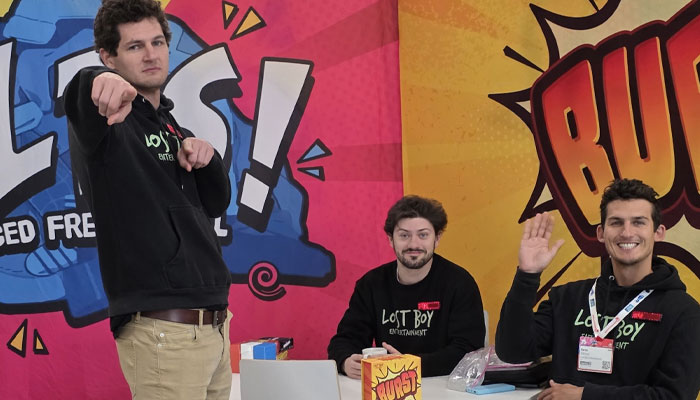
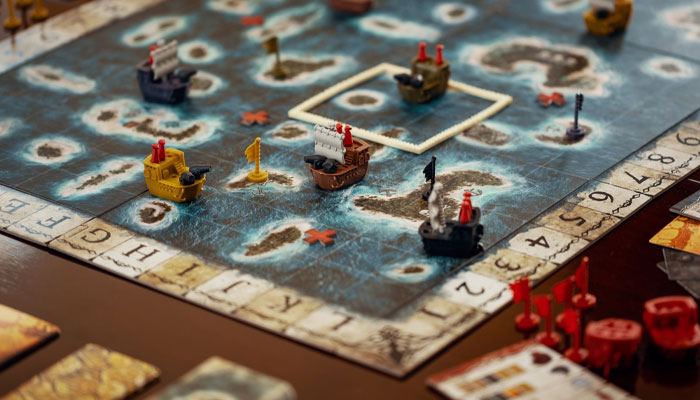
KC Schrimpl: I worked in Hollywood, working at Disney – writing scripts, doing my film-maker thing… Then COVID hit and Hollywood shut down. I had to do something, and board games were a natural fit because it allows you to be creative and it’s still in the field of entertainment. And we’ve always liked board games. So we made Plunder, our pirate game, just for fun initially.
And it went well?
KC: Yes, people like our crude prototype so we decided to make a real version – we hired an artist and found a manufacturer. I asked: “What’s the lowest number of units I can order?” They said: “1,000”. So we went for it, but I was convinced we’d never sell them all… We put Plunder on amazon and first week – one sale… Week two – two sales… Week three – three sales… And three months later we were sold out.
Terrific – and you were a one-man-show at this point?
KC: Yeah, and then when we got big enough, I needed some help. So that’s when I reached out to my brother and my cousin, who were both just graduated college. And when you hire two college grads, naturally the next game you make is a drinking game.
Ha! And King’s Cup Extreme was born!
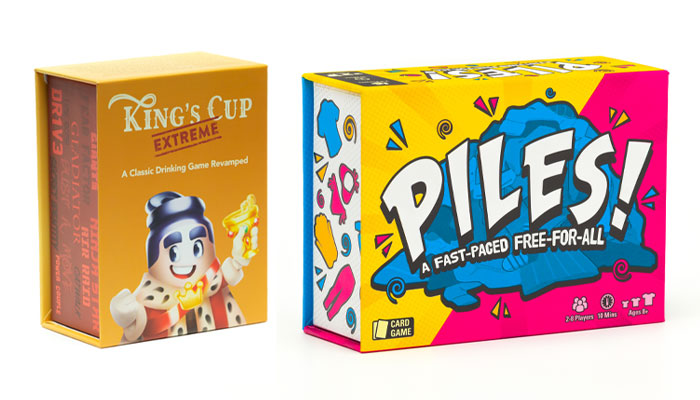
KC: King’s Cup Extreme was born! And that also did well, so we just kept it going and launched our third game, Piles. We thought those first two games were good sellers, but Piles dwarfed their sales. That was 2023 and we’re all in on this now.
And Plunder, King’s Cup Extreme and Piles are each very different.
KC: Yes, we had a strategy game, a drinking game and then a family card game. Early on I was advised to stay in a lane – and when anyone tells me to do something, I do the exact opposite… We’ve even started doing yard games just to anger them.
Ha! So what dictates where you go next?
Corey Schrimpl: We’re focused on classic play patterns and things that aren’t trend-based. We want to launch games that are going to be around a long time.
KC: Disney had one of Walt’s quotes up on the wall that resonated with me… Someone was accusing Walt of making children’s stuff – saying there’s no prestige in that. But Walt said: “I don’t make children’s movies. I make movies for the child in all of us.” It’s a great line and that’s how I feel about some of our games.
On that, has your background in movies steered anything about how you design games?
KC: Absolutely. And look, I love how the board game industry has a low barrier to entry – that a random accountant can make a game, go on Kickstarter and get started. But I also get a little annoyed because – and Corey’s gonna laugh when I say this – but I’m a classically trained entertainer. I went to school for entertainment. There are principles and theories and laws that go into entertainment. It’s not just like you just go out there on a whim – there’s rules, proven formulas, and a reason why things work. And when I went into the board game industry, I was like: ‘No one’s really following these principles…’
So you apply those entertainment principles to game design?
KC: Absolutely – it’ll make the games resonate more. Players will be more emotional attached.
Can you tell me some of them? How do they translate?
KC: Movies are divided into a three-act structure – the first act, the middle act and the third act. Each act is supposed to feel different than the other one, so if you turned on a movie randomly and you showed me a scene, I could tell if we’re in the second act. It’s the same when you make a game. You don’t want players to have the exact same feeling for the 10 minutes that you’re playing the game. You want the first three minutes to feel one way, the middle to feel this way and the end to feel different too. There’s an arc.
It’s like in The Matrix Reloaded, there’s an action scene on a highway that lasts around 30 minutes. For the five minutes, you’re like: ‘This is awesome. This is the best fucking thing I’ve ever watched!’ And then it’s just more action for 20 minutes and it becomes the new norm. You don’t have the thrill anymore, because people don’t feel action, they feel tempo. You feel the change in action. You feel that up and down. That’s what you want in a game.
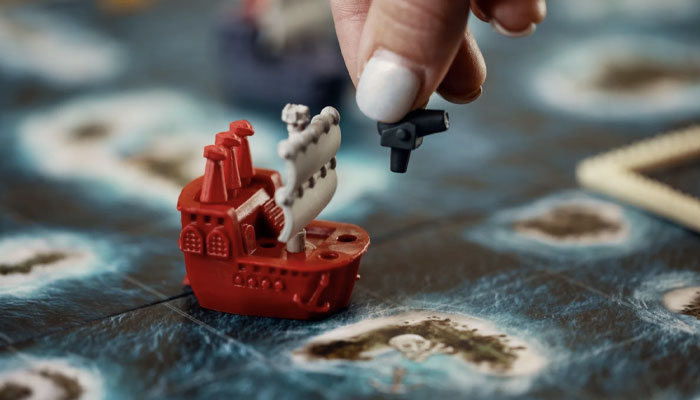
Corey: When we were building Plunder, I remember KC saying that the components had to be premium – the greatest things you ever hold in your hands. I thought it cost way too much and was unnecessary… But you said: “Players should be devastated when this ship gets taken from you.” It needed an emotional attachment, like you’d have to a lead character who dies in a movie. That always stuck with me.
I’m loving this! And Burst is a good example of that in action.
KC: Yeah, pressure builds and fades as the cards get played. We’re big on momentum.
Let’s dive into how these games came about, starting with Piles – what sparked the idea there?
KC: We had played with this kind of mechanic in an old card game we played back in the day using a normal deck of cards – but we thought it had the potential to be something better. And to cater to more players. We also needed a theme – and a lot of people make fun of us for the laundry theme, but it fits perfectly… And it’s testament to this being a good game that I can get you excited about laundry!

Absolutely – and you mentioned this was a jump up sales-wise from your previous games.
KC: Yes, thankfully, because I ordered way too many units. Someone told me once that for their print runs they order 3,000 units. And if you get over the hump of 3,000 units, good job! Then maybe it has legs. We did a first run for Plunder of 1,000 units and we did around 5,000 on the first print run for our drinking game, so with Piles I ordered a full container – and that was 40,000 units! They showed up and Corey and Cameron were like: “What the fuck did you do?!”
Ha! There were literally piles and piles.
KC: Yeah, and for the first three months, no one knows this game exists… We barely sold any… And these guys gave me so much shit.
Corey: But it ended up being the greatest mistake he ever made, because it meant we didn’t sell out over Christmas. We were able to fulfill demand fast.
Let’s move onto Burst, what’s the origin story there?
KC: We were studying what was out there in the world of family games, and games with this kind of mechanic like 5 Alive or ONO 99… But we found they were all too simple. We wanted to add an ounce of strategy to elevate it. So with Burst, you play cards building to the number you can’t cross, 21. And everyone likes power-ups in a game, so we added special abilities on some of the cards. And the fun part here is how everyone dances around the edge of 21 – because some rounds last 40 seconds and other last four minutes. It keeps you on your toes.
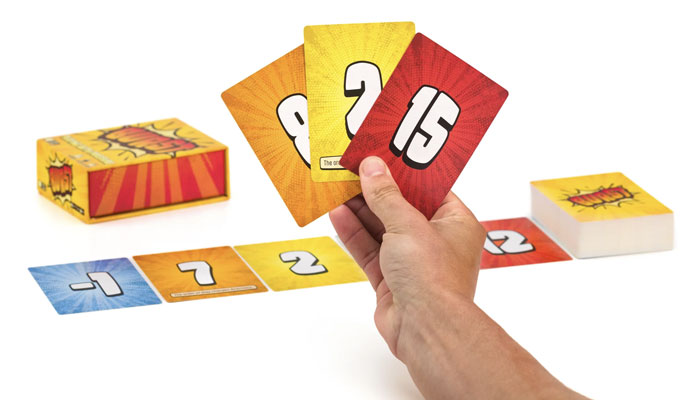
Corey: And from a business strategy standpoint, our first game was a $50 gateway game. Then we made a $20 card game, but we saw a lot of people selling these $10 hang tab games, so we wanted to dip into that.
KC: But we retained our quality magnetic boxes because I can’t stand tuck boxes; they just disintegrate.
Corey: It’s back to that emotional attachment… It costs more money, but it’s premium. And it doesn’t really cost us that much more to do.
KC: It’s marketing. When you own nice things, you want to show those nice things to your friends and family.
Absolutely. And tell us about one of your new games, Detonate…
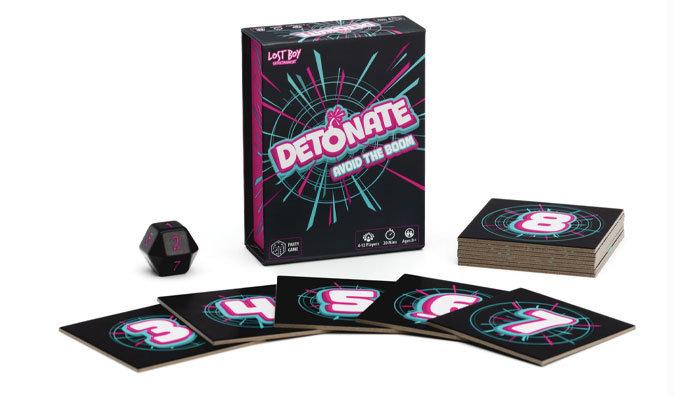
KC: It’s part of our $10 line-up – a large group, push-your-luck type game. Push your luck style. There’s a 10-sided die and you’re going around the group rolling it. If you roll a one in round one, you’re out for the round.
So for round one, as long as I don’t roll a one, I stay in.
KC: Exactly. Then round two, you have to avoid rolling a one or a two… Round three, don’t roll a one, two or three – and so on. But there are these points cards out, and at any point, you can back out by taking the lowest number of points available. The points cards get progressively higher, so if more people bail and take cards, it leaves the higher points cards for you… So if you want to be a risk taker, you can be a risk taker. Or if you want to be a steady Eddie and just collect small points each turn, you can do that. And you can encourage players to risk it and laugh when it blows up in their face.
It can be as mean as the group you’re playing with.
KC: Absolutey. I like games that feel different with different people.
And another new launch from you guys is Super Speed.
KC: Yeah, this one is for fans of Piles. It’s a fast-paced free for all card game that feels familiar, but is a bit different. Super Speed is that – plus it’s wild! It’s out soon, so we’ll put it on amazon, and you’ll be the first sale that week. Then week two, my mother will buy one. And by week four, it’ll be sold out.
Sounds like a plan! And how many games are you up to now?
Corey: We’re at 10 games now and we’re hoping to get to 15 or so by the end of the year.
KC: We want to launch three or four a year.
Corey: And they’ll span a mix of genres. There’s going to be some more family card games, another outdoor game, Piles expansions…
Terrific. And you mention you’re next outdoor game, but we haven’t talked about your first – this is Kangaroo Toss?
KC: Yes! We think this is eventually gonna be a Spikeball or a Kan Jam – it’s going to be big! It’s a cross between Cornhole and Bocce, but it’s for three to six players.
Corey: You play on like a volleyball sized court. You have rings and sandbags. You’ve got to get your coloured ring to the other end of the field and back. On your turn, you throw your ring as far – or as short – as you want. And then you have three sandbags to try and land it into that ring. So the farther you throw it, the harder it is, the shorter you throw, the easier it is. When you land a sandbag in the ring, you advance up the field to that spot. So on your next turn, that’s where you throw the ring from.
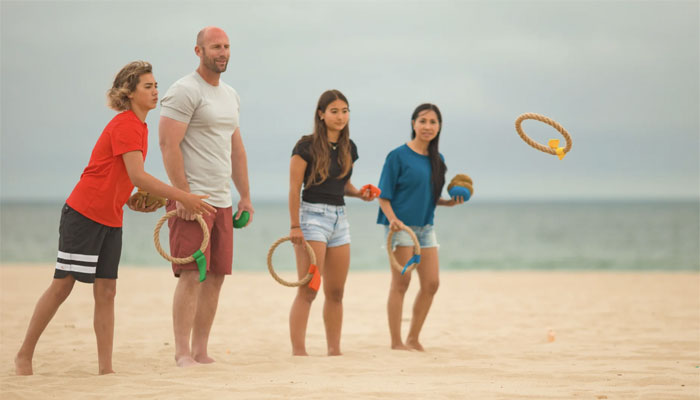
But there’s strategy… We grew up playing croquet and different games where you could sabotage people while you’re playing. I love that mechanic – so in Kangaroo Toss, you can target other opponent’s rings. So on my turn, if I see your ring five yards to my left, I can choose to land a bag into your ring. And if I land it, I get to move you back three steps at the end of my turn.
So I might think, shall I sabotage Billy’s progress, or focus on my own race. If Deej was ahead, we might all start to target him… The Mario Kart effect! It’s a game that allows your personality to shine. Am I risk-taker? Am I going to focus on myself? Am I an asshole? Am I Deej?
“I am an asshole? Am I Deej” You’re the third person I’ve heard say that today. But that sounds terrific! I also wanted to ask, you’re brothers, so what are some of the perks when it comes to working with family?
KC: In terms of benefits, we don’t have to have an HR department. We can just scream at each other and then let our mom decide who’s right or wrong.
Corey: There’s always been a clear power dynamic. He’s eight years older, so he’s always the big brother – you know, he’s smarter…
KC: Better looking… Taller…
Stronger…
Corey: The list goes on.
KC: Some might say I’m the alpha.
Corey: We disagree on stuff all the time, but we’ve all sweated it out in the warehouse together. We trust KC’s direction and KC trusts us when it comes to areas that we’re much, much better at – because he has so many deficiencies.
Well that’s clear. And I imagine there’s a short-hand and a level of honesty that comes with family-run businesses that other companies perhaps have to build up to.
Corey: Exactly. We can do things our way and we each have our strengths.
KC: Corey loves networking. He’ll go out, come back and say: “They’re doing things this way, this way and this way”. I say: “Great, we’re going to do the complete opposite.”
Corey: I tend to be good with people and on the sales side, while Cameron comes from the data side of things – he’s the brainiac. So bringing all these elements together, it works out.
And how does this industry compare to Hollywood?
KC: This is a fantastic industry. Everybody’s friendly. In Hollywood, everyone’s a bit standoffish. In Hollywood, especially when you go to pitch things, it’s their job to say no. If they say yes to something, their ass is on the line and it must succeed. And the stakes are a bit higher with $100 million movies. But in board games, there’s a low barrier to entry and everyone shares information and advice happily. I’m still in slight disbelief that we’re all supposed to be competitors – but I think that’s the best thing about games. We all win.
Corey: If companies like Exploding Kittens or DSS Game or Relatable didn’t exist, then we wouldn’t. They had to pave a way for new games and these categories, so we’re very thankful for these companies who came before us. And everyone has been so welcoming and generous. Except for the trade press – like yourself – who have just been miserable.
KC: You guys are the worst. Somehow worse than the paparazzi in Hollywood.
Snakes, the lot of us. I can’t apologise enough. Before we wrap up – and without wanting to sound like an old man – as younger guys in the industry, does that help create for your audience? You’re closer to the trends…
Corey: It does. But although we’re aligned with trends, that’s not what fires us up design-wise. We want to make things that have longevity. I’m very grateful to be the age I am – in the Millennial bracket – because I feel like I’ve experienced every social media platform. That’s useful from a marketing perspective because if you’re a little older, like my sweet brother here, you might not have that desire to go and learn something like TikTok.
Last question! What fuels your creativity?
Corey: Ideas tend to come out of the blue for me. And just like if you want to be a great director or screenwriter, you’ve got to watch a lot of movies… The more we play games, the more inspired we get. And creativity needs boundaries. I always find that helps us come up with ideas, compared to having limitless options.
And for you KC?
KC: I’ve never sat down and come up with an idea.
You stand up?
KC: That’s it, I’m always standing up! I’ll be doing something, and I’ll jot an idea down. I have a little waterproof pad in my shower that I write on. I do some of my best work there. But ultimately, we make the games that we want to make. Walmart and Target and whoever else will tell us what they want – and if we happen to have that, we’ll show it – but we don’t design to those briefs.
Look at Jaws – after Jaws, everyone wanted to do a shark movie. The following year, Star Wars arrived – it was a film no-one asked for. Directors sometimes say: “You tell the audience what they’re going to like”. So a retailer might be asking us for Jaws, but we’ll give them Star Wars!
Great answers. Guys, this has been a pleasure. Let’s tie-in again soon!
–
To stay in the loop with the latest news, interviews and features from the world of toy and game design, sign up to our weekly newsletter here
More Recent Interview


From the Magic Bean to Happy Nappers: inventor Bill Ward on pitching, persistence and finding his path
Bill Ward discusses his unconventional route into toys – and the real value of feedback.

Gregory Benassar on Khadou, kidults – and why Pop Mart and B&M have more in common than you might think
“We are not here to push a lot of volume into the market and move onto the next thing”: In conversation with Gregory Benassar – CEO at Heathside and Co-Founder of Saga Alliance.

Inventor Mandela Fernández-Grandon on design, collaboration and the joy of playtesting
“Working with others offers a list of benefits…” In conversation with Mandela Fernández-Grandon.

Dina Al Rifai – Creative Director at The Loyal Subjects – on how being a collector shapes her approach to design
“I usually start with the emotional hook – what is this product supposed to make someone feel?” In conversation with The Loyal Subjects’ Dina Al Rifai.

“Play is evolving…”: Hasbro’s Tim Kilpin talks kids, Kidults and KPop Demon Hunters
Tim Kilpin, Hasbro’s President of Toys, Board Games, Licensing and Entertainment, on recent highlights – and things to get excited about.

Spin Master’s Angus Walker on bringing classic horror brands into TCGs with Hellbreak
“Faithfully representing these beloved characters was our design team’s top priority”: Angus Walker – VP, Marketing & GBU Lead, Games & Outdoor at Spin Master – talks Hellbreak.


Popular Articles

Asmodee's Moodbox Games details debut slate of titles
Hasbro launches Bop It Buzz Lightyear
Registration now open for Spielwarenmesse 2027's International Game Inventors Convention

Play Creators Awards 2026 finalists revealed
Fugglers creator Louise McGettrick on how an eBay listing for a bag of false teeth inspired her line of plush monsters

Upcoming Events
-

- 30th January 2026
- Spielwarenmesse, Nuremberg
International Game Inventors Convention
-

- 19th - 21st May 2026
- Mandalay Bay Convention Center, Las Vegas
Las Vegas Licensing Expo
-

- 23rd - 25th June 2026
- Stamford Bridge Stadium, Chelsea, London
Play Creators Festival
-

- Tuesday, June 23rd, 2026
- Stamford Bridge Stadium, Chelsea, London
Play Creators Awards
-
- Wednesday, June 24th, 2026
- Stamford Bridge Stadium, Chelsea, London
Play Creators Conference
-

- Thursday, June 25th, 2026
- Stamford Bridge Stadium, Chelsea, London
Mojo Pitch
-

- 6th - 8th October 2026
- Excel London
Brand Licensing Europe