Open 2 Design’s founder, Matt Burtonwood, on creative partnerships – and the joy of collaboration

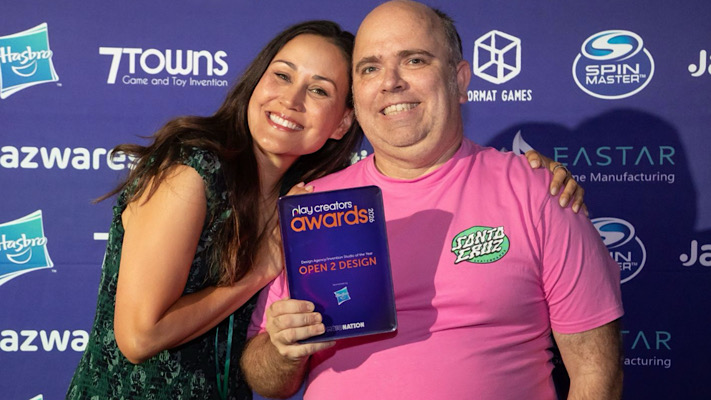
Matt Burtonwood – the award-winning Matt Burtonwood! Seems like I’ve been making a bit of a fuss of that… It’s not your first Mojo Nation award though, is it?
No, I’ve won a Mojo award before. In fact, I think it was the same one – Design Studio of the Year. I do feel like winning it this time is the bigger achievement, though because – last time – I think we were mostly riding high on the success of Rubik’s Cage. This time, I’d like to think that it’s a reflection of a lot of other work rather than a specific item. I don’t know if that is true! Maybe it is… I didn’t see the nominations!
No, Mojo doesn’t reveal who said what. That’s a shame because I think you’d be so thrilled to see how many people such wonderful things. But I also think it was a delight this year because Bill told you that – because we’ve invented with you – you can’t win an award in case someone thinks it’s a fix… And you seemed to believe that!
I did! I mean, I know how utterly straight down the line you guys are with everything – reporting, doing the awards and overseeing the judging – so I totally believed it. And it’s about perception, isn’t it? There can never be a whiff of any kind of corruption or favouritism…
Exactly that! But most of the industry knows how fairly it’s done…
In any case, the fun – for me, personally – of doing collaborations with lots of people would always outweigh the downsides of, say, Open 2 Design not getting some column inches if we invented a game or a toy and you felt it would look odd to cover it in depth
Well, you take it on the chin very nicely! And it is frustrating, I think, because I’d love to interview you about Pounce, or Chit-Chat or Articulate: Under Pressure… They’ve all got really interesting stories behind them!
Yes! It’s a double-edged sword. I love collaborating with people, and if the price of working with you guys is that those stories live in the shadows, and not many people know what we do, then I can’t be cross and bitter about them not getting the attention.
I’ll quote you on that! But the unbreakable rule is that nothing we invent together can win an award because that would be daft… Happily, none of this stops us writing about the extraordinary work you do with other people. Of which: how much of what you do these days is invention versus work for hire?
I’d say that a good 70 to 80% of what we do is work for hire. The business grew from that in the first place; it grew out of a relationship with Disney that then pushed out to Disney license holders. A lot of our early work was with Fisher-Price Friends in New York, then – when that office closed – I thought we were going to lose a lot of work. Instead, all those fantastic designers we were working with got scattered across other toy companies… Jazwares, Spin Master, Just Play. And we’ve been lucky enough to work with them ever since.
Amazing! And I was going to ask you: do you still get a kick out of seeing work you’ve done on shelf?
Oh, yes! In fact, when I go to New York Toy Fair, it’s always fun to take a trip to a toy store to see what’s carried in different countries that maybe isn’t carried in the UK – Fisher-Price Little People, for example… When I went to a toy shop in New York this year, there must’ve been eight feet of Little People stuff on the shelves… It’s awesome to see; it’s still one of the the most exciting parts of the job – to see something you’ve worked on in a store. As long as it’s not Cash Converters.
Ha! No…
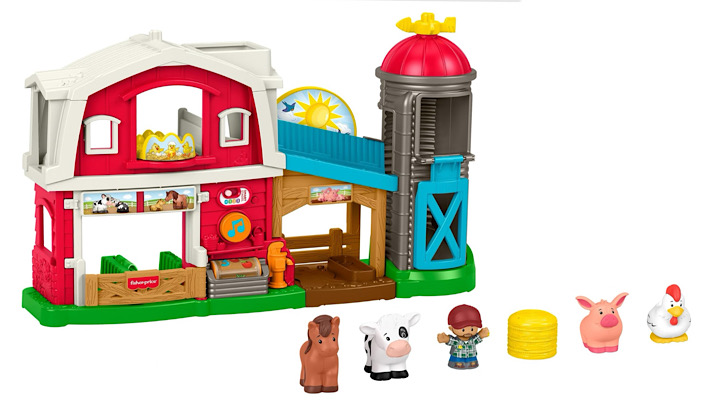
Over the years, we’ve been lucky to work on some great projects – things I never thought I’d get to work on. Barbie comes to mind – the three-and-a-half inch-high Barbie, which is, I think, a really cute version. I also got to work on a Fisher-Price garage! I don’t know if you remember a Fisher-Price garage from your youth, Deej, but that was always a real halo item for me as a kid. And then the one you mentioned before we started: the red barn, the iconic US farm barn…
Ah! Yes, I was going to tell you why they’re red! Early American settlers mixed their own very cheap paint using linseed oil, milk, lime and iron oxide…
Is this true?!
It is! Barns are rusty red because they originally used rust in the paint! In any case, when I saw the red barn promo video, it looked like a perfect execution of that brand.
Thank you! I think one of the things Fisher-Price and Mattel do really well is that they go through a huge number of development cycles — not because anyone gets it wrong, but because they want things to be absolutely right. And I don’t kniw if you remember this, but my background is in traditional product design… So before toys and games, I worked on products that were scrutinised in extreme detail.
Like what?
Mobile phones, laptops, projects for Nike – all sorts. And for a lot of that stuff, you’d have extreme close-up photography examining every surface and every join! So in a way, I’ve always wanted to bring that same level of attention to detail to toys because I don’t think toys deserve any less care than premium consumer products. It’s not always possible, but it’s lovely when you work with partners who share that philosophy. And then there’s the testing! Fisher-Price has a brilliant test lab. Actually, I think Nikki Bauman did an interview with you about that a few years ago!
You’re absolutely right. I’ll put in a link to that here.
What Fisher-Price tends to do is put products in front of children who don’t know you and have absolutely no problem telling you if something’s rubbish! But they also pay close attention to things adults notice, maybe only subconsciously – the thickness of the plastic, the weight of a figure, the way a product feels in your hand. You might not be able to articulate why something feels high quality, but you can usually tell when it does. People pick up on these details… The chunkiness of Little People figures, for example, is completely intentional. That’s partly why the brand has such a strong reputation.
Is there anything else you’ve worked on recently that made you think, ‘That was a particularly satisfying project’?
I’ve should’ve written a list! We have our fingers in a lot of pies. We do a lot of licensing-pitch support for toy companies. Often, a company knows it needs extra resources for a major pitch – a Toy Story 5-style opportunity, say – but it doesn’t yet know whether it’s won the business. There, we can come in, help make the pitch happen and secure the licence. We’ve also continued to work with people across the industry – Spin Master, Jazwares, Melissa & Doug and a lot of the teams we’ve known for years. Another area that’s grown for us is animation and video work: creating sizzles for retailer pitches and project presentations. That’s largely Verity’s department; she’s done a fantastic job building that side of the business.
Amazing! It’s a shame Verity wasn’t there to collect the award. One thing that I’d love to understand better, Matt, is why you prefer to invent with others?
It’s so many things, all of which make the process better than if you’re just doing it on your own. Emotionally, for example, you can commiserate with each other when things don’t make it over the line. Equally, you can share the wins. Then, on a practical level, I find it’s easier to motivate myself when I’m working with others because I’m a people pleaser! I just want to do things for other people…
And yet that’s never come across with me… I never get a whiff of that!
Ha! Well, with everyone else, I want to please people. So for example, if I’m going to hit a deadline, I’m going to hit a deadline for someone else before I’m going do it for myself. I’ve always been like that. Since the start of my career, the thing that motivated me more than anything was someone saying, ‘Well done, Matt.’ So if you want to motivate me today, tell me I’ve done something great. If you really want to motivate me, don’t tell me I’ve done a good job because that will rile me so much that I’ll then continue to try and do better!
Blimey! This is a very odd variation of the stick and carrot…
Yes. I think I work best when someone’s hitting me with a carrot. Actually, one of my old bosses – John, with whom I still work in many guises – has always been a bit of a mentor to me. But he used to be terrible at telling me when I’d done a good job to the extent that I wondered if he did it deliberately. He’d also often say something like, ‘I don’t know what I want. I’ll tell you when I see it.’ It was his way of saying, ‘Just keep drawing so that I don’t have to think.’
Maybe he was aware that that forms part of your make up, though… And is there anyone else you think warrants a mention?
Definitely. From a work perspective, I like to think that it’s been a two-way thing in that I’ve done something that’s benefited someone while they’ve looked after me in the last 25 years. But it’s important to acknowledge – particularly in the winning of the award – that there are so many people that took a leap of faith in the early days and gave me work…
Even in my first job, a company called Astro Studios, the guys were pushing me to do well. And they were insanely good! There was one guy there called Carl Liu, who was an amazing sketcher and visual storyteller, so I was really lucky because I could benchmark myself against the best. Then there are people like Alpesh Patel from Tomy… Al’s kept work coming into us for 20 years. Brian Davis at Jazwares; he’s great; a fantastic designer. Bobby Saygan at Mattel… There are so many; I love working with people!
David Snow? So Sound, you often say…
Oh, the team at So Sound! From a technological point of view, there’s no one like them. I can go to them and literally say, “I’ve got an idea. I’ve no idea how it could happen…” Two weeks later, they can show me a functioning prototype. David Snow works in a very different way from me and I think that’s great! We did Plant Eyes together and I don’t know how else it would’ve got to market. Who else?!

Fi Murray?
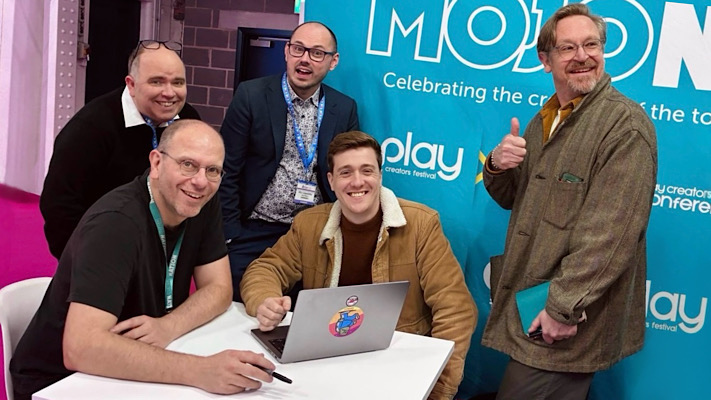
Fi Murray is wonderful! We pitched together at the Mojo Nation event last week she’s amazing. I like pitching with other people because it’s great to have someone next to you that can see when you’re starting to flounder, or let you know if you’ve dropped the ball. Sometimes literally! I’m going to forget loads of people, Deej; I hope they realise I’m under pressure! Oh! I’ve also worked with Stephen Wilson on a game which looks like it’s going to cross the line. He’s a lovely guy; I like collaborating with Stephen…
I know I’m not going to mention people – sorry! But what I was going to say was that one of the best things for me about toys and games is that I do feel a rising tide lifts all boats. For the vast majority of the time, people are helpful and supportive and every win is a win. There aren’t many people that just want to cream off every penny, stand in your way and stop you moving forward.
Yesssss. You’ve not worked in the trade press, have you, Matt?! Ha! So it doesn’t sound to me like you’re in any kind of hurry to replace your many human collaborators with AI. Do you use it, though? And if so, is there anything for which you wouldn’t use it?
We wouldn’t use it to create ideas but we do use it to help us present things that we’ve already created. As you know, Deej, there are parts of the invention process that are quite laborious: consolidating information and putting together presentations, say… Some of those things drive me crazy. If I can use AI as a tool to speed up something like that, I do. One good example is that I
just used AI to generate a shooting script for a sizzle…
But not from scratch?
No, not from scratch. I uploaded everything we’d already got for the item – the rules, the back of the box company, all of that – and described what I wanted to do. Then I asked it to generate a shooting script for a sizzle, and it said – in effect – ‘For the first three seconds, we need a close-up of this. Then, cut to five seconds of this…”
Well – that’s the bit I need; that’s not my traditional skill set! So I think that’s where it works really well for me. For me, the skill in using AI is – obviously – the questions you ask it and the prompts you give it… Writing the right prompts to get the right results.
Yes, it’s like the age-old adage of computer programs all over the world: “Rubbish in, rubbish out.” But I do think it can be a very useful tool with which to research and shape ideas, and make light work of the one-star review.
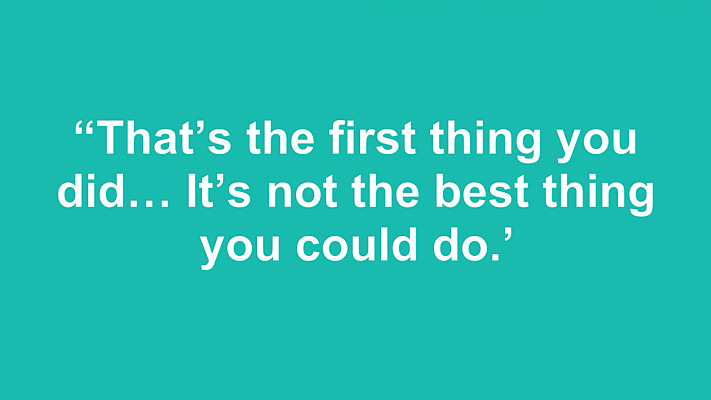
Exactly. But I do think there are challenges for certain roles… You know, years ago, I used to see students who were presenting their first products as 3D CAD drawings. They would often show you the first thing that they’d created and say, ‘Look at this; this looks brilliant.’ But in fact, it was only okay. So then it became about being able to critique work and say, ‘It’s a good start. But that’s the first thing you did; it’s not the best thing you could do.’
Oh, I completely agree! And here I am worried… That people give something to AI to do and assume that what AI does is the best-possible version of something.
Right! Just because it can create one thing that looks great, it doesn’t mean it can’t do something better. Right now, I think part of understanding how to use it as a tool is knowing when to use it and when not to use it; it’s about knowing when to stop and knowing when to keep going.
That’s a helpful way to look at it!
All that said, I’ve had a few meetings with companies after which I’ve walked off thinking, ‘Oh, crap!’ And even at the Mojo Nation event, during the Room 101 panel, James Vaughan was wondering if AI spelled the death of the junior designer… After he said that, I turned to Alpesh and said, “And the senior designer!” Because there’s so much that AI can do, and so much that you’re happy to accept it can’t do perfectly.
Which is where I personally itch a little. I know a couple of people that’ve used AI to write their rules from scratch… Sometimes they’re okay, sometimes they’re very good. Sometimes they’re absolutely awful!
Right…
The problem being that if you can’t do a task, and you give it to AI, and AI immediately gives you something that’s better than you’re capable of doing on your own, then there is a temptation to think: “This is fantastic!” and stop work Only it isn’t fantastic; not at all. I think that’s the trap right now.
I think that’s right. I think – right now – you have to accept it’s here. Accept it’s a tool. Accept it’s going to do some things incredibly well – and then understand when not to use it.
Fantastic! Well, Matt: congratulations again on the award. Thank you for making time to talk today… I know you’re incredibly busy following up on the Mojo Nation pitches, so I appreciate it.
–
To stay in the loop with the latest news, interviews and features from the world of toy and game design, sign up to our weekly newsletter here
More Recent Interview

Sidekick Games’ Asger Harding Granerud on Tembo, Hutan – and 10 years of Flamme Rouge
“We were looking at games we were pitching to other publishers and at some point said: ‘Maybe we can do this ourselves…’”: In conversation with Sidekick Games’ Asger Aleksandrov Granerud.

Game designer Luca Borsa on the magnetic magic of Geistertanz
Designer Luca Borsa talks us through recent launches including Megableu’s Geistertanz and Blue Orange’s Ice Split.

Gurdeep Bains – Creative Director at YuMe Toys – on creating collectibles with staying power
“A good collectible used to be about likeness, now it’s more about interpretation”: In conversation with YuMe Toys’ Gurdeep Bains.

“I see faces everywhere!”: Zack Buchman – Creative Director at Furry Puppet Studio – on creating characters
“I look at a plug socket and my brain turns it into a character!”: In conversation with Furry Puppet Studio’s Zack Buchman.

“It’s the gift that goes on giving!” Artist Emily Abeydeera on biros, experiences… And Disney Lorcana
Illustrator Emily Abeydeera reveals the one thing she always does creating Disney Lorcana cards.

“Lasers, explosions, giant robots…”: Inside the new M.A.S.K. comic with writer Dan Watters, artist Pye Parr and Skybound’s Ben Abernathy
We take a look at the creative process behind the latest title in Hasbro and Skybound’s interconnected Energon Universe – M.A.S.K.
Popular Articles
Ravensburger details influencer initiatives for Disney Lorcana
Pablo Clark discusses the six-year development journey behind the game design – and art – of The Old King's Crown
GALLERY: Play Creators Conference 2026

The Happy Accident: Deej Johnson explores a dozen toys and games that came about by mistake
Mini Brands Really Works Vinyl represents "major step forward for the brand", says Zuru
Upcoming Events
-
- 30th January 2026
- Spielwarenmesse, Nuremberg
International Game Inventors Convention
-

- 19th - 21st May 2026
- Mandalay Bay Convention Center, Las Vegas
Las Vegas Licensing Expo
-

- 23rd - 25th June 2026
- Stamford Bridge Stadium, Chelsea, London
Play Creators Festival
-

- Tuesday, June 23rd, 2026
- Stamford Bridge Stadium, Chelsea, London
Play Creators Awards
-
- Wednesday, June 24th, 2026
- Stamford Bridge Stadium, Chelsea, London
Play Creators Conference
-

- Thursday, June 25th, 2026
- Stamford Bridge Stadium, Chelsea, London
Mojo Pitch
-

- 6th - 8th October 2026
- Excel London
Brand Licensing Europe