Sidekick Games’ Asger Harding Granerud on Tembo, Hutan – and 10 years of Flamme Rouge
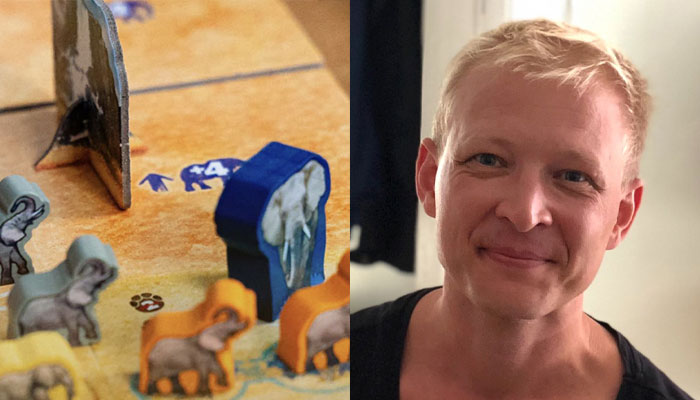
Asger, it’s great to connect. To kick us off, how did you get into game design?
I played games a lot with my dad, from when I was six or seven. I picked up chess at eight and I still play chess daily on my phone. Then, at age 13 or 14 I got into Magic: The Gathering and a year later, one of my mates bought me a beginner set of Warhammer fantasy miniatures. That led to a 15-year-plus obsession with Games Workshop!
Then after high school, at 20, I moved to England and I lived there for two years working for Games Workshop at the HQ in Nottingham. I was doing sales stuff, but I wanted to be a game designer for Games Workshop. That did not manifest, so I went back home and did a master’s degree at university. The first job I got after that was in a company that used educational games for organisations going through management changes – a serious game to help facilitate the consultancy process.
While working there, I designed Flamme Rouge and soon signed with Lautapelit.fi. I then started working in the industry with a distribution company, and then a retailer, before committing myself full time to game design. So it’s been a journey!
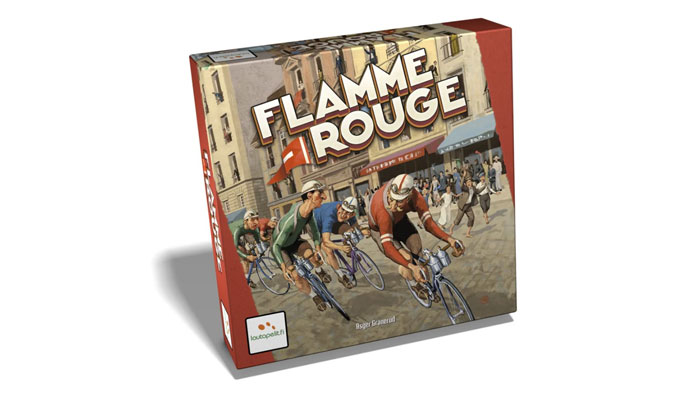
I’m a huge Flamme Rouge fan – I think it should get more love among non-gamers because everyone I’ve played it with falls in love with it fast!
I agree. It ought to get more recognition as a gateway game. It has that unique ability to make non-gamers something that uses mechanics they’re not used to. They might associate a dice with moving something along a track, but Flamme Rouge does something else.
Absolutely. And Flamme Rouge is 10 this year and continues to be popular, so why do you feel it resonates?
Well, it uses the oldest form of competition that any human being has ever engaged in – a race! Everybody knows and engages with this, so if you walk past a game of Flamme Rouge being played, you can see who’s in the lead and understand the tension there.
Of course, lots of the details when you then play the game are hidden inside the decks and the positions of the cyclists – who got slipstream, who lost a movement due to being blocked, who will be taking an Exhaustion card…. A lot of the game state is actually hidden, which can make it hard to decipher, but also makes it more tense towards the end because you don’t know exactly what the state of play is. That maybe is also what makes it not quite as accessible as something like Ticket to Ride.

I also think part of what it does well and what makes people engage with it is that it has these tiny dopamine hits every turn. Every turn, someone is getting an Exhaustion card. As a minimum, there’s going to be one leader, so someone’s getting a penalty, while most turns, other people are getting small bonuses. We plan, we imagine what might happen, we hope something great will happen, then we have the reveal – and then we hand out some rewards and penalties.
And did it always have this cycling theme?
I am from Copenhagen, so I use my bike every day – but that’s different from being a sports cyclist. That said, I own my dad’s old sports bike because when he was a youngster, he used to race – and to this day he still watches races. So yes, the theme was there from the first few hours of thinking about the idea.
And how soon did you realise that Flamme Rouge was going to be something special?
From the second prototype. I used the first prototype just to see how people interacted with some mechanics, but from the second prototype the game was 90% of what you see today. There are some tweaks, but the decks are the same. And from that second prototype, my playtester didn’t want to play any of the other games I had fiddled with, but we played Flamme Rouge three times in a row. I took it out to other testers and everyone wanted to play it immediately again. So from the prototype stage, it was clear that there was something here that engaged people.
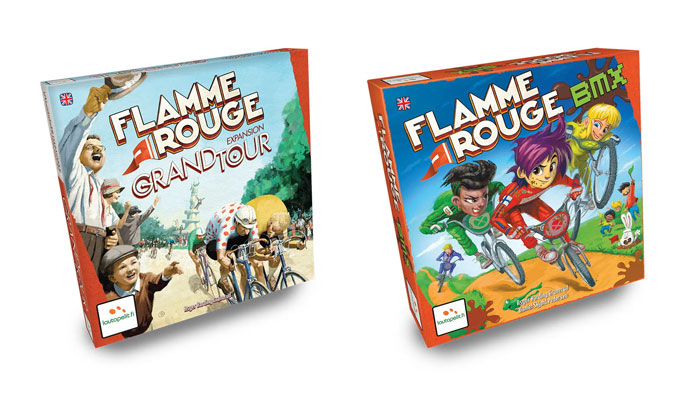
How did it change things for you as a game inventor?
Well, when Flamme Rouge first launched, I said to everyone: “You can’t make a living doing game design.” But as Flamme Rouge grew, it showed me that I could! And I of course secretly hoped that maybe it could do well enough for that, but I’m also humble enough to not plan for it. So as a designer, Flamme Rouge allowed my dream to become possible.
And as for opening doors, the success of Flamme Rouge made it easier to get some meetings, but it doesn’t make it easier to sell games. At the end of the day, a game has to prove itself on its own merits.
Absolutely. You’ve since moved over to the publisher side of things, launching Sidekick Games with Daniel Skjold Pedersen, and Dan Halstad. What led you to self-publish?
We were looking at all these games that we were pitching to other publishers and at some point said: ‘Maybe we can do this ourselves…’
One of the primary drivers was a little bit of frustration with some of the publishers we had worked with. I think we’ve published games with maybe upwards of 15 different publishers in the industry, including some of the really big names. We always felt we could hand something off – a game that was a little bit rough around the edges – and the company, with their full professional team, would go in, do playtesting and make everything about the concept better… But we found that publishers would take our prototype and make it pretty, but they wouldn’t make it more functional. If there were flaws in the functionality, they would survive into the final product. So we figured that if we are going to be doing all of this work anyway, we might as well try to publish it ourselves.
And what sorts of games are you focused on at Sidekick Games?
The first step was to create something that someone who doesn’t play games at all could get hooked on. We wanted to make games that had that mass market appeal without being mass market games. So strategy games – or ‘family plus’ games – and we wanted them to be for two to four players. We also knew we wanted to hire excellent illustrators and ensure the components were top quality.
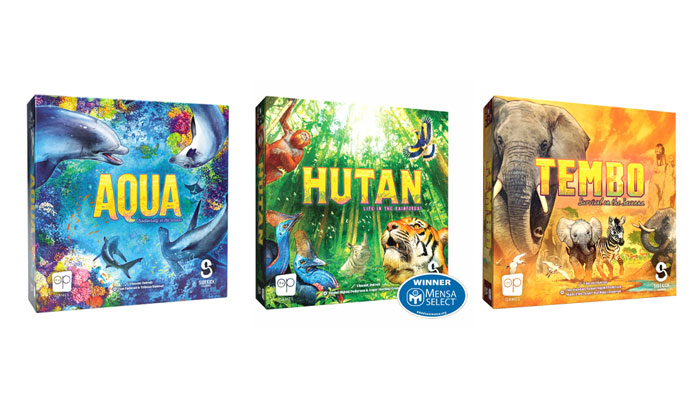
And three of your recent launches all had a nature theme – Aqua, Hutan and Tembo. What was the thinking behind crafting this ‘nature trilogy’?
Aqua always had that theme, but Hutan – in previous prototypes – was about flowers and growing things… But with that stacking aspect, it could have been a city building game. But over time, the play felt more organic that building skyscapers so the rainforest theme became a neat fit. But then the next game we picked to publish initially didn’t have a nature theme…
So where does theming come in your process?
When we first start assessing whether to publish a concept, we remove the theme. When we playtest it with people, if a playtester starts envisioning a theme, we go back and remove anything that could be construed as a theme!
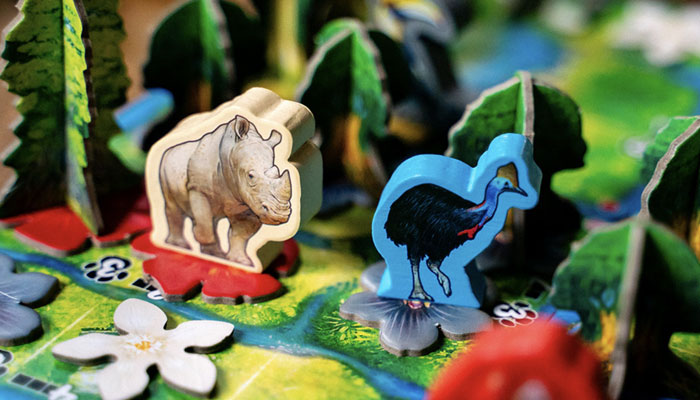
Ha! Why is it important to boil away any trace of a theme at that stage?
We want to find the core mechanism – the simplest form – that we cannot remove. Once we have that down, then we look at what could represent it thematically. We did the same for Flamme Rouge back in the day.
For Tembo, the core mechanism was about something moving across the board collecting things. It felt like a herd of animals moving from A to B to C. Once that was in place, the most obvious choice for us ended up being elephants.
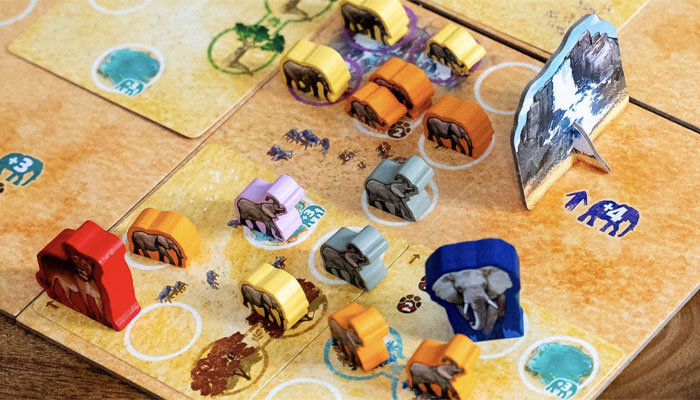
Terrific. And what does the game design process look like between you, Daniel and Dan?
We sit in a room together, typically four or five days a week, working on all manner of things. Sometimes it’s graphics coming in, or details about which direction to take a game in, but we try to set time aside for specifically doing game design. And we take four to five weeks on one game and then we pause and deliberately do not work on it for another three or four weeks.
Ah! Why is that?
We’ve found that we, if we grind away at a single project, we sometimes get our heads stuck in the ground. We end up focusing on perceived solutions rather than what the problem actually is. But if we then have breaks where we work on other games, it means that when we come back, it’s easier to look at the game more honestly.
Makes sense. And your next game doesn’t sound like it fits in with the nature themes: Not Your Grandma’s Bingo.
Yes!
These feels like it will be a different speed to something like Aqua or Tembo?
Difficulty-wise, we always want to take a game to where it feels it wants to go. I consider our role like sculptures, having to find the shape of the rock as we chisel away – and we have to adapt to what the rock tells us. We are not painters that sit down with a blank canvas. Sometimes we might have a vision for the game being simple or something complex, but if the game is telling us it wants to be something else, we avoid fighting against that.
And even though we only do one game a year and we’re work on long timelines, sometimes those timelines push themselves. So if we want to stay on our schedule, sometimes we have to make the next project a smaller project. Part of the reason that Not Your Grandma’s Bingo got fast tracked is that it’s a smaller project.
Well, I’m sold on the name alone! Before we start to wrap up, what helps fuel your creativity? What helps you have ideas for games?
This is one of the areas I differ from my colleagues. Daniel will sit and think about a new mechanism or component – and he’ll come with a list of ideas that could use that. Whereas I think about some existing mechanics that I could do better, or identify a small mechanism in another game that could be a game in its own right. So he has many more ideas than me! But my ideas are typically more mechanically ‘sound’ because they’re departing from something that already exists. Those two approaches complement each other rather well, and Dan then also has ideas from different angles.
What is the design community like in Copenhagen?
When I started designing games, a design community started growing around a convention that held a small game design competition during the Easter holidays – and it’s still running to this day. Off the back of that, we all started meeting up regularly, with a focus on giving feedback to each other. From there, it really exploded and now we have a strong community of designers in Denmark – including Spiel des Jahres-nominated designers – who get lots of published games every year.
Last question. What would you say is your most underrated game?
Well, Hutan is the game I’m playing the most. I think if it had been released 30 years ago, where the market was not as flooded with good games as it is now, it would have been an evergreen. I’m very proud of it.
Good pick! Asger, this has been great. Huge thanks again – and congrats on 10 years of Flamme Rouge!
–
To stay in the loop with the latest news, interviews and features from the world of toy and game design, sign up to our weekly newsletter here
More Recent Interview


Open 2 Design’s founder, Matt Burtonwood, on creative partnerships – and the joy of collaboration
From Fisher-Price to AI: why award-winning inventor Matt Burtonwood feels sharing ideas beats going it alone.

Game designer Luca Borsa on the magnetic magic of Geistertanz
Designer Luca Borsa talks us through recent launches including Megableu’s Geistertanz and Blue Orange’s Ice Split.

Gurdeep Bains – Creative Director at YuMe Toys – on creating collectibles with staying power
“A good collectible used to be about likeness, now it’s more about interpretation”: In conversation with YuMe Toys’ Gurdeep Bains.

“I see faces everywhere!”: Zack Buchman – Creative Director at Furry Puppet Studio – on creating characters
“I look at a plug socket and my brain turns it into a character!”: In conversation with Furry Puppet Studio’s Zack Buchman.
“It’s the gift that goes on giving!” Artist Emily Abeydeera on biros, experiences… And Disney Lorcana
Illustrator Emily Abeydeera reveals the one thing she always does creating Disney Lorcana cards.
“Lasers, explosions, giant robots…”: Inside the new M.A.S.K. comic with writer Dan Watters, artist Pye Parr and Skybound’s Ben Abernathy
We take a look at the creative process behind the latest title in Hasbro and Skybound’s interconnected Energon Universe – M.A.S.K.

Popular Articles
Ravensburger details influencer initiatives for Disney Lorcana
Pablo Clark discusses the six-year development journey behind the game design – and art – of The Old King's Crown
GALLERY: Play Creators Conference 2026

The Happy Accident: Deej Johnson explores a dozen toys and games that came about by mistake

Mini Brands Really Works Vinyl represents "major step forward for the brand", says Zuru

Upcoming Events
-
- 30th January 2026
- Spielwarenmesse, Nuremberg
International Game Inventors Convention
-

- 19th - 21st May 2026
- Mandalay Bay Convention Center, Las Vegas
Las Vegas Licensing Expo
-

- 23rd - 25th June 2026
- Stamford Bridge Stadium, Chelsea, London
Play Creators Festival
-

- Tuesday, June 23rd, 2026
- Stamford Bridge Stadium, Chelsea, London
Play Creators Awards
-
- Wednesday, June 24th, 2026
- Stamford Bridge Stadium, Chelsea, London
Play Creators Conference
-

- Thursday, June 25th, 2026
- Stamford Bridge Stadium, Chelsea, London
Mojo Pitch
-

- 6th - 8th October 2026
- Excel London
Brand Licensing Europe