Rhino Hero inventors Steven Strumpf and Scott Frisco reveal the origins of the popular game
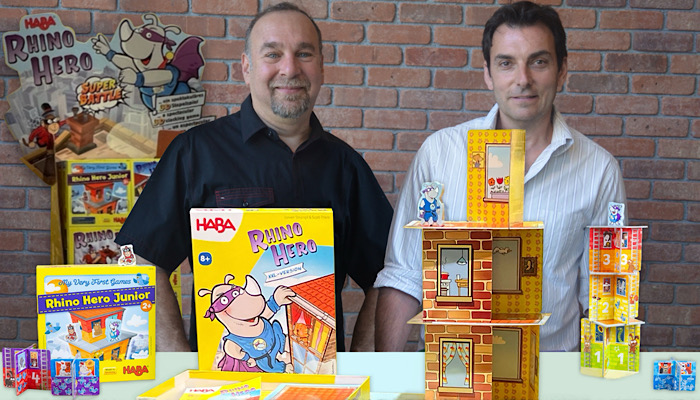
“A wobbly tower game – with a rhinoceros!” That’s how I describe Rhino Hero to get newcomers curious… Scott and Steven: as the inventors, how would you describe it?
Steven Strumpf: Well, we’ve heard a lot of people describe it as Jenga meets Uno in a card game – but maybe a reverse Jenga is more accurate.
That puts it across very nicely! And Rhino Hero – one of my favourite games, by the way – is 15 this year. Congratulations! I’m dying to know: how did it come about?
Steven: Scott and I both worked at Parker Brothers. I was the Director of Creative Services; I ran their graphic design department. Scott was in their preliminary design department. We got along great! A short time after Parker Brothers was purchased by Hasbro, I got downsized out and let go. I started running my own graphic-design business while Scott carried on working for Hasbro… When he eventually left, he wanted to do his own design thing, and his disciplines were different than mine…
Because – just to clarify – you were more graphics, Scott was more game design?
Steven: Exactly right. So we felt it was a good match. Plus, I’d been a designer my whole life, so it wasn’t that far of a stretch for me to come up with game designs… You can see the kind of packaging, videos, logos and design I do now at www.Strumpf.tv. Anyway, the problem I had back then was that I didn’t really know gameplay. And that’s where Scott’s strength was. So Rhino Hero was one of the first ideas that I came up with, but I didn’t really have a gameplay. When I was a kid, though, I remember I used to love to build houses out of cards, you know?
Like a card castle? With the triangles?
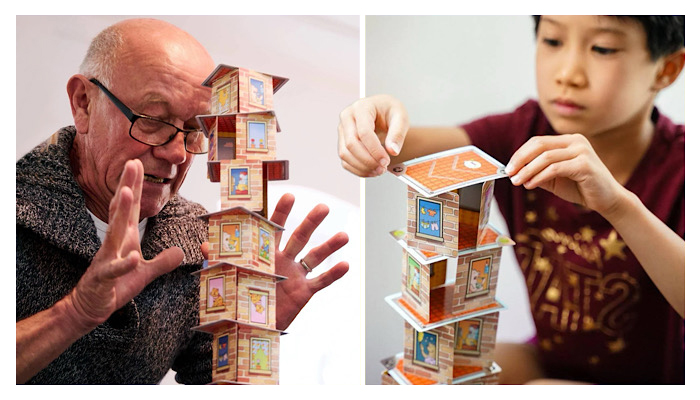
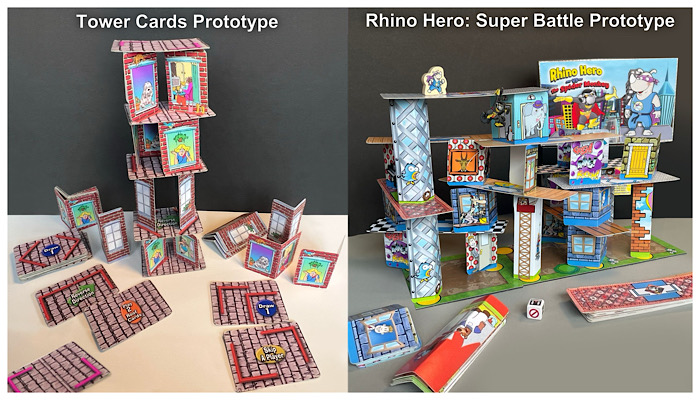
Steven: Yes, like pyramids and layers. They’re really difficult to do, but – at that time – a lot of toy companies were asking for card games. Typically with card games, you read information on the cards and do something based on that. But I was thinking it would be fun to use cards in a different way. So I was asking myself, ‘What if we made it easier for kids to play a house of cards game?’ So that’s when I decided to fold the cards and use them as wall sections with the idea of placing them on the roof cards in different shapes to make it wobbly and a little off balance. I showed it to Scott and he really liked the idea – but he was like, “It needs to be interactive with other players.”
So Scott drove that; the idea that you’d have to have some back and forth and competition going between people. Which, of course, was completely over my head! I was really going for the sizzle and the graphics… And because it was a building theme, I decided to put windows on the side. That way, you could peer into what you’d built and see what everybody was doing… Like in the Alfred Hitchcock movie Rear Window! You’d look in and get this little bit of intrigue every time you built up a level. A lot of people really love that about the product. So we built a finished prototype, and we started showing it to game companies.
And was it called Rhino Hero at that point?
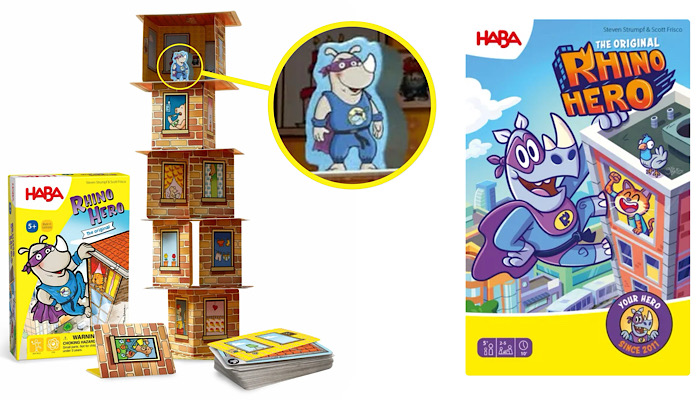
Steven: No, actually – it didn’t have the rhino in it at that point so it was just called Tower Cards… And nobody was really interested. Ha! But then a really good friend of mine, who’s also a designer in the toy industry, suggested Scott and I meet with a rep who specializes in showing games in Europe. He said something like, “If it’s still sitting in your closet, give it to this guy – he’ll bring it to Europe and show it around.” So we did, and he happened to show it to HABA. They immediately licensed it – and added the rhino. So we built the stage and they added the cast of characters!
Oh, lovely! I didn’t realize HABA added the rhino. It’s such a great touch.
Steven: We thought it was genius – it completed the story, so to speak. And it’s funny, Deej, because you work with all these toy companies, everybody has a different approach… Some really improve your product, some just do your games exactly as you show them – and some ruin them. Ha!
Ha! Some magicians have a phrase when it happens to their tricks; they say their ideas were “Ruined by improvement…”
Steven: Ha! Yes, ruined by improvement. But not with Rhino Hero; HABA did a great job – we were delighted with it. They were selling it in Europe for about a year before it came to the US, and it did pretty well. It’s since sold all over the world. Unfortunately, that does mean we’ve seen knockoffs coming out of the Middle East with the Rhino looking all big and buff, and the knockoffs coming out of China have a re-illustrated cover – they still call it Rhino Hero. Some companies just steal the gameplay. We work with HABA to chase after them to try to stop them but it’s impossible, really.
Oh, so disappointing – and it must be such a giant, joyless job. And you mentioned there that you had other games. What other ideas have you worked on together?
Scott Frisco: When Steven and I were really hitting it hard, I’d say we probably came up with anywhere from 20 to 30 games a year. Because really, when you’re trying to work the balance of how much to put in and when to stop and move on to something else, it’s a numbers game. A lot of the items that Steven and I have done have taken maybe five, six, seven years to sell.
Gosh!
Scott: We often show items, then we show them again and again and again… Maybe we should take it as a compliment; maybe Steven and I are always seven years ahead! Ha! So it often takes a long time to get people on board with what we’re showing.
Steven: Actually, I saw in your interview with Sam Unsicker that he said the same thing about Monopoly Scrabble… They were showing that game to Hasbro for 15 years.
You’re absolutely right. Billy interviewed Sam about that a couple of years ago; people can read it here. So you’re not alone!
Scott: Yes, it’s not uncommon. I do think it’s hard because often – after that amount of time – we’ve got over the product concept and we’re onto something else… We have new ideas we want to work on and the older ideas just get backlogged. We still show people though when we think it’s still a good idea – because we’ve seen good ideas get out there eventually.
Steven: Of course, sometimes somebody else has come up with the same idea in the meanwhile! And then we feel like, “But that’s our idea!” Ha! I can tell you that happens much more than we’d like it to – and more than you’d believe it would. It’s not uncommon because we’re all marching in the same society with the same clues around us. And if you’re in the industry, you can all see what’s happening; you see the trends, you see what people are gravitating towards and it makes sense when a number of people jump on that same thing. You try to avoid that, but sometimes you can’t.
And away from that, you’ve had some Rhino Hero variations, haven’t you? Walk me through some of those…
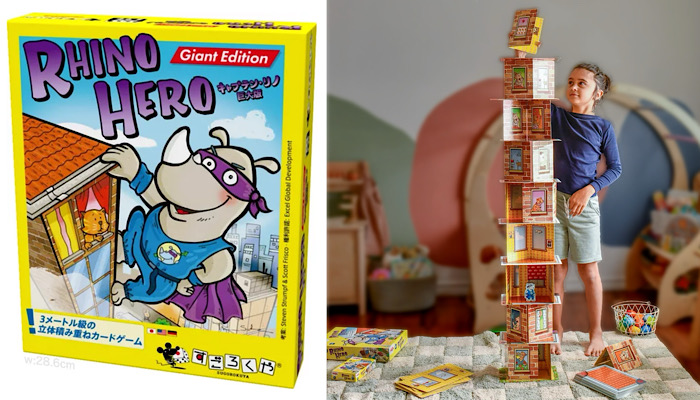
Steven: HABA has done a couple that don’t feature vertical play like Rhino Hero. One is called Rhino Hero: Missing Match. That’s more like a memory game where kids have to turn over the cards to find matching pairs. There’s also one called Rhino Hero: Active Kids. Neither of those are our concepts. But in terms of innovating around the original play pattern, we’ve done Rhino Hero Junior, which has thicker cardboard for younger kids. Also, have you seen the Japanese version with the extra-large cards? XXL Rhino Hero? When you play that, the tower can go something like 12-feet high. The Rhino is about five inches tall!
I’ve not seen that! I would absolutely play that, though. Is that out in the UK? Or the US?
Steven: Now you can get them in the US but, at first, it was not easy to get. What happened there was that HABA licensed the idea to a Japanese game company. They then manufactured a short run of this giant edition. People were buying them in the US and having them shipped over… Well, this box probably weighs five pounds, so it was about a hundred dollars a game with shipping and everything! When I went to GenCon, it was everywhere! I think that took us into a bit of a different realm… All of a sudden, gamers were using Rhino Hero as an icebreaker, or a lighter game between more tabletop titles.
So there wasn’t a US release?
Steven: Not when it first came out in Japan. We wanted to see it sold here too! We had conversations with HABA about it, but they had some concerns that they could get sued. Why? Because the tower gets so tall that you have to stand on a chair or a step ladder or whatever to get to the top of the game!
The worry being that the US audience could be more litigious? If somebody fell off a chair, they’d say it was the fault of the game?
Steven: Exactly. In terms of other variations – because Rhino Hero was doing well – HABA suggested we create a follow up game, so we came up with Super Battle. We wanted to make it with an element of battling to appeal more to gamers, so we brought in dice and the idea of competing to get to the top of the tower. We also wanted to bring in a nemesis, so we created the spider monkeys as a threat to bring down the tower. At one point, we actually called it Rhino Hero versus the Spider Monkeys!
Anyway, we wanted it to be modular, so we did tall walls, short walls and long walls so that players could really get creative and have freedom to set out the foundation cards however they wanted. When we sent it to HABA, they really loved it! They then added the other characters: Big E the elephant, Giraffe Boy and Batguin. It really took off in some unexpected ways… We’ve had hardcore gamers on blogs saying this is in their top ten games because it plays so well, for example.
And – generally speaking – when you two work together, where do your ideas come from? Does it tend to be a look first? Or an idea first?
Scott: Either! I think it happens both ways, right, Steven?
Steven: We’re always looking out for inspiration, and a big part of that comes from just being in the world, looking around and seeing what’s happening. We also look at what’s happening with electronic games themes and internet games… Sometimes we reverse engineer an electronic game into a traditional board game! Beyond that, we both have kids, so we look to see what they’re interested in.
Can I get an example of that?
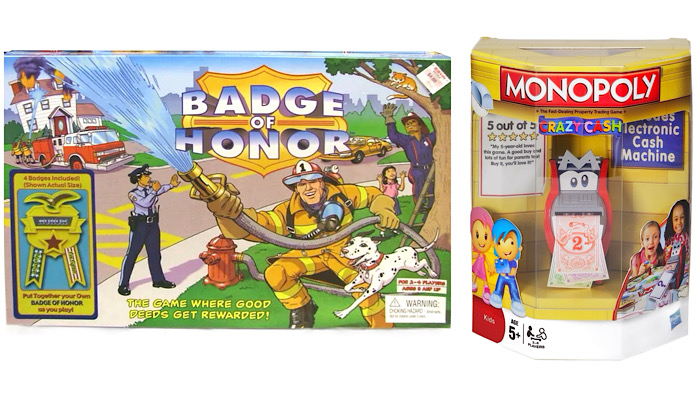
Steven: For example, my son was taking swimming classes… When he graduated, they put a medal around his neck, as if he’d graduated from something great, you know? And honestly, Deej, he wore that medal as if he was an Olympian! So I asked Scott if there was something around that… We worked it up as a game called Badge of Honor. It was a firefighter themed game. We licensed it to Pressman Toys. we knew kids love firefighters – and you went around the board being heroic…
You had to rescue a cat from a tree – a slider on the board! Then you had to put out a house fire, which was a spinning wheel under a cardboard house that had windows in it. There was a nice house on one side of the wheel, then – when you spun it – flames came into the window! There were also two little cardboard walkie-talkies to let you call in the emergencies! Anyway, whenever you accomplished a job, you’d get a piece of the badge of honor.
Oh, you had to build the badge? Piece it together?
Scott: Yes. It was fun! Another example was a concept we pitched to Hasbro. It was called Monopoly Money Ball. That was a clear ball with a fan in the bottom to blow money around… Kids reached into it to grab as much money as they could in a few seconds. The idea came when I was at my daughter’s school for a fundraiser. The kids who raised the most money got to go into this money tube at the school. Basically, the kids had to try and grab The money that was being blown around inside a tube! They go nuts for it! So I said to Steven, “Flying money is a great theme!”
Off the back of that, we then licensed a game called Monopoly: Crazy Cash – a cash ATM that shoots money in the air. This was about 15, 20 years ago… After a few years on the market, Hasbro licensed the concept – with a bunch of other games – to Carnival Cruise Lines… That was for a Hasbro game night; like a game show night for people on the cruise. A short time, after that, another inventor came up with a gun that shoots money in the air! Because it used the same mechanism as our Crazy Cash Machine, we got paid for that as well.
And all that started from one of you saying, “…money in the air”!
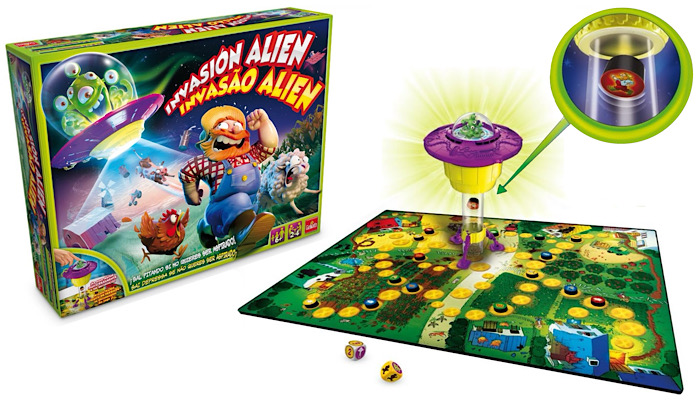
Steven: Yes, that led to quite a lot! And at some point, Scott had almost the opposite idea as well… At the time, the concept of aliens sucking people up into ships seemed to be everywhere. So Scott came up with this idea: what if we put a fan in a spaceship and then suck players’ pieces up through a tube?
Love it! This got to market?
Steven: Yes, we licensed it to Goliath as Alien Invasion. In the end, I think the gameplay was a bit overdeveloped. When Scott came up with the concept he went home and tried it out by switching a hairdryer into reverse. Then he put a tube on it! We were able to suck a little foam mover up inside a tube so we built this whole game around it based on that. The movers were actually little sponges…
So sometimes you played as the spaceship, sometimes as the characters that moved round the board. It was an incredibly gorgeous game. The colours, the detail – even the vacuum-form tray! When you opened the box, the product looked beautiful. We’d still love to bring that to the US with simpler rules. The problem is that the cost would be too high, because of the price of plastics, motors and tariffs.
That sounds great! Great examples, thank you chaps. To wrap things up, let me ask you this… What’re the most interesting objects in your studios?
Steven: Oh man! Looking behind you, I can tell you that my studio is like the shelves behind you…. Every inch of shelf space is taken up. I can’t even find stuff on my desk because it’s covered with 50 different things I’m working on at once. So to narrow it down…
Scott: But Steven, you have some really cool stuff on your walls that you’ve collected! I think that’s interesting; there’s some real memorabilia from Parker Brothers and Hasbro…
Oh, yes? What comes to mind from that?!
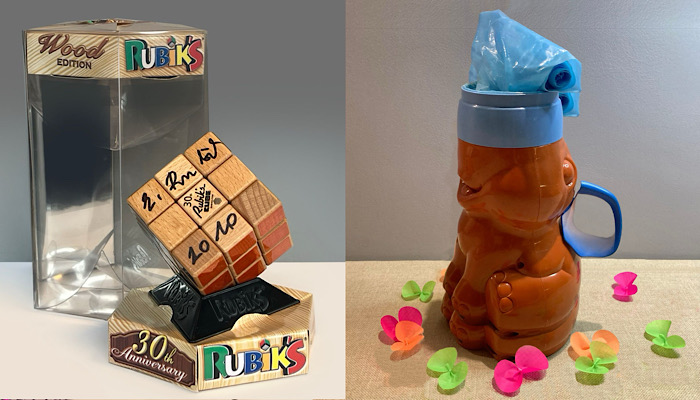
Steven: I have a Rubik’s Cube signed by Ernö Rubik himself from when I was working on the brand. That’s pretty cool! I also have a Monopoly game board signed by all the people at Parker Brothers from when I left my job. It reminds me of all the fond memories I have of all the great people I worked with over the years… And most of all it reminds me how much I love the toy industry and all the wonderful people I met along the way while doing what I love to do… I love doing packaging and coming up with concepts and knowing how it connects with people.
Scott: Actually, one great joy for both Steven and I is going onto some of these platforms and seeing a video of someone having fun playing Rhino Hero or One of our products. That’s really joyous to us; to know other people having fun was something we had a hand in. Like the YouTube video you saw before we started talking – the two guys singing a song they’d written about Rhino Hero! Ha! Things like that are great.
Steven: What’s your favourite thing in your workspace over there, Deej?
ME? Oh, my god! I’ve no idea! Ha! That’s actually a very stressful question!
Steven: Ha! It’s a good question!
Well, it’s a good question when I ask it! Ha! You know, I’ve been asking people that for nearly ten years… Only now do I realise how difficult it is. Alright, I just spotted something that I think is lovely… Years ago, some colleagues bought me a tin of tea. Apparently, you could personalize the blend, so this is Deej’s Magic Brew…
Steven: This is like a one-off tin?
Yes, exactly that. Let me see if I can reach it… There! You can see they personalise the label – supposedly to match the person to whom you’re giving it. So this says, “A bright, intelligently formed infusion with a lively character and eccentric charm… This blend is kind on the senses and loyally supportive of those in need. Enjoying creative elements, with warmth and open features, this lovely combination is perfect in any social situation.”
Steven: That’s great!
It’s a charming gift. Obviously, the people that gave it to me were appalling judges of character, but… They made me sound great!
Steven: And the tea sounds delicious!
Ha! I need a tea now; I really felt the pressure there! So Scott… See, now it feels like I’m turning the screw because you didn’t tell me your object!
Scott: Well, when I was back at Parker Brothers a million years ago, one of the first things I worked on was Elefun which is the Theora Designs game with the elephant that blows butterflies up its trunk… The kids have to catch the butterflies as they come down.
Oh, yes! I know it well… In fact, I think Elefun turns 33 this year… We’re planning to speak to the Theora team about that.
Scott: 33? Yes, I guess it must be about that. Wow! So the interesting object I have is a test version of Elefun. It’s chocolate coloured because they used any colour plastic that they had to hand – just to test the mould. And I just love that thing!
Great answer! And what did you have to do on Elefun, Scott?
Scott: When the idea first came in, it was really just a dome that sat on the table with a tube coming up. And because it didn’t yet have the theme, it didn’t have butterflies. Instead, it had little pieces of foam that came up the tube. So the hardest thing for me to do as a designer was come up with something to replace the foam; something that didn’t have a choke value. So I worked for months trying to think of a solution… I kept thinking about stuff in nature that sort of spins down – like the whirlygigs.
Oh, like a sycamore seed?
Scott: Yes, exactly that. But everything I tried didn’t quite do it. At one point, the other guy I was working with, the project manager, had a sailboat. While I was bending a piece of material, he suggested that he bring in a piece of old sail material. When he did, I crimped it and made it into a butterfly shape – and the rest, as they say, is history. So that was a real challenge – and I don’t know what would have happened if the project manager didn’t suggest a piece of old sail, and we hadn’t crimped it to make those safe, lightweight little butterflies!
That’s absolutely brilliant. Chaps, what can I say? You’ve been wonderful! Apart from making me answer my own question – that was horrible… That aside – thank you so much!
–
To stay in the loop with the latest news, interviews and features from the world of toy and game design, sign up to our weekly newsletter here
More Recent News

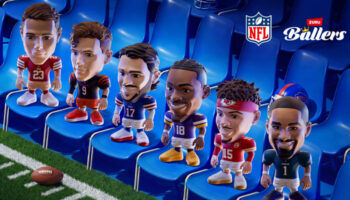
Zuru readies NFL Ballers
“NFL Ballers is built for the way fans collect today – instantly recognisable stars, real chase mechanics, and a price point that keeps the thrill of the pull within reach,” said Chloe McKenzie, Global Marketing Director Zuru.
Hasbro launches AI studio Sixth Wall to give partners a framework for bringing its characters into AI experiences
“It opens entirely new surfaces for play and storytelling, from making a store greeting feel magical to transforming a call waiting experience into a moment with a fan’s favourite character,” said Hasbro CEO Chris Cocks.

Visitor registration now open for BLE 2026
“BLE 2026 is set to be the biggest edition yet,” said Ella Haynes, BLE event director.
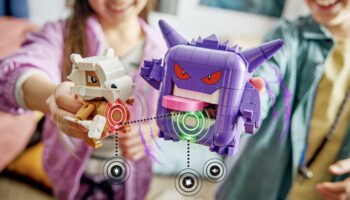
LEGO brings SMART Play tech to Pokémon sets
“LEGO Pokémon creatures respond to children’s actions: meaning fans can build, train and interact with their LEGO Pokémon creatures through hands-on, imaginative play that encourages creativity, confidence and storytelling,” said Julia Goldin, Chief Marketing and Product Officer at the LEGO Group.
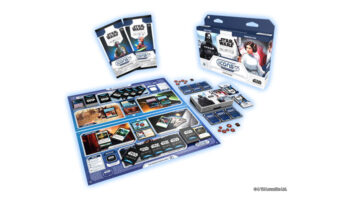
Asmodee readies Star Wars: Unlimited Icons
“We can’t wait for fans, both old and new, to get their hands on the set and show the community what they’re made of,” said Roger Martin, Marketing Director at Asmodee.
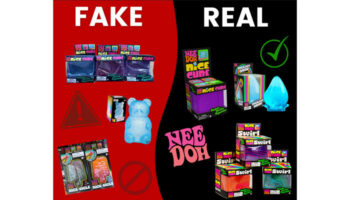
Bigjigs Toys issues warning over rise in fake NeeDoh product
“The safety of children is always our top priority, and we’re concerned that these knock-offs not only fail to deliver the same quality experience, but may also expose customers to unregulated, harmful chemicals,” said Sam Ireland, Operations Director of Bigjigs Toys.
Popular Articles

Spirograph at 60: Meet Duncan Fisher, son of Denys Fisher – the inventor of Spirograph, Cyclex and Stickle Bricks!
Mini Brands Really Works Vinyl represents "major step forward for the brand", says Zuru
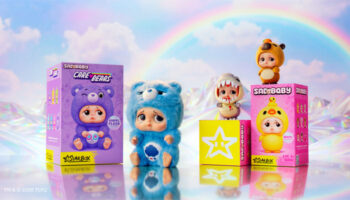
Zuru's Starbox collectibles brings together "elevated design, strong storytelling and trend-led play patterns"

Bop It’s Dan Klitsner on creative techniques, his favourite inventions and more
Zuru readies NFL Ballers
Upcoming Events
-
- 30th January 2026
- Spielwarenmesse, Nuremberg
International Game Inventors Convention
-

- 19th - 21st May 2026
- Mandalay Bay Convention Center, Las Vegas
Las Vegas Licensing Expo
-

- 23rd - 25th June 2026
- Stamford Bridge Stadium, Chelsea, London
Play Creators Festival
-

- Tuesday, June 23rd, 2026
- Stamford Bridge Stadium, Chelsea, London
Play Creators Awards
-
- Wednesday, June 24th, 2026
- Stamford Bridge Stadium, Chelsea, London
Play Creators Conference
-

- Thursday, June 25th, 2026
- Stamford Bridge Stadium, Chelsea, London
Mojo Pitch
-

- 6th - 8th October 2026
- Excel London
Brand Licensing Europe