RoseArt’s Jake Beauchemin on RoseArt Games’ debut slate of titles – and working with inventors
Jake, it’s great to connect. Talk me through your route into the industry – was this always part of the plan?
No, not at all. I don’t think I had a plan as a kid. I liked to play and hang out with friends and even at High School I still had very little direction. I had a natural acuity towards mathematics and problem solving – that kind of brain. I went to college for computer engineering and realised very quickly that I was not an engineer…
How so?
I think I’m more social than the typical engineer – I’m not a ‘squirrel away and do code’ type of person – no judgement, but it’s just not in my makeup. Yeah. So when I left school, I really didn’t know what I wanted to do, but I was still into computers and technology so I got a job in a regional office for CompUSA. I did that for a few years and that’s where started to learn retail.
Then through a couple of jobs I ended up at a small electronics accessory manufacturer located here in southern New Hampshire. That’s where I started to get interested in business – in negotiating and doing deals. At the time we working with Apple before the iPhone launch. We went from hundreds of thousands in sales to many millions in sales and got really fortunate. That began a 10-year ride in tech and I really fell in love with consumer packaged goods and the whole sales infrastructure.
The technology industry changed a lot in the 2010s and it wasn’t my thing anymore – and I’ve always had an affinity towards games and toys, so I found my way through a couple of companies to Ceaco, now owned by Buffalo. I felt ‘this is where I belong’ and I’ve been in it ever since.
Terrific! Now, let’s talk RoseArt Games – for anyone new to the wider company, what should we know?
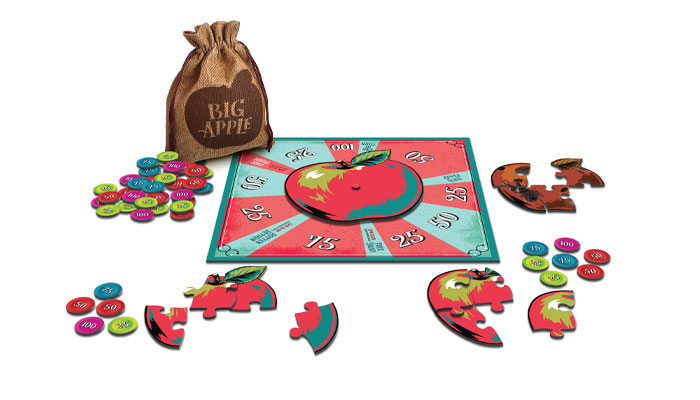
It’s a third generation, hundred plus -year-old company. Rosebud Art Company was founded in the 1920’s by Isador Rosen. His grandson, Larry Rosen owns the company today. The company started with learn-to-draw books and tabletop games. Big Apple, which is part of our launch slate this year, was one of the initial games introduced back in the 1920s – so games have always been part of the company. We became RoseArt in the 1970s and through the decades we’ve grown to be an industry leader in toys, crafts, school supplies and stationery.
So games became less of a focus?
Yes, but we launched games when we had opportunities. In the 80s and 90s, RoseArt had tremendous success with licensed games like the Teenage Mutant Ninja Turtles and Strawberry Shortcake. Then more recently, Trudi Lazarus joined as EVP of the whole division and brought me in – both of us came from Ceaco/Gamewright. So we’re serious about getting back into games and that starts with this new slate of titles.
How have you found inventor relations so far?
I’ve been on the fringes of it for a long time, but this is my first time really doing it and guiding and it’s been really fun to learn. Firstly, the community is phenomenal. And then it’s about keeping your ducks in a row and make sure that you get back to folks. It requires a lot of planning and coordination, but it’s been really fun.

Terrific! Let’s dive into this slate of games. You mentioned Big Apple earlier – the one that first launched back in the 1920s?
Yes, I’m really excited about this one. When I first met with Larry, we were in his office talking about games and then we went into the archive – it was this total treasure trove! I gravitated to Big Apple – one of our first games – because apples are ubiquitous, multi-generational, and gender neutral. It’s a nice theme to build a game around.
Did the gameplay need updating?
Yes. It had a spinning board that earned you points – so it was not built with strategy in mind! We didn’t want to mess with the roots of the game, but we have added more strategy and updated the components. We turned the Apple into a puzzle because it certainly makes sense – we make puzzles already! But we’ve retained the spirit of that original game. That was important to us. We’ve even put a call out on the box to let people know it was first released in 1923.
Amazing. And what sorts of things were you looking for from the inventor community when building this slate out?
We’ve tried to come up with pillar games that occupy different lanes. Our company is a mass retail focused company, a high volume focused company. We’re not a hobby company and we’re not a specialty company. So we certainly have to think in terms of mass – so broad age demographics, gender neutrality… Things you would see at a Target or a Walmart. But essentially, we looked at ‘family+’ or ‘strategy-‘. Games that parents can get their kids into games with it, or gamers can get non-gamers into.
Nicely put! And one such title is Blooming Bouquets…
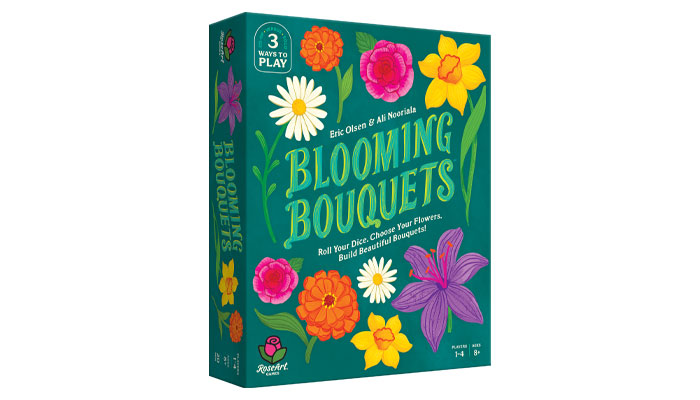
Yes, this comes from Eric Olsen and Ali Nooriala. It’s a dice game – and I love dice games. We had a game at Gamewright called Qwixx – it’s a phenomenal dice game and we always had dice games in the Gamewright line. And the reason we liked Blooming Bouquets is that players have a lot of agency – which isn’t easy in a dice game! Here you’re rolling dice, drafting flowers and completing bouquets. It’s a great game.
Looks fun! And then there’s Grand Photo Adventure?
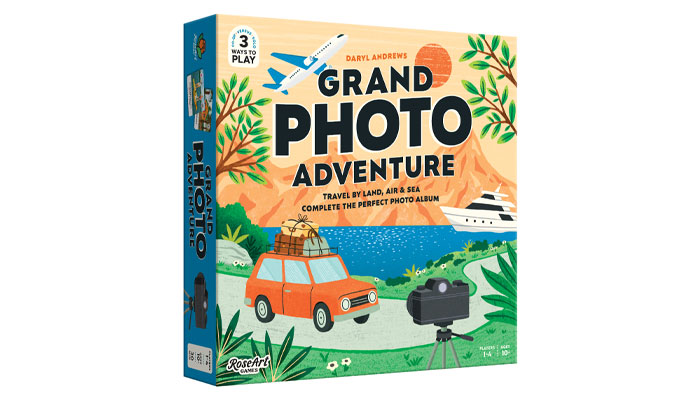
Yes, this one came from Daryl Andrews. He’s maybe best known for Sagrada, and I’m a huge fan of that game. So I messaged Daryl on LinkedIn and said: ‘Sagrada is one of my all-time favourite games. It is absolutely beautiful. Do you have any games to show me?’ And he had a lot of games to show! But he said: “I’ve got this really cool travel-themed game and if we strip some stuff out of it, it could be mass market friendly.” So we stripped it down so that you’re just travelling, collecting photos and building a photo album. It had the most development of the four games to evolve it into what it is today – and Daryl’s been terrific to work with on it.
And how do you define that line between hobby and mass market?
With mass market, you maybe don’t realise how strategic you’re being – it’s a trick. Look at something like Azul which is sold everywhere. It’s very beautiful, very strategic and in the mass market because the strategy is very accessible. That’s the difference between a mass market with strategy, and something that stays in the hobby lane.
Great answer. And then, completing the line-up, we have Ferris Wheel Rush!
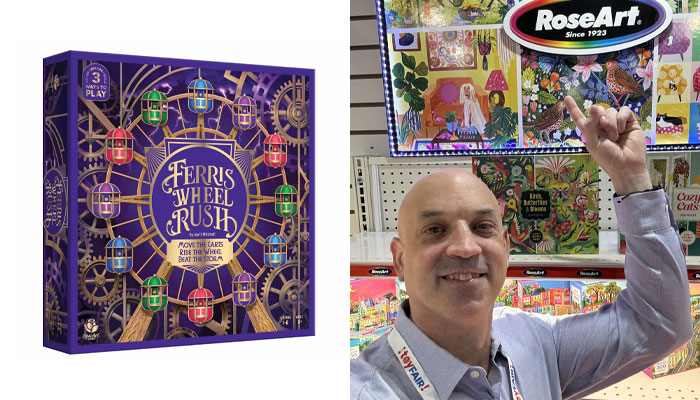
Yes, Ferris Wheel Rush is our game with April Mitchell. April is one of the best humans –I met her through Ed Gartin. He helped develop a game called Slanguage for a company I used to work and that game was a collaboration between Ed and April. I reached out to April to see her games but to also see if she could connect me with other designers, because she’s an amazing networker – and a lovely person!
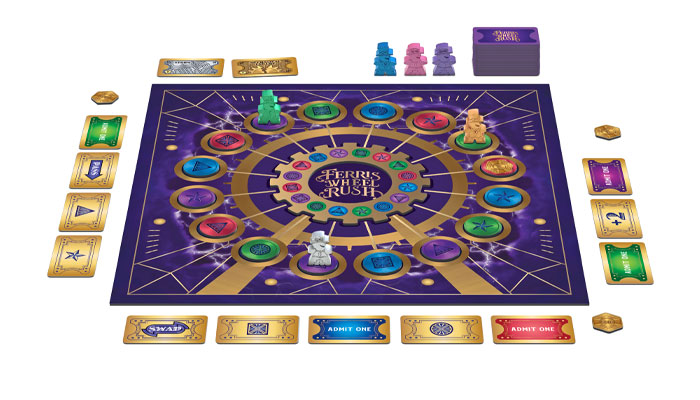
And Ferris Wheel Rush is extremely unique. You have these Ferris wheel carts, but they’re out of order. You have a solution card in the middle and players must work together to move your ride engineers around to fix the Ferris wheel. And there are storm cards in the deck – if too many storm cards come out, you lose. The two things I thought were super unique about it was the working together to move these carts around, but also not knowing the length of the game. It could end at any moment, which makes each game feel very different.
Sounds like a winner! Before we wrap up, what fuels your creativity?
Well, I try to listen a lot more than I speak – and I try to ask open-ended questions. I’m only one person, so the bigger my community is, the more powerful I can be as a person in this community. So I try and take lots of meetings with people – you never know where a good idea could come from, so I really try to engage with people, listen and travel. We’ll be in Europe quite a bit next year and we’ll continue to travel and meet folks over there. I can’t wait to do that. It’ll be super fun.
The other thing I try to do is play a lot of games. I go to a lot of local game nights where people bring their games. And I try and play games that, on paper, I might not lean towards, because there’s always something interesting there… Maybe an idea or mechanic that inspires something else down the road.
Great answer. Jake, a huge thanks again and congrats on a cracking slate of games!
–
To stay in the loop with the latest news, interviews and features from the world of toy and game design, sign up to our weekly newsletter here
More Recent Interview


Designers Adrien Pédron and Thomas Favrelière on the origins of Archeo – and why Gigamic proved the perfect publisher
“We’d wanted to work with Gigamic for a long time…”: In conversation with designers Thomas Favrelière and Adrien Pédron.

BOTI’s Nico Blauw talks Pembe the Pink Cat, innovation – and the International Toy Board
“The look, the design, the audience, the messaging… It all appealed”: Nico Blauw reveals what made Pembe the Pink Cat a winner for BOTI.

“This was the missing piece…”: Rubber Road’s Jack Fox on TUBBZ’s move into blind collectibles with Mystery Eggs
Jack Fox, Sales & Marketing Director at Rubber Road, talks TUBBZ Mystery Eggs – and why Minions were a perfect fit.

Educational Insights’ Lisa Guili on TikTok, 20 years of Kanoodle – and ten million units sold
Lisa Guili reveals how one addictive brain teaser found its audience and became a phenomenon.

“I want people to bet on themselves”: Spin Master Co-Founder Ronnen Harary discusses his new book, No Experience Necessary
Spin Master Co-Founder Ronnen Harary talks to us about his exciting new book, working with inventors – and Spin’s most underrated launch.

David Norman of Stormin’ Studios on inventors, Orchard Toys – and shaking things up!
“It’s not just a name, it’s our mission statement”: In conversation with Stormin’ Studios’ David Norman.
Popular Articles

DSTLRY launches card game based on its award-winning Somna comic
BOTI’s Nico Blauw talks Pembe the Pink Cat, innovation – and the International Toy Board

Mattel’s Tyler Kenney on bringing toyetic fun into fingerboarding with Hot Wheels Skate

Bop It’s Dan Klitsner on creative techniques, his favourite inventions and more

Wow! Stuff to launch Fuggler Puppetronics in 2026
Upcoming Events
-

- 30th January 2026
- Spielwarenmesse, Nuremberg
International Game Inventors Convention
-

- 19th - 21st May 2026
- Mandalay Bay Convention Center, Las Vegas
Las Vegas Licensing Expo
-

- 23rd - 25th June 2026
- Stamford Bridge Stadium, Chelsea, London
Play Creators Festival
-

- Tuesday, June 23rd, 2026
- Stamford Bridge Stadium, Chelsea, London
Play Creators Awards
-
- Wednesday, June 24th, 2026
- Stamford Bridge Stadium, Chelsea, London
Play Creators Conference
-

- Thursday, June 25th, 2026
- Stamford Bridge Stadium, Chelsea, London
Mojo Pitch
-

- 6th - 8th October 2026
- Excel London
Brand Licensing Europe