How do Paper Engine’s Product Designers develop ideas? Melissa Morris shares her secrets!

Melissa Morris – Melly – I can’t tell you how pleased I am to be speaking with you! You’re a Product Designer with Paper Engine… How did you come to be working at Paper Engine? And how long have you been there?
I’ve been here seven and a half years. I pretty much came here straight from studying product design at Loughborough University. It was complete luck! I just happened to see the role advertised and that it was to do with design. I thought maybe I could do it… I quite like paper and I’ve always liked making stuff with my hands. A lot of our university course was preparing people to design websites and apps – digital things which I really didn’t get on with. But when we were in a workshop making something in wood or metal, I really enjoyed it.
Perfect! And we’re talking today because I just LOVED a product at London Toy Fair… The Marble Maze in your Build Your Own range. How would you describe it to people?
It’s a 3D puzzle maze consisting of eight different cubes joined together to make one big cube. You start off by putting a marble in one section, then you have to tilt and rotate the whole thing to steer the marble through all the obstacles until you get to the last part… So you’re constantly changing which way’s up – and trying to make sure the marble doesn’t fall out.
And – before I get to the bit that I can’t comprehend – where did the idea for this come from?
Well, we did a marble run a few years ago and we’ve always had it in our heads that we could do that another way. Then, at the beginning of last year, we had a brainstorming meeting to come up with new products. The marble run came up and there was a conversation about how cool it would be if you could pick it up, hold it and move it. Our meetings are quite collaborative; we all just discuss what ideas we have and which ones we think have legs. Not everything works out, but I think everyone thought this one was good.
So once the idea was on the table, what was the next step?
I think I just made a frame with eight sections in it, just so I had a starting point. We have a set sheet size for our kits because they have to fit inside our standard packaging. So working backwards from the largest measurement there let me scale everything. And as it happens, that means it’s ended up a nice size – because we wanted it impressively big, but not so stupidly big that you couldn’t hold it. After that, I just started with the first cube; I cut out some bits of card with scissors and sellotaped them together… Just to make some random paths to see how it felt to go from the entry point through some paths. Then I turned the cube around – so the exit point became the entry point – and that was cube two. Then I just did that for each of the eight cubes.
I hadn’t thought about it, but the packaging size is a tremendously helpful limitation here, isn’t it? You can’t go bigger than the box! Were there always going to be eight cubes?
Yes, I think that’s the most logical way to split up, because it had to be modular and a cube number…
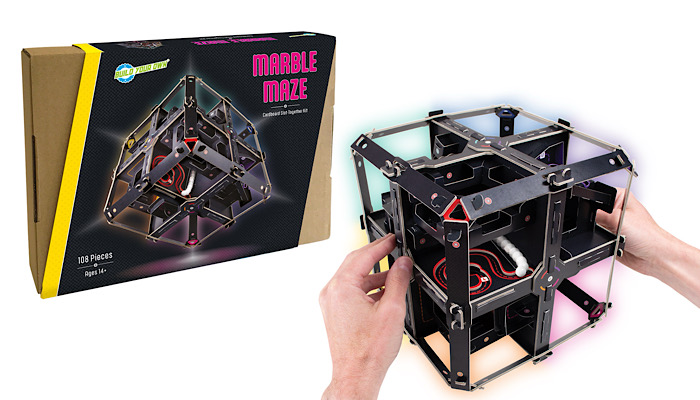
Of course it did! I should take that bit out really, Melly, because I sounded very dense! I’ll leave it in, though… So people see how tactful you are! How long did it take to build the first prototype?
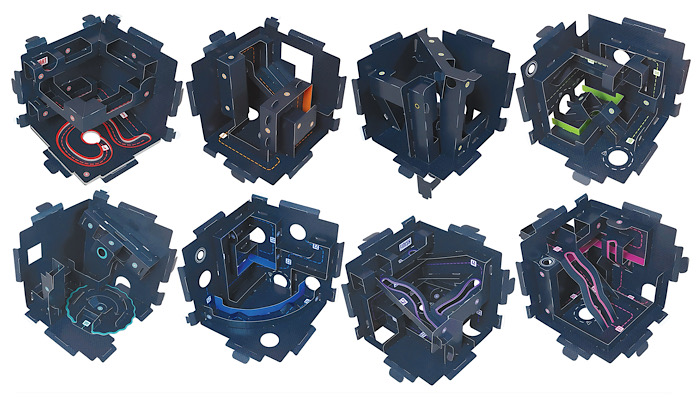
The first prototype took me a day. That was the easiest part! I just mapped out each of the eight sections. Then I came up with a general theme for each one. So in the final model, the first cube just has paths around the edge and then a spiral at the bottom… That’s on a flat plane so your marble just goes around it to the exit. It’s quite simple.
Nothing too intimidating while you get used to it…
Exactly! In cube two, I built in a sort-of mini wall for the marble to go up. But in the third one, I wanted to add some traps… So there’re three ways you can go out of the cube. If you go out of the wrong ones, you end up in an endless loop! Then there’s a little bridge in the middle of cube four, and a turntable in five. Six is just a simple one with some little speed bumps. And then seven and eight are more complex versions of some of the earlier cubes!
Well, I appreciate that tour. I’ll put a couple of images in here because I want people to know how clever the design is. In terms of others contributing to the design, did you playtest everything with the team as you went?
No, I came up with the initial design myself and – basically – made it way too difficult! When we had people test it in the office, no one could complete it because I put in too many traps. The marble could fall out at any time – which I thought was funny and a good challenge… But the people in the office disagreed. Ha! So we very sensibly made it easier!
I can imagine people giving feeedback with foul language and colourful metaphors! It’s still not easy though, is it?
No, no – it’s still a challenge. Obviously, I’ve tested it and tested it – I think I’ve only completed it a couple of times without the marble falling out at least once! But it’s quite satisfying to progress from one cube to another. And in a way, that was the biggest challenge for me… It took a long time to work out how to actually connect everything together because, obviously, the cubes back up against each other… And then you put the whole frame around it. So coming up with a way to put it together so that I wasn’t getting in my own way with the tabs was difficult.
After that, making the frame strong enough and sturdy enough to handle was also a challenge. The first few prototypes fell apart if you picked them up by the corner. So for the final design, we just made everything lock at every opportunity using techniques I’ve learned from the other paper engineers I work with who are a lot more experienced than I am. Or sometimes I might just come up with stuff at home. At one point, I think I came up with about 20 different ways of connecting a tab to the wall… In the end, we went with one of the simplest. But I think I do tend to overcomplicate things and then pare it back, and that feels like it’s the best way to do it.
I’m curious to know then, Melly… At what point did you know the product was finished?
That took a long time, actually. There was a time when we thought we’d nearly finished it – but it took another six months to iron out every detail. Putting together our instruction booklets is always a massive part of our process, for example – and this is the most complex kit we’ve ever done. In fact, there are three instruction booklets which took me, I think over six months to finish… Because during that process, we kept testing it with people; testing the building of it. And, of course, they notice things other people might not pick up on! So even after we finalized the product, the instructions were still in development as we kept testing the build.
So much work, Melly! And that’s not reflected in the price because I think it’s quite affordable! Where can we buy this? And what’s the RRP?
It’s £24.99. We mainly sell online so you can get it from our own website – www.buildyourownkits.com – and from amazon and Menkind. You can also get it in independent toys stores.
Amazing! In a moment, I’m going to start wrapping things up, but is there anything I should’ve asked you today that I didn’t?
Hmmm. I don’t think so… Maybe what’s next?
It would be rude not to ask what’s next! What’s next? Don’t say you don’t know! Ha!
Ha! No, I do! I think you know we did a book nook based on Roald Dahl’s Matilda because you interviewed Hayley about it…
I did; Hayley Symonds – thank you for reminding me! I’ll link to that here.
Well, we’ve got two more coming out this year with, both with Roald Dahl. We’ve got the BFG and Charlie and the Chocolate Factory coming out this summer. We’ve also got a new Ardman kit coming out based on the character Shaun from the Wallace and Gromit films. That should be out in in June.
Brilliant! Well, thank you for making time to chat, Melly. I think your work is incredible, so I really appreciate it. To wrap things up, tell me: what’s the most interesting object on your desk?
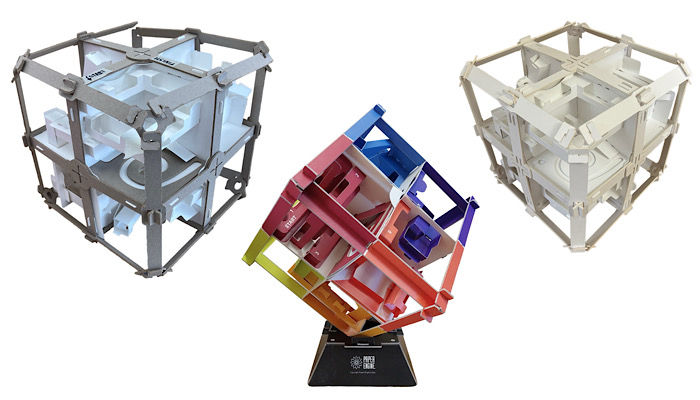
Oh! I don’t know! When I was designing the maze, I had a wall of prototypes piled on my desk; just every iteration I’d done. I had at least 12 – it was getting a bit ridiculous, so I had to get rid of them! I’ve only just put them in the recycling.
Argghh! I’d love to have seen those! What a shame!
Well! I kept the first one!
Ah!
I kept the first one, one in the middle and one at the end… They’re on my desk if that’s interesting.
Absolutely that is interesting! Great answer! Let’s get a photo of those three iterations; we can end on that!
–
To stay in the loop with the latest news, interviews and features from the world of toy and game design, sign up to our weekly newsletter here
More Recent Interview


Inventor Mandela Fernández-Grandon on design, collaboration and the joy of playtesting
“Working with others offers a list of benefits…” In conversation with Mandela Fernández-Grandon.

Dina Al Rifai – Creative Director at The Loyal Subjects – on how being a collector shapes her approach to design
“I usually start with the emotional hook – what is this product supposed to make someone feel?” In conversation with The Loyal Subjects’ Dina Al Rifai.

“Play is evolving…”: Hasbro’s Tim Kilpin talks kids, Kidults and KPop Demon Hunters
Tim Kilpin, Hasbro’s President of Toys, Board Games, Licensing and Entertainment, on recent highlights – and things to get excited about.

Spin Master’s Angus Walker on bringing classic horror brands into TCGs with Hellbreak
“Faithfully representing these beloved characters was our design team’s top priority”: Angus Walker – VP, Marketing & GBU Lead, Games & Outdoor at Spin Master – talks Hellbreak.

As he retires, Make It Real’s Dominique Roy reflects on career highlights, mentors and lessons
“Even though you design something once, the injection machine will produce one unit every 30 seconds – that’s a serious responsibility”: In conversation with Dominique Roy.

Zatu Games’s Rory Kelly on Yubibo, demoing games and celebrating ten years in the industry
“If someone can explain a game in 30 seconds, I’ve done my job.” Catching up with Zatu’s Rory Kelly.

Popular Articles

Spirograph at 60: Meet Duncan Fisher, son of Denys Fisher – the inventor of Spirograph, Cyclex and Stickle Bricks!
Mini Brands Really Works Vinyl represents "major step forward for the brand", says Zuru

Zuru's Starbox collectibles brings together "elevated design, strong storytelling and trend-led play patterns"

Bop It’s Dan Klitsner on creative techniques, his favourite inventions and more

Zuru readies NFL Ballers

Upcoming Events
-

- 30th January 2026
- Spielwarenmesse, Nuremberg
International Game Inventors Convention
-

- 19th - 21st May 2026
- Mandalay Bay Convention Center, Las Vegas
Las Vegas Licensing Expo
-

- 23rd - 25th June 2026
- Stamford Bridge Stadium, Chelsea, London
Play Creators Festival
-

- Tuesday, June 23rd, 2026
- Stamford Bridge Stadium, Chelsea, London
Play Creators Awards
-

- Wednesday, June 24th, 2026
- Stamford Bridge Stadium, Chelsea, London
Play Creators Conference
-

- Thursday, June 25th, 2026
- Stamford Bridge Stadium, Chelsea, London
Mojo Pitch
-

- 6th - 8th October 2026
- Excel London
Brand Licensing Europe