“I taught myself to sew cat ears – and got a publisher in months!” Inventor Jim Williams talks theming.
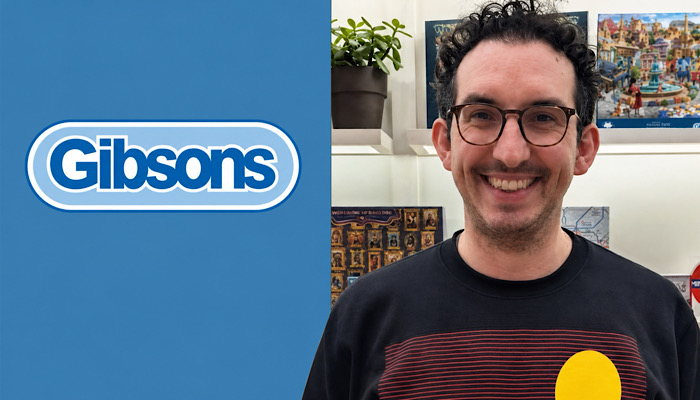
You have a new game out, Jim – Categories. What’s it all about?
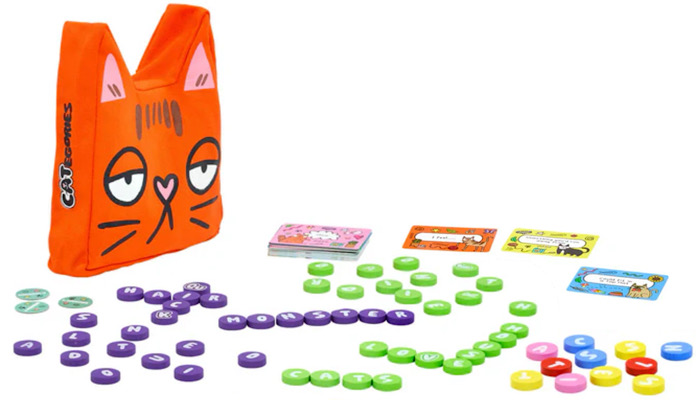
Categories is a cheerfully silly, chilled-out word game for families and the classic ‘kids of all ages.’ It came from a love of word games like Scrabble and so on… Whenever I actually played a game like that, though, I found myself sort of ignoring the structure of the game, you know? I wasn’t too bothered about the Triple Word Score…
What were you bothered about? What was the aim of the game for you?
For me, the fun is in the words themselves and making your mates laugh with the words you managed to make from whichever letters you’ve got. That’s the big-kid fun for me – so I started thinking about a game like that. But Categories is driven by a deck of gloriously silly category cards… Things like ‘Stuff at the Back of the Fridge’ or ‘Things at the Bottom of Grandma’s Handbag’ or ‘Silliest Body Part’…
In my grandma’s case, those three things weren’t mutually exclusive…
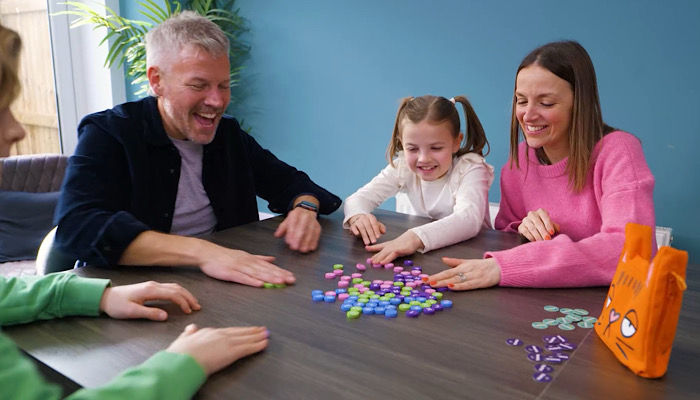
Ha! So the way it works is that everyone plays at the same time. It isn’t a race. You all start off with the same letters and categories, and you have about five minutes to make words – either in a Scrabble-like grid or just as individual words. You get points for using difficult letters or having a long word, but most of the points come from convincing your friends that the words you’ve used are perfect examples of the categories at the centre of the table.
I see! So part of the fun is me trying to convince you that my word is a legitimate fit for the category?
Exactly right; the joy is in the way people try and finagle their word into the category while everyone else looks at them really skeptically! It’s like, “Are you sure?” And I don’t know if you know this, Deej, but Categories started out as a game called Widgets, which got a lot of interest when I pitched it to a bunch of people at the Mojo Nation pitch event. This is a while ago, because I couldn’t quite get it over the line…
I did not know that! What changed between the Widget iteration and the version that got over the line?
I had a ‘come to cat-shaped Jesus’ moment…
A tale as old as time…
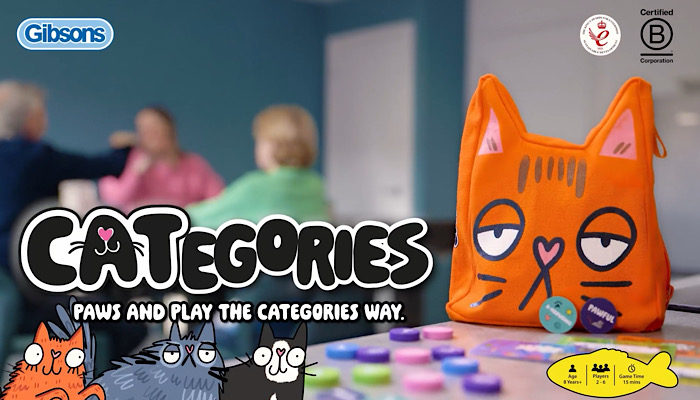
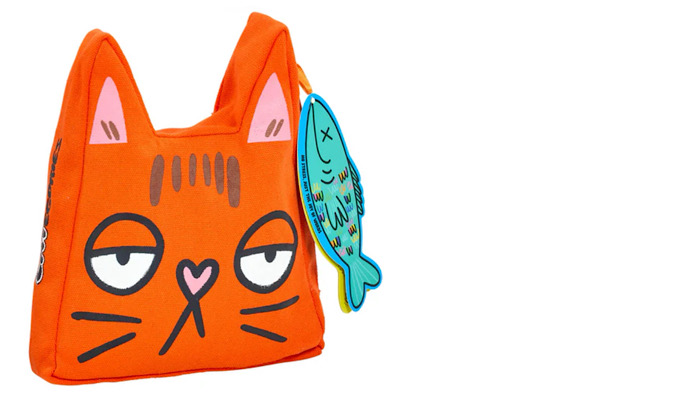
…I just leaned into the Categories pun and put everything in a cat-shaped bag! Ha! I made the very first prototype during lockdown. After pitching it and play testing it, and thinking about the theme, I changed the name to Catagrams. I taught myself to sew so I could stitch the ears on a cat pouch! But you know, as soon as I gave it that theme, I got a publisher within months. Gibsons then had the brainwave I’ve just calling the game Categories which, embarrassingly enough, hadn’t even occurred to me.
Ha! And even though this is your first game to get over the line, you’ve designed games before, have you not?
Yes. Essentially, I’ve been working on designing games as a hobby since about 2013. With my first game, I did the classic first-time designer thing of working exclusively on a single game for years on end as a passion project that was perfect for me and my friends. But rather than just leave it at that, I wanted to get it published – so I went to Essen to try my luck – and my first pitch was to Vlaada Chvátil; the inventor of Codenames.
I imagine that made you a little nervous?!
Right?! I’d never pitched a product of my own before, and that first pitch was to my favourite boardgame designer. I was amazed and delighted to have the opportunity. But you know how it is: I arrived at this temporary room… My pitch was scheduled for the last slot of the day – 5pm. I got there a little early, but Vlaada was running late. That being the case, his team invited me to play Vlaada’s new game – Codenames!
Oh, amazing!
That was lovely actually! I sat there playing Codenames with some strangers! Then, about an hour and a quarter later, I was invited into the room. Vlaada and his translator looked exhausted… I don’t think they’d left all day; the room was stale – no daylight; no windows… You can probably imagine how they felt when I started setting up and explaining this giant game about gambling and sabotage in a sort of mock Roman Empire. Ugh! I mean… Looking back, the game looked beautiful, but it wasn’t – obviously – the best game!
Anyway, about ten minutes into my one-hour session, Vlaada – who up to this point had spoken entirely through a translator – said, “I am sorry, but we will not be publishing your game.” And – well, you know how it is with first-time designers, Deej: I’d been building up to that pitch for years… I had no idea that rejection was coming. I didn’t take it personally – but it was still an emotional blow. I mean: I hadn’t even finished setting it up and it was all over with another 50 minutes on the clock! Ha!
Ouch! Did Vlaada give a reason? Or any useful feedback?
Yes – he kindly explained that they didn’t publish games with lots of randomness in them – which my game had: too many random elements… Another mistake I made on that trip was that I hadn’t scheduled any other pitches! So the next day, I just hustled around Essen and tried to get meetings. I ended up pitching to Queen Games, Z-Man Games and loads of others. And I really remember my pitch to Zev Shlasinger! He basically sat me down and said what the problem with the game was.
And what was it? Randomness aside?
Well, all have to do was point out that it had a really family-friendly theme, but a worker-placement mechanic that took three hours to play. Sounds obvious now, but it was Zev who laid that out to me – gently, but professionally. He suggested that I either needed to change the theme or change the rule set. And that advice came in really useful when it came to Categories. The difference between Widgets and Categories being ostensibly that the theme is more family friendly.
And you say you’ve been doing this since 2013? Have you looked at your back catalogue for ideas you could now publish?
Well… I’ve not been able to do any game design at all for about two years. Until a couple of years ago, I had a really intensive job which I then quit to go back to uni. Then I got the same job back again! In the last year of that job, I really clocked out of design. But game design is what I want to be doing! So I’ve made and pitched loads of prototypes. You can see some of them in this folder if I share screen…
Oh! And these are like one-sheets, right?
Exactly. Anything that’s ready to pitch, I have a single sheet for. Anything that’s at the concept stage, but not yet ready to pitch, I just track it in a document as a half slide. Anyway, much as I’d love to quit everything and become a full-time game designer, I’m continuing in my job for now. I have restructured things to act as a freelance consultant right now, though, rather than a full-time job.
And what is that job, Jim? You’ve been a little circumspect about it; I know you travel a lot; I know you’re quite enigmatic… You’re in Mexico now, you said you lived in Prague; I know you were in Pakistan at one point… So I can only guess you’re a spy.
Ha! Wouldn’t that be wonderful? No, I’m a revenue consultant; I just help companies make more money.
But that’s exactly what a spy would say, isn’t it? So what is it about being a game designer, Jim, that’s so alluring?
It’s just joy, isn’t it? Think about it like this… As a game designer in London, you could spend every Friday playtesting new games at the National Theatre with all the other designers! They’re all wonderful people; it’s a lovely little community. I love how there’s nothing serious or pretentious about game design at all; it’s just joy. Beyond that, I think being able to go from, ‘Right, we’ve made something really silly and fun. How do we turn it into a product?’ is actually quite a challenging and interesting process… For example, I’m really happy about how Gibsons took a fun little game and turned it into a real product.
You don’t have any aspiration to do that part of it yourself, though? You wouldn’t go down the self-publishing route?
No… At the very beginning of this process, I decided I didn’t want to do any Kickstarter-funded games or anything like that until I had a game taken on by a publisher. I think it’s useful to have that stamp of someone else saying, ‘This game is good enough to go to market.’ I wanted to make a game that people who know what they’re talking about like and want to publish.
I also knew I didn’t want to do the commercial side of it back then. I just wanted to design a game and get it to people who do the rest because I didn’t ever want game design to feel like a job. It’s my passion. So I’m very happy with taking a royalty, not having to risk my own capital, not having to run the social media and all that stuff. At my time to keep coming up with silly ideas for games, playtesting them and getting them to a stage where they can be taken forward. I’m really happy with that division.
Amazing. Now, there’s no reason you would know this, Jim, but I tend to sign off my interviews by asking people, “What’s the most interesting object in your office or on your desk?”
Oh, gosh!
I knew that would trouble you! Being on His Majesty’s Secret Service probably stops you talking about stuff in your office, does it? That being the case, let’s talk about the article you mentioned before we were on the record…
Oh! Well… As I think I said to you, it’s probably the nicest thing someone’s ever done for me. I never show it to anyone really, but it’s the most touchingly lovely thing… I just… I can’t. I can’t. It’s, it’s… It’s the thing that I would ask to be read at my funeral.
Oh, gosh and golly! It sounds amazing!
It’s a very generous profile that a boardgame journalist wrote about how I approached Essen two years ago. The journalist is a good friend of mine, Andrew Lynch. He lives in New York. Andrew’s a translator of boardgame rules and part of the team that runs what is, in my view, the best boardgame cafe in New York – the Brooklyn Strategist. For reasons that weren’t entirely clear to me, Andrew decided to write a piece on me going around Essen.
This is on the trip you were telling me about? When you met Vlaada?
No, about ten years later, actually! So there I was… I’d been super busy with work. I hadn’t been doing any games. I hadn’t booked any appointments – I just had my prototype and rocked up to Essen… And I knew I was doing exactly the wrong thing: blagging my way round. I didn’t even have a ticket to the thing – in the end, I think Ellie Dix found a spare ticket for me. So I was just walking around looking gormless with my prototype, but Andrew wrote a whole load of lovely things about me and my approach to Essen. It was like a study in cheerful failure. I don’t ever look at it because it’s so complimentary that I can’t really cope with it.
Oh, what a lovely thing to do. Fantastic! Well, thank you, Jim. This has been great! I hope categories does well for you; come back and let us know how you’re getting on. In the meanwhile, I’ll link to the article you mentioned here.
–
To stay in the loop with the latest news, interviews and features from the world of toy and game design, sign up to our weekly newsletter here
More Recent Interview

Serial inventor Richard Levy on the Spirit of America, seeing the world and why curiosity never retires
Richard Levy talks blank pages, big journeys and a why every ‘no’ is a rehearsal before the big event.

“I don’t need the game – I need what it creates…” Tela’s Gabi Drew on how great products connect with people
Tela’s Creative Director, Gabi Drew, on creating stronger Human, Emotional and Value-Based connections.

Anomia inventor Andrew Innes tells the story of his game’s long journey to market
“It was a Frankenstein’s monster…” Andrew Innes on the past, present and future of Anomia!
Designers Adrien Pédron and Thomas Favrelière on the origins of Archeo – and why Gigamic proved the perfect publisher
“We’d wanted to work with Gigamic for a long time…”: In conversation with designers Thomas Favrelière and Adrien Pédron.

BOTI’s Nico Blauw talks Pembe the Pink Cat, innovation – and the International Toy Board
“The look, the design, the audience, the messaging… It all appealed”: Nico Blauw reveals what made Pembe the Pink Cat a winner for BOTI.
“This was the missing piece…”: Rubber Road’s Jack Fox on TUBBZ’s move into blind collectibles with Mystery Eggs
Jack Fox, Sales & Marketing Director at Rubber Road, talks TUBBZ Mystery Eggs – and why Minions were a perfect fit.

Popular Articles
Spin Master details latest wave of Ms. Rachel toys
Serial inventor Richard Levy on the Spirit of America, seeing the world and why curiosity never retires
Hasbro details Avengers: Doomsday line-up, spanning action figures, Clobberin' Fists, Doomglow Blaster and more
Toniebox Lite brings fans the tonies experience in a smaller, lighter form

Renegade Game Studios welcomes Tom Lischke as Director of Product Development

Upcoming Events
-
- 30th January 2026
- Spielwarenmesse, Nuremberg
International Game Inventors Convention
-

- 19th - 21st May 2026
- Mandalay Bay Convention Center, Las Vegas
Las Vegas Licensing Expo
-

- 23rd - 25th June 2026
- Stamford Bridge Stadium, Chelsea, London
Play Creators Festival
-

- Tuesday, June 23rd, 2026
- Stamford Bridge Stadium, Chelsea, London
Play Creators Awards
-
- Wednesday, June 24th, 2026
- Stamford Bridge Stadium, Chelsea, London
Play Creators Conference
-

- Thursday, June 25th, 2026
- Stamford Bridge Stadium, Chelsea, London
Mojo Pitch
-

- 6th - 8th October 2026
- Excel London
Brand Licensing Europe