“I don’t need the game – I need what it creates…” Tela’s Gabi Drew on how great products connect with people
I don’t know if you realise it, Gabi, but you’re one of the very few people that Mojo routinely invites to speak at the Play Creators Festival…
Wow. I take that as a huge compliment. Sometimes it’s a good reminder, though, because the creative processes at Tela – the way we think, our mission, our vision for the company – are so intrinsic to what we do that they feel obvious. I’ll be completely honest with you: sometimes it feels like I’m talking about the ABC!
Well, that’s the beauty of cross-pollinating industries, isn’t it? It might feel obvious to you because of your background in licensing, but it clearly isn’t in toys and games! You only had to look around the room to see how engaged everyone was…
Yes! And I had some really lovely feedback afterwards. People from the audience came up to ask if I could share the slides, the worksheets and all the material that was on screen. So the approach clearly sparked some interest.
Oh, no question! And I’m very excited to talk today because you have some fascinating tools. And you spoken to Billy before, so are linked to a couple of interviews on our sister site here and here. For the uninitiated, though, what is it that you do?
I’m the founding Creative Director of Tela, a global creative agency based in Milan. We predominantly work with licensors; our main clients are major brands and entertainment properties. We’re particularly strong in the lifestyle space, working with brands like Chupa Chups and Jeep to develop a more lifestyle-led positioning across consumer products.
That includes the traditional creative services – everything from pitch decks and product mock-ups to style guides and art packs. But over the years, we’ve also carved out a more strategic role. We help brands understand their stories, define their values and communicate those consistently across every touchpoint. It’s something that’s constantly evolving.
Wonderful! And your talk at this year’s Mojo Nation Play Creators Festival was right up my alley. What was the central idea?
The aim was to shift how people think about creativity, decision-making and development. At Mojo, that was an interesting challenge because the audience included lots of different people. An inventor might be thinking about how to apply these ideas creatively, whereas someone working for a toy company might be asking how they decide whether or not a product deserves to move forward. Does it fit the business? Does it align with the brand? That same thinking can also influence how you communicate or promote ideas once they exist.
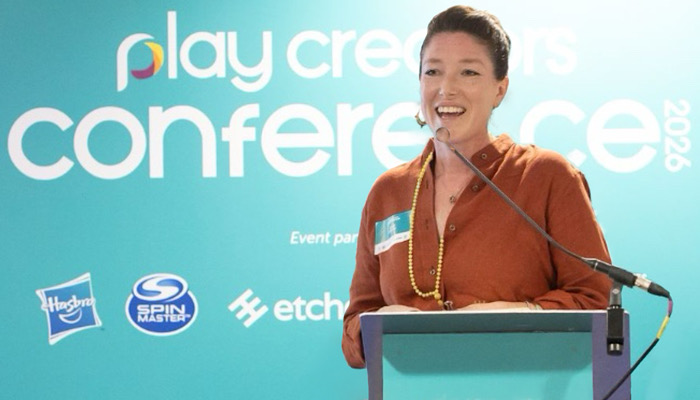
And yet so many inventors, designers and publishers never actually talk about the values behind their ideas. Is this game really about competition? Or is it about spending quality time with your family? Is it really about switching off for half an hour? That was really the focus of my Mojo talk: decision-making, creative development and the communication of ideas through three different kinds of connection: Human Connection, Value-Based Connection and Emotional Connection.
And are those connections distinctly different? Human, Value-Based and Emotional?
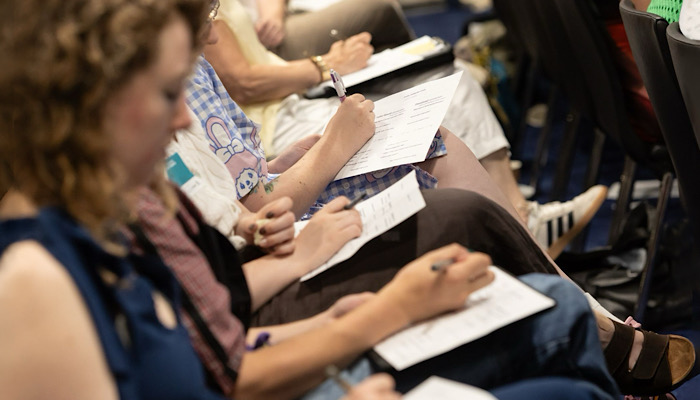
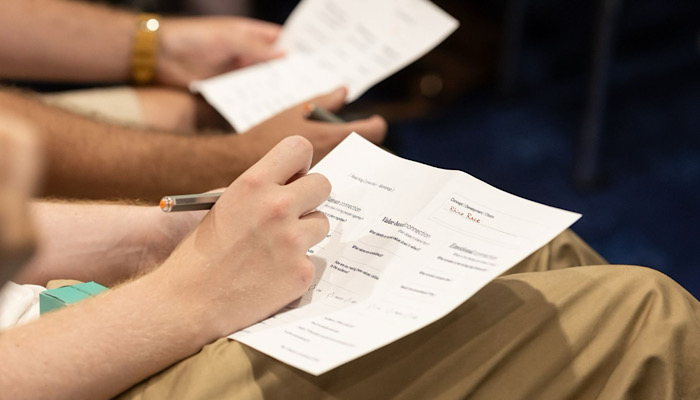
Yes. They overlap, but they are different. Emotional Connection is about how something makes you feel. Human Connection is about relationships, shared experiences and the way our memories work… Then there’s Value-Based Connection – how closely a product aligns with what matters to you. But the point of the session wasn’t simply to explain why those things matter. I wanted people to experience them which is why it became more of a workshop. People had to stop and think about those ideas in relation to something they were actually working on, or decisions they need to be making.
Yes! You handed out worksheets and asked us to think about one of our current projects. I loved that, by the way.
Thank you! Theory definitely has its place, but there’s far more value in applying it. That’s especially true today, when we have access to almost unlimited information and AI tools can generate endless answers for us. It’s one thing to convey information; it’s another to sit down and ask yourself, “What am I actually bringing to this idea?”
That’s especially important in creative development because, once I understand my intent, I can identify the ingredients I need to achieve it. The era of people just chasing numbers is coming to an end…. People spend so much time trying to predict the next big hit or work out what’s going to sell the most. But how can you start with the numbers? Surely the numbers should be the consequence of creating a genuinely great idea – one that makes meaningful connections.
So instead of saying, ‘Robot toys are lucrative – let’s make robot toys,’ you’re suggesting we start by asking what connections a robot toy might create?
Exactly. That’s where I think we’re being genuinely disruptive. Too often, people begin by deciding what shape a product should be or what colour it ought to be. But if I understand the values behind an idea, and the emotional connection I want it to create, then many of those decisions become obvious.
If I want a toy to communicate joy and delight, for example, it should probably be yellow. If I want it to feel calming and comforting, maybe it needs to be light blue – and that’s just touching on the chromatic experience of design! Those creative decisions become a consequence of understanding the connections you’re trying to build.
Of course, there are practical considerations too – manufacturing, costing, production – all of that important stuff. But even those decisions become clearer… If I want something that feels premium and reflects quality, I’ll make different choices than if I’m designing something inexpensive and highly accessible. Ultimately, it’s about understanding how the product’s going to be perceived used, remembered and chosen by the person who buys it.
It’s fascinating because I guess many inventors naturally think in terms of features: this mechanism does this or that… Meanwhile, marketing teams tend to think in terms of benefits: this solves that problem. But values and human connection rarely get the same level of attention…
Exactly. That’s why we encourage people to think about Emotional, Human and Value-Based Connections. Those are universal because, ultimately, we’re creating products for people, but it’s especially true in toys and games where we’re entering people’s homes; we’re becoming part of the time they dedicate to family, friendship and simply being human. We’re not designing functional tech to make someone marginally more efficient at work, you know?! We’re creating products that occupy people’s most personal moments. I think that should always be our starting point.
But not in isolation! You’re completely practical about that…
Oh, of course! If you can’t actually make the product or get it into people’s hands, none of this matters! But those human connections should be the thread that runs through the entire development, commercial and communication process. Traditionally, though, creativity is seen as something with no right or wrong answer. What we’re trying to do is introduce meaningful Key Performance Indicators around it…
Now, within licensing, success is usually measured by the number of partners, the number of products or the amount of revenue you generate. We’re working with clients to put in place different indicators: how closely does this product align with your brand values? Is it reaching the right audience? Because success isn’t just about how many people you reach, but who you reach and how your brand is connecting with them.
Can you give me an example of that, Gabi?
Let’s take Jeep… When you’re licensing a brand like that, you’re obviously not designing the vehicle itself! You’re designing something completely different, a T-shirt perhaps. Clearly the mechanism to do that already exists, so you simply have to decide what kind of T-shirt it should be. You could make a completely generic shirt with a Jeep logo on it for example. Or you could create something that genuinely reflects the values that define the brand: exploration, adventure and the outdoors.
Actually, Jeep’s a good example of this. During a trip to China, I mentioned that we worked with Jeep. Someone actually said, “Oh, the fashion brand?” I said, “No – the car brand.” But they genuinely thought of Jeep primarily as an apparel company because there are so many Jeep monobrand fashion stores out there. So what they’re buying into isn’t the vehicle – it’s the spirit of exploration. Those brand values have become bigger than the product itself. They’re buying into adventure – not just a car.
Gosh, that’s extraordinary! The idea that someone could almost forget what the company actually makes because the brand identity has become so strong. Going back to your presentation, I loved the worksheets you handed out… And not just because they doubled up as fans in that sweltering room!
Ha! I did wonder afterwards whether branded fans would have been the more human-centric solution!
But the reason I loved the worksheet is that people started filling it in there and then…
I know! That surprised me because I realise that, as a strategic approach, this isn’t for everyone. There are always people in the room who think they already know what they’re doing and don’t necessarily feel they need something like that. But that’s where the change begins. Even if someone only answers one question on that sheet, they’re already shifting their viewpoint and applying it to something they’re working on. This is the true essence and strength of creative thinking.
It does seems to me, though, that a lot of inventors are driven by a very particular kind of faith. They can start with something intangible and simply believe there’s a great idea in there! But I wonder whether that makes some of them reluctant to use a worksheet like yours… Because I can well imagine being halfway through filling it in and suddenly realising that my brilliant idea isn’t quite as brilliant as I thought…
Ha!
…at which point, it might be easier for my ego to reject the worksheet than abandon my idea.
That’s why I think it’s important to see it as another layer rather than a judgement. We use the same approach when we run Brand Wisdom workshops. We ask exactly these kinds of questions. It’s another way of looking at something you’ve already created. Perhaps you’ve invented an amazing dinosaur toy, for example, with some fantastic mechanism. This process simply asks different questions. How do you want people to feel? How do you want them to interact with it? What values does it communicate?
Great inventors often understand those things instinctively – they just haven’t necessarily stopped to articulate them.

So really, it’s about making the implicit explicit?
Exactly. If an idea genuinely comes from you, then those connections are already in there somewhere. This process simply helps define them and gives you clear checkpoints as you move forward. It also changes how you pitch the idea… Instead of talking only about the mechanism, the size or the features, you can talk about how you want the person sitting opposite you to feel…
That way you’re creating an emotional experience before they’ve even seen someone play with the product. And if you work through the process and realise the idea doesn’t really connect emotionally, humanly or through values, then perhaps that’s the point at which you go back and strengthen it.
I have used this, by the way, since you did the talk! I got a good deal out of it; I think it’s really helpful.
Thanks, Deej. One thing I also realised after last year’s talk – which was about creating with value – things mean more to people when they can walk away with a practical understanding. At Tela, we advocate that creativity is an action – not just an outcome.
Oh, I like that; that’s a great way of putting it.
I also want to call out that value doesn’t have to mean kindness or mindfulness. Your product might be about releasing frustration, for example. Think about rage rooms – somebody understood exactly what emotional need those fulfil! That’s a perfectly valid value. The emotion doesn’t have to be positive; it’s more that you’ve consciously defined what you’re trying to make people feel.
Amazing! I love that. You really got me thinking with that because one of the great challenges in toys and games has always been a horror game. Films can control the lighting, the music and the atmosphere, but a board game has to create those same emotions around a kitchen table. It strikes me that your framework could almost act as a stress test for an idea like that.
Interesting… And that’s why I think it helps to break it down into so much detail. If we were talking about a horror game, I might ask you what kind of human connection you’re trying to create… Are the players working together against the evil? Or are they turning on each other? Horror films use both approaches, so which experience are you trying to recreate? Then there’s the emotional connection. Are you trying to make people jump? Build suspense? Create tension? Those are very different emotions.
Our whole team has trained extensively in emotional intelligence, so we’ve spent a lot of time understanding emotions, how they work and how people experience them. We’re interested in understanding why people feel certain connections, giving emotions, correct definitions, and understanding how to evoke them through creative work. And on that, we recently developed numerous SKUs across horror-related development for apparel retailers – Chucky, for example.
Oh! No way? Is that right?
Yes – but, as with Jeep, people aren’t buying a Chucky T-shirt because they want to feel frightened. They’re buying it because it reminds them of something. The emotional connection isn’t horror anymore – it’s nostalgia. It reminds them of a period in their life, of films they watched, of people they watched them with. So the emotional connection, the human connection and even the values behind the product become completely different.
That’s fascinating. And I suppose it also proves your point that we shouldn’t try to make products for everybody. I’m completely the wrong audience for horror, whereas Billy absolutely loves it.
Exactly. We have to stop assuming every product has to appeal to everyone. The important thing is understanding exactly who it’s for and then creating the strongest possible connection with that audience. In licensing, the franchises that work are the ones that have that within them. And sometimes it’s intentional, sometimes it isn’t…
If you think about it, a lot of classic films touch on human needs. Then, when people are remembering things, they go back and buy products that they associate with that branding. Unfortunately, with viral ideas and sales, things move so fast that people think of success in the short term, but it’s actually in the long term. And it’s going to become more and more like that because it’s going to be what remains that has the greatest impact. Our brand equity should have embedded purpose.
Fascinating. With your permission, I’ll be sure to include the worksheet you had on the day here. In the meantime, what’s next for Tela, Gabi?
Hmmm. That’s a difficult question because we’re constantly changing… More and more, we’re moving towards value-based creative development and helping our clients embrace that way of thinking. Sometimes we have to push a little because there can be a little natural resistance when you’re asking people to rethink established processes. We’re equally selective about the partnerships we build. Our value lies in helping brands shape ideas, challenge thinking and create meaningful solutions… So we’re most effective with clients looking for a strategic creative partner, rather than a standard service provider.
There are commercial success stories that come from this way of thinking, but there’s also a much bigger picture. We can’t just keep filling the world with products for the sake of it. We should be creating things that people genuinely want in their lives. That applies environmentally, commercially and – perhaps most importantly – from a human perspective. Products shouldn’t exist simply because they can. They should earn their place by creating genuine value.
That’s especially interesting in toys and games because, strictly speaking, they’re not basic human necessities…

Is there a way that a toy or a game could be a necessity? Or very close to a necessity?
If it became a way for me to communicate with my child, for example, or a chance for a family to spend meaningful time together, or simply an opportunity to relax after work, then suddenly it is meeting a very real human need. I always use quoits as an example. Do you know quoits?
I do! I don’t think I’ve heard the word for about 40 years, mind! What happened to quoits?! When did people decide they don’t need quoits?!
Ha! Well, this is to my point! Do I need a wooden peg and a few cord quoits in my life? No. Do I need another thing cluttering up the cupboard? Probably not. But do I need those afternoons spent outside with my family? The friendly rivalry? The memories? The fact is, I grew up playing quoits with my sister. We always played in teams of two, and I was always on my dad’s team – we were determined to win! Those moments became part of how we connected as a family. So what I actually needed was not the game itself, it was what the game created – and that remains.
That’s beautiful! This is fascinating. I think this is so useful because what you’re offering isn’t a replacement for existing techniques. It’s another layer.
Exactly. It doesn’t compete with the creative process – it complements it; it holds it up. This is why part of what’s next for us includes more workshops… More speaking… More opportunities to share this approach.
As you know, I’ve spoken at Play Creators Festival and at BLE, and I’d love to keep doing more of that because I don’t think this process should only be available to the companies that hire Tela. In fact, the more people who think this way, the better it is for the industry. Better products, better ideas and, ultimately, better experiences for the people we’re creating them for.
Brilliant. Well, I’ll certainly be running plenty of ideas through that worksheet. And if people want to reach out directly about the sheets, what’s the best email address to reach you?
They could reach me directly at [email protected].
Perfect. Thanks Gabi – always a pleasure to chat.
–
To stay in the loop with the latest news, interviews and features from the world of toy and game design, sign up to our weekly newsletter here
More Recent Interview


Anomia inventor Andrew Innes tells the story of his game’s long journey to market
“It was a Frankenstein’s monster…” Andrew Innes on the past, present and future of Anomia!
Designers Adrien Pédron and Thomas Favrelière on the origins of Archeo – and why Gigamic proved the perfect publisher
“We’d wanted to work with Gigamic for a long time…”: In conversation with designers Thomas Favrelière and Adrien Pédron.

BOTI’s Nico Blauw talks Pembe the Pink Cat, innovation – and the International Toy Board
“The look, the design, the audience, the messaging… It all appealed”: Nico Blauw reveals what made Pembe the Pink Cat a winner for BOTI.
“This was the missing piece…”: Rubber Road’s Jack Fox on TUBBZ’s move into blind collectibles with Mystery Eggs
Jack Fox, Sales & Marketing Director at Rubber Road, talks TUBBZ Mystery Eggs – and why Minions were a perfect fit.

Educational Insights’ Lisa Guili on TikTok, 20 years of Kanoodle – and ten million units sold
Lisa Guili reveals how one addictive brain teaser found its audience and became a phenomenon.
“I want people to bet on themselves”: Spin Master Co-Founder Ronnen Harary discusses his new book, No Experience Necessary
Spin Master Co-Founder Ronnen Harary talks to us about his exciting new book, working with inventors – and Spin’s most underrated launch.

Popular Articles
DSTLRY launches card game based on its award-winning Somna comic
Educational Insights’ Lisa Guili on TikTok, 20 years of Kanoodle – and ten million units sold
A Game Studio launches Proof-of-Play model to help 'exceptional games reach the market faster'

Hasbro's Angus Walker on creativity, pitching and the key to successful inventor relations

How does the Mojo 100 work? Billy Langsworthy on the nomination process – and why bribes won’t help!
Upcoming Events
-
- 30th January 2026
- Spielwarenmesse, Nuremberg
International Game Inventors Convention
-

- 19th - 21st May 2026
- Mandalay Bay Convention Center, Las Vegas
Las Vegas Licensing Expo
-
- 23rd - 25th June 2026
- Stamford Bridge Stadium, Chelsea, London
Play Creators Festival
-

- Tuesday, June 23rd, 2026
- Stamford Bridge Stadium, Chelsea, London
Play Creators Awards
-
- Wednesday, June 24th, 2026
- Stamford Bridge Stadium, Chelsea, London
Play Creators Conference
-
- Thursday, June 25th, 2026
- Stamford Bridge Stadium, Chelsea, London
Mojo Pitch
-

- 6th - 8th October 2026
- Excel London
Brand Licensing Europe