Yechin Zhao – Key Lead Product Designer for Vehicles at Mattel – on bringing slime to Hot Wheels with Mutant Chaos
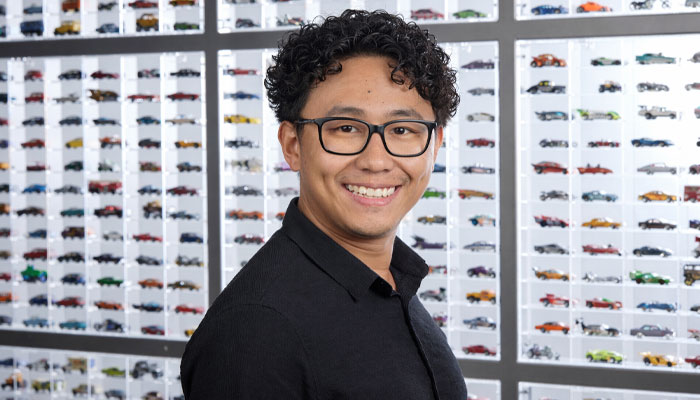
Yechin – it’s great to connect. For anyone that hasn’t seen this line in action yet, how would you pitch Hot Wheels Mutant Chaos?
Mutant Chaos is what happens when monster truck mayhem collides with slime-fuelled mutation. We took the smash-and-crash action that defines Hot Wheels Monster Trucks and injected it with unpredictable slime play that completely changes the experience.
Trucks get splattered, slimed and ‘mutated’ as the action unfolds, so every run feels chaotic and surprising. It’s the kind of play where kids immediately lean in and go: “Wait… What just happened?”
Ha! And how did this range come about?
The idea started with a pretty simple design question: how do we push monster truck play into something even wilder? Smashing and crashing is core to Hot Wheels Monster Trucks, but our team is always pushing for innovation and looking for ways to create new kinds of play experiences.
Slime kept coming up because kids love that tactile element. Once we started exploring that direction, we worked closely with our chem lab to develop the precise slime formula that could deliver the monster truck play experience we were imagining. It had to be tactilely and visually satisfying – but also behave consistently with the vehicles and the playset mechanisms.
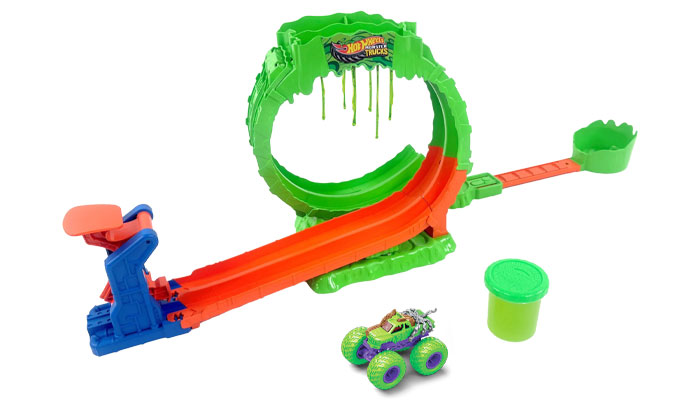
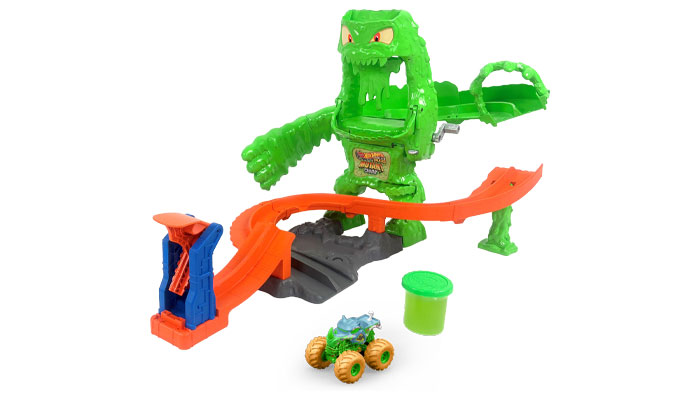
Once we started imagining monster trucks interacting with slime and triggering chaotic reactions, the concept really started to grow. That’s when the Mutant Chaos world began to take shape. From there, we explored different over-the-top challenges – like defeating a chomping slime monster or blasting through a slime-filled loop. Those big moments helped define the line and turn it into a really unique monster truck experience.
Were there any interesting design dilemmas thrown up by adding slime to Hot Wheels play?
Slime is incredibly fun from a play perspective, but from a design standpoint it introduces a lot of variables. It moves unpredictably, it can get into mechanisms, and it interacts with materials in ways you don’t always expect. So, one of the big challenges was making sure the slime enhanced the monster truck action rather than interfering with it.
We worked closely with our chem lab to dial in the exact slime formula that would create the play moments we were aiming for. Viscosity became really important. For example, when the slime is triggered by the chomping monster, we needed it to move and stretch at just the right speed so kids have enough time to launch their truck and jump through the slime before resetting the stunt.
Along the way we also discovered some fun physical properties of the slime. It doesn’t just splat – it can stretch and hang in interesting ways, which opened up some really satisfying visual moments when the truck blasts through it. In the end, it was all about balancing chaos and control. We wanted the slime to feel messy and unpredictable, but still behave in a way that reliably delivers those big monster truck stunt moments.
What are some key considerations when bringing something new to Hot Wheels? What helps a new idea get across the line?
One of the biggest considerations is making sure the idea still feels unmistakably Hot Wheels. The brand has a really strong DNA around speed, spectacle and big action moments – so even when we introduce something new it has to deliver that sense of excitement and over-the-top fun.
With Hot Wheels Monster Trucks specifically, we’re always thinking about how to amplify the smash-and-crash play pattern. The trucks are bigger, louder and more exaggerated, so the experiences around them need to feel just as extreme. Whether that’s crushing obstacles, triggering huge reactions or blasting through something unexpected like slime, the goal is always to create those big ‘wow’ moments that make kids want to run the play again and again.
At the same time, the play pattern has to be instantly clear. A good test is whether you can explain the toy in one sentence and a kid immediately understands what they want to do with it. When the action is obvious and the payoff is big, that’s when an idea really starts to resonate.
Last question! What makes Hot Wheels a great sandbox for toy designers to play in?
One of the things that makes Hot Wheels such a great sandbox for designers is the brand’s ‘Challenge Accepted’ spirit. For kids, the toys are all about taking on outrageous challenges – clearing the loop, crushing the obstacle, beating the monster… That same mindset carries into how we design. As a team, we’re constantly challenging ourselves to push ideas further and find new ways to surprise kids with play they haven’t seen before.
At its core, Hot Wheels is about vehicles, but the world around those vehicles can go almost anywhere. You can mash up wild ideas – monsters, slime, giant creatures, impossible stunts – and as long as the vehicles and the action are at the centre, it still feels unmistakably Hot Wheels. That foundation gives designers a lot of freedom to experiment. Kids instantly understand vehicles and motion, so that lets us build all kinds of imaginative challenges around them and keep pushing the play experience in new directions.
Great answer. Thanks again Yechin – I look forward to seeing the range in action when it launches this Fall.
–
To stay in the loop with the latest news, interviews and features from the world of toy and game design, sign up to our weekly newsletter here
More Recent Interview

Designers Adrien Pédron and Thomas Favrelière on the origins of Archeo – and why Gigamic proved the perfect publisher
“We’d wanted to work with Gigamic for a long time…”: In conversation with designers Thomas Favrelière and Adrien Pédron.

BOTI’s Nico Blauw talks Pembe the Pink Cat, innovation – and the International Toy Board
“The look, the design, the audience, the messaging… It all appealed”: Nico Blauw reveals what made Pembe the Pink Cat a winner for BOTI.
“This was the missing piece…”: Rubber Road’s Jack Fox on TUBBZ’s move into blind collectibles with Mystery Eggs
Jack Fox, Sales & Marketing Director at Rubber Road, talks TUBBZ Mystery Eggs – and why Minions were a perfect fit.

Educational Insights’ Lisa Guili on TikTok, 20 years of Kanoodle – and ten million units sold
Lisa Guili reveals how one addictive brain teaser found its audience and became a phenomenon.

“I want people to bet on themselves”: Spin Master Co-Founder Ronnen Harary discusses his new book, No Experience Necessary
Spin Master Co-Founder Ronnen Harary talks to us about his exciting new book, working with inventors – and Spin’s most underrated launch.

David Norman of Stormin’ Studios on inventors, Orchard Toys – and shaking things up!
“It’s not just a name, it’s our mission statement”: In conversation with Stormin’ Studios’ David Norman.
Popular Articles
DSTLRY launches card game based on its award-winning Somna comic
BOTI’s Nico Blauw talks Pembe the Pink Cat, innovation – and the International Toy Board

Hasbro's Angus Walker on creativity, pitching and the key to successful inventor relations
“It’s a game and soundtrack in one!”: Inventor Marcus Carleson and Jumbo’s Ferran Codina on the story behind Hitster
Pablo Clark discusses the six-year development journey behind the game design – and art – of The Old King's Crown
Upcoming Events
-

- 30th January 2026
- Spielwarenmesse, Nuremberg
International Game Inventors Convention
-

- 19th - 21st May 2026
- Mandalay Bay Convention Center, Las Vegas
Las Vegas Licensing Expo
-

- 23rd - 25th June 2026
- Stamford Bridge Stadium, Chelsea, London
Play Creators Festival
-

- Tuesday, June 23rd, 2026
- Stamford Bridge Stadium, Chelsea, London
Play Creators Awards
-
- Wednesday, June 24th, 2026
- Stamford Bridge Stadium, Chelsea, London
Play Creators Conference
-

- Thursday, June 25th, 2026
- Stamford Bridge Stadium, Chelsea, London
Mojo Pitch
-

- 6th - 8th October 2026
- Excel London
Brand Licensing Europe