Meet Pamela and Jonny Klamer – the children of Game of Life inventor Reuben Klamer

Thank you so much for joining me! Jonny, your other name… Blu? A middle name?
Jonny: Ha! No, my full name is Jonathan Scott Klamer but, for many years, I was a performer under the name Jonny Blu. So Jonny Blu was my stage name when I started a career as a pop singer in China.
A pop singer in China. Of course you were! Alright. We may need more than 45 minutes here…
Pam: Ha! When you’re talking to the Klamer family, Deej, you’ve no idea what you’re getting into… This is only the beginning! Ha!
Ha! Well, it’s a cracking start, Pam! And I ask at my peril: what’s your background?
Pam: Totally different track! I’m a behind the scenes person; I’m a set designer for TV and film. Before I had my kids, I worked on a lot of big features The Matrix 2: Reloaded, The Matrix 3: Revolutions, Jurassic Park 2: The Lost World, Independence Day, Jumanji…. Now I do TV and features because my kids are out of the house; I’ve got a little more time and space. So that’s been my career.
Absolutely amazing! If your dad wasn’t such a fascinating man, we could just wrap it up there! So – on that: who was your dad?
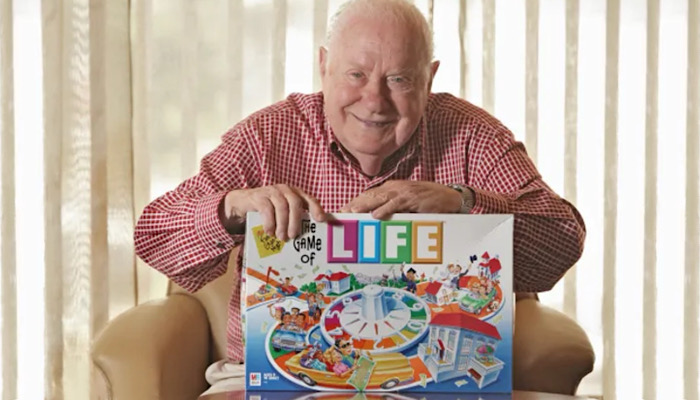
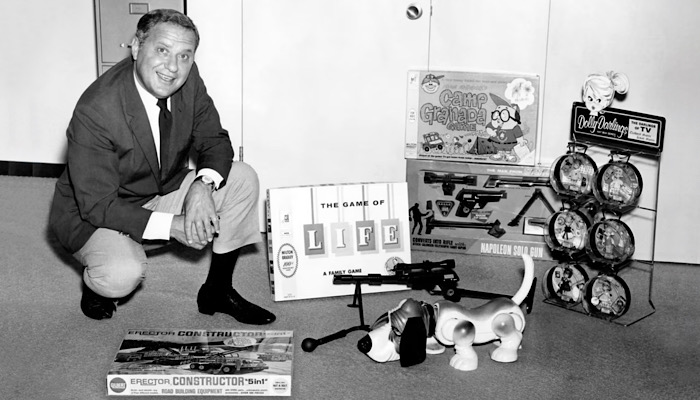
Jonny: Our dad was Reuben Klamer – best known as the inventor of The Game of Life. But the interesting thing is that Pam and I have been going through our dad’s archives over the last couple years… He got over 200 products, toys and games to market! So in going back and seeing all that, we’ve realised his archive isn’t just the history of our dad – it’s the history of the toy business…

Oh, wow! Yes… Tell me more!
Jonny: When we really started to look back, we realised The Game of Life wasn’t really his starting point – it was a culmination in a way – because it was the thing that endured longer than anything else. But our dad was an engineer whose business acumen allowed him to get involved in different areas of the toy and game industry… And one of the biggest things he did was pioneer the use of plastic in toys and games.
Well, let’s talk about that… What kind of plastic did he pioneer?
Jonny: Polyethylene which, to this day, is the near-unbreakable colour-safe plastic used in toys, including injection-moulded toys. It was instrumental in creating The Game of Life – which was the first of its kind; a 3D boardgame. So, until then, every boardgame was flat – there’d never been a board game that had those kinds of element to it; the little paths and bridges going up and down.
So polyethylene is the durable plastic we see in a lot of toys now? And up until your dad’s work on it, children’s toys were mostly made of – what?
Jonny: Most commonly wood, rubber or metal, or a brittle, early form of plastic called Bakelite. With his background in engineering, dad discovered that polyethylene – being non-toxic and slightly flexible – opened up a completely new world of play, particularly for babies and young children. In turn, that opened up a market demographic for toys that exploded into a multi-billion-dollar industry and influenced generations of play.
Wow! Can you tell me the name of an early polyethylene toy?
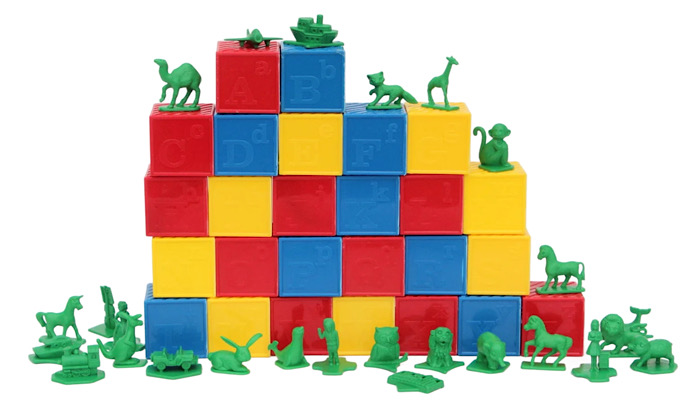
Pam: One of dad’s early partners was Tupperware; they made Tuppertoys toys for babies, toddlers and kids including Zoo It Yourself, Build-O-Fun Construction Sets and Busy Blocks. Busy Blocks were bright, colourful alphabet blocks that that you could snap together to build shapes and designs… The blocks also opened to reveal a little toy that began with the corresponding letter of the alphabet: from aeroplane to zebra! So yes: in the 1950s, companies were suddenly able to make toys for that market.
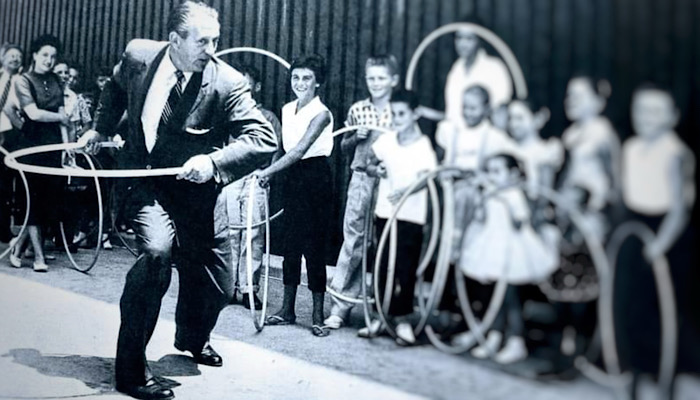
Pam: Another thing dad created was really the first spinning hoop; what would become known as a hula hoop. It was called the Art Linkletter Spin Hoop, or Spin-A-Hoop When we cleared out his warehouse, we actually found the prototype and the original packaging – all done by hand from when they presented it. And it was something that dad got into, did well, made big, then got out of. That was typical of dad! Because he was quite easygoing; he wouldn’t necessarily fully cash in on all his ideas because money wasn’t his motivation. He’d just have an idea, jump on it, go crazy – and then he’d be done.
With the Spin Hoop, for example, dad found a way to mass produce it by approaching different garden-hose companies around the country that had plastic-extruding machines. They would extrude the plastic in a long tube, make it into a hoop and put a little thing in it that like spun around inside to make a noise. So the Spin-A-Hoop craze was like a frenzy, then they got out of it – and now everyone just remembers Wham-O for it.
And it had – did I hear you right – something inside that made a noise?
Jonny: Right! But the original was known as a reed hoop; used for tribal dances in New Zealand! Dad was given one; Pam and I still have it… It’s one of our family’s prized possessions!
Fascinating. And Joan Anderson – the lady credited with taking the wooden hula hoop to Wham-O passed over quite recently… I’ll link to her obituary here. Now, you mentioned your dad’s warehouse in the present tense…
Pam: Yes, it’s now a travelling warehouse! It’s currently in Los Angeles, but Jonny and I spent several months in San Diego going through over 700 huge boxes. There were also rows and rows of filing cabinets bursting with papers and photos. Dad saved everything… There were bank statements and payroll stubs from the fifties!
Oh, what fun for you!
Jonny: Absolutely, this is a lesson learned! I’m basically going to leave one thing for my child because it’s a nightmare! Ha! That said, we’ve been able to look at so much amazing stuff that was sitting in boxes – most of which we didn’t know existed. Some of it was dad’s, some not – but all of it an amazing history of toys going back to the fifties. We’ve now photographed and cataloged everything. We disposed of or donated all the stuff we didn’t want – and now we have a collection of things we’re not really sure what to do with!
Pam: We have a huge trailer truck full of folders that we’ve not even opened yet. We don’t know exactly what we’re going to find… I’m hoping that we find a lot sketches and mechanical drawings because that’s my kind of thing! It’ll be interesting to see what we uncover, but I have a feeling we’re going to get a lot of concept sketches…
Tantalising! And what are some of the toys and games your dad invented?
Jonny: As well as those with Tupperware, he did a bunch of stuff with Eldon Toys and the Ideal Toy Corporation. Then there were the Erector Construction Sets, Pipsqueeks dolls and playsets, Peepul Pals – dolls and paper dolls… The list goes on and on…
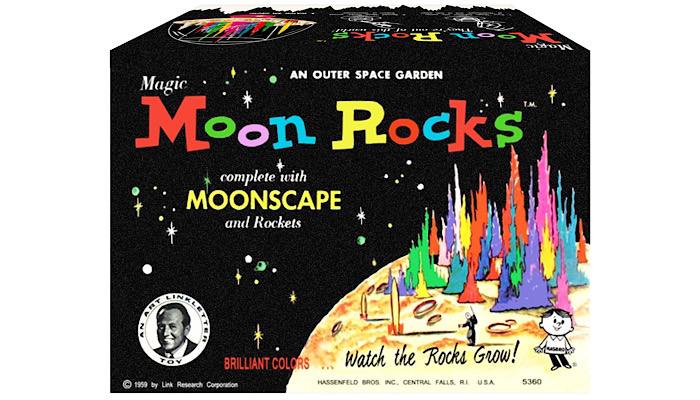
Pam: He did one called Moon Rocks. You put these little pellets in water; they’d grow into stalagmites that look moon things! Super simple, but he tied it into the space race to help them sell. That’s the way he thought.
Yes, I guess he could’ve themed that any which way – but the Moon was so topical…
Jonny: Right. He also did a lot of work with Fisher-Price, including the 1-2-3 Skates which were a big thing for him for a couple of decades. Again, that idea depended on the versatility of the plastic.
And the 1-2-3 Skates got a mention in an interview about the inventor relations guy from Fisher-Price… The I.DI.O.T. Award winner Paul Snyder. People can read that here. In terms of The Game of Life, how did your dad come to be involved?
Jonny: The way dad used to tell the story, he originally went into Milton Bradley to meet with the executives… This was in 1959. He was going to pitch a type of art set he’d created. That didn’t come to anything, but – since he was a well-established toy inventor – the executives asked him to create a game to commemorate Milton Bradley’s 100th anniversary the following year…
After they gave him access to the company archives, he discovered a game in the vaults called The Checkered Game of Life. Believe it or not, this was a game from 1860 that was invented by Milton Bradley himself! Dad loved the idea of a game in which you were ‘playing at life’ because it’s a universal experience. However, the original game reflected rather moralistic, Victorian-era standards.
So that theme still seemed relevant, even though aspects of the game itself had dated?
Jonny: Exactly. The word ‘life’ just resonated. And dad was all about buzzwords, buzzwords, buzzwords… So his immediate interpretation was to create a game that was about the path of life. Happily, it turned out to be this very positive, interactive family game that’s lasted and lasted.
Amazing. And why do you suppose that is? Why is The Game of Life still on shelves 65 years later?
Jonny: I think one aspect of it is its ethos… It’s not like most games in as much as it’s not a zero-sum game. Right? In most games – and arguably in life, generally – everybody else loses when you win. And so many things based on a zero-sum game, especially in the environment we live in now. But with The Game of Life, it’s not about who loses when you win…
And yes, in the original version there were revenge spots and the other person could bust their bank account, but the essence of the game is everyone going on this journey together. You don’t lose at the end – you either go to Retirement Acres, which is not so bad, or you get your Millionaire Estates. I think that was relevant and important in the 1950s and 1960s and it stays relevant today. We need more Games of Life right now; this idea that nobody has to lose in order for you to win.
Amen to that! Pam, anything to add?
Pam: I also think it endures because you’re not just rolling a dice and following a path around a board. The Game of Life can inspire communication across the generations as a conversation starter… If you’re playing the game and you pick college, for example, that’s an opportunity for a grandparent to say, “You know what? This is what it was like when I went to college!“ Right? “Did you go to college, grandma?” It means a lot to me that you can play it multiple times and learn about your parents, your grandparents and your kids.
Well, that’s a great sentiment. And I love how all that has come about through serendipity; your dad being in the right place at the right time and having the right idea…
Pam: Serendipity was one of dad‘s favourite words! He loved that word and you’re right: The Game of Life was serendipitous… Dad being dad, and being in the right place at the right time… That trip, that conversation, that visit to the vault served as a springboard into a colourful, optimistic game about a journey from young adulthood to retirement… It embodied the post-war American Dream! And it was serendipitous that dad got on a pay phone and cold called Art Linkletter’s office hoping that he’d endorse the game…
Now, older Americans will remember Art Linkletter but our readers in the UK probably won’t. So I’ll explain that he was a US radio and TV personality; very well established…
Jonny: And dad saw the value of bringing in Art, who was – as you suggest – a major force in radio and television. He wholeheartedly endorsed dad’s hula hoop and The Game of Life. It proved to be a marketing masterstroke and led to a lifelong friendship between them… And this was serendipitous again because it proved to be dad’s entry point into the film and TV business.
Let’s talk about that! What did your dad do in film and TV?
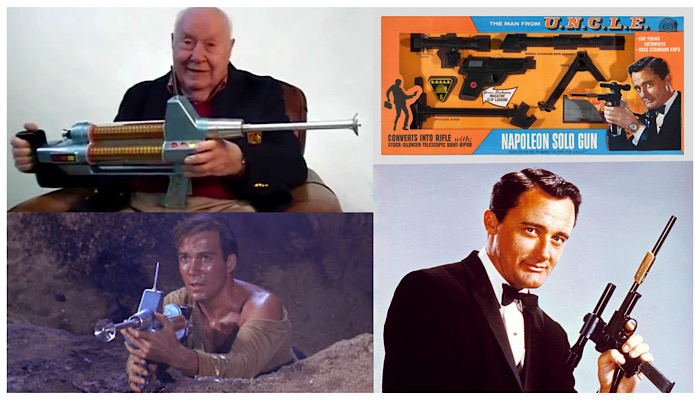
Jonny: After establishing himself in Los Angeles, dad helped create some iconic prop items. He met with people like the screenwriter Ray Bradbury… Over time, dad became known as a go-to creator and was asked to make props. He built the secret communication device on The Man from U.N.C.L.E., and Napoleon Solo’s gun. That was so popular that the gun itself received fan mail! Ha! Later, some of his props for The Man from U.N.C.L.E. became toys in themselves – he made them for the Ideal Toy Corporation.
Dad also created a car for the Pink Panther cartoon show – not the full size one, but what ultimately became a toy for the Pink Panther line. Then, for Star Trek – as well the communicators and tricorders – he made the phaser rifle. I don’t know if you know it, but William Shatner used it as Captain Kirk in his first episode and some iconic publicity stills.
I do remember it! It was used in the second pilot… I had no idea your dad was involved in that. How extraordinary.
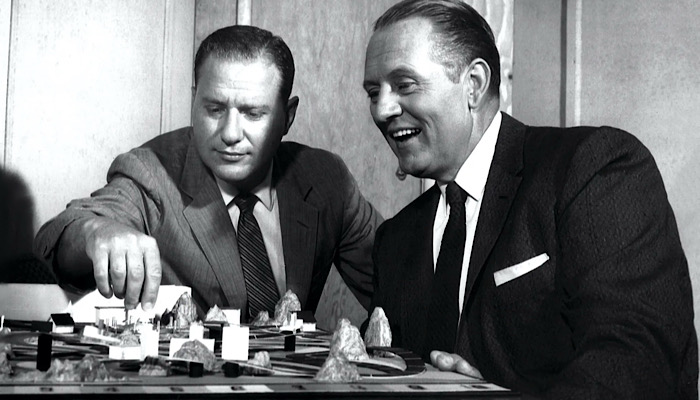
Pam: Dad was also invited to a meeting with Walt Disney and the owner of Carnation Dairy Products. At the time, Disneyland was in the planning stages… Eventually, Carnation became the supplier of all of Disneyland’s ice cream products. But Walt wanted dad to do a line of unbreakable plastic Disney characters to sell in the gift shops…
I can’t recall exactly the way my dad phrased it, but he went into this meeting thinking that this ‘Disneyland’ was the most unbelievably absurd project… Right up until he walked in and saw Walt with a model of the park sitting on a table. At that point, dad knew Disney was really onto something. So he saw the original model of the Disneyland park, more or less through serendipity again; through random connections when he had no idea what he was getting himself into.
Like this interview! You did warn me. Ha! And when you’re clearing out an archive of that size, I guess you’re not just finding interesting stories and cataloging old ideas… You must be thinking about the ideas that never made it to market! Are you looking to pitch any of these things?
Jonny: Yes, we’ve definitely got plans for that kind of stuff. Fortunately, Pam and I are at points in our careers where we can actually take some time to do this, so we’ve founded Toylab², a modern take on his toy and game licensing company. Basically, we’re planning to revive, reimagine and reintroduce ideas through updated product releases, digital and entertainment adaptations and licensing partnerships. Our mission is to bring some of these iconic creations into the present for current and future generations to enjoy.
Perfect. On a sadder note, of course, we’re not able to talk with your dad directly because he passed over a couple years ago; 2021. Let me say how sorry I am for that…
Pam: Thank you. I appreciate that. Yes, it’s been a journey…
Well, I get moved when I say this because I mean it from the bottom of my heart: it’s never too late to say “I’m sorry for your loss” when the loss is that profound.
Pam: Oh, thank you… That’s beautiful. Thank you.
You’re welcome. It’s true. I’m just so sorry.
Jonny: Thank you. Dad had 99 years, and I think that was a testament to the way that he was in his mind and character. He found balance… Yes, there’re things going on in the world that we can be stressed about it. But there was that part of him – when he looked back on his life, and we did discuss this with him – that knew he had a life well lived, and he knew he’d brought fun and joy to people. And he was fortunate to live as long as he did…
One thing that stuck with us at his memorial service is that if there’s anything to emulate, I want to know that – when I’m gone – my kids are going to talk well of me… That my kids are going say, “He was good. He enjoyed life and knew how to make life special for everybody, and he lived it to the fullest.”
Wow. Thank you for sharing that. You know, you call to a mind a story about a man called Eddie Braben. He was the main writer for Britain’s best-loved comedy double act, Morecambe and Wise…
Pam: Morecambe and Wise? Did they come to America?
Rarely! They did the Ed Sullivan show maybe a dozen times… But over here, literally half the population would tune into their Christmas specials: 28-million people. And if ever Eddie Braben had a bad day, he would cheer himself up by looking at a person and thinking: “You may not know it, but – at some time in your life – I’ve made you smile. Laugh, even.”
Pam: Oh, that’s lovely!
Well, that it’s going to be true of Reuben… You could look at any number of people of a certain age and say that about your dad. He made countless millions of people smile… Laugh, even.
Pam: That’s beautiful, that’s exactly it. It’s so heartwarming to hear that. Thank you. I think that’s a beautiful way to sum it up.
Jonny: And that’s why we’re trying to do what we’re doing and why we feel it’s important to grow it. And until you hear a story like the one you just told, it’s hard to understand what the driving force is behind why you want to do something. You know, we brought this up before – Pam and I have had our own careers and lives and now we love the idea that we can invest time in this because we want to keep it going. Why would we not? Why wouldn’t we want to perpetuate such a positive legacy?
Pam: And legacy was really important to our dad because he wasn’t a showy guy… He lived well, but he wasn’t flashy. It’s about legacy to him. He wanted all this to be passed to his children and then to his grandchildren rather than dispersed… It being a family thing was really important to him.
Oh, lovely! And as part of that legacy, are there any other toys or games we’ve not really discussed that you’d like to mention?
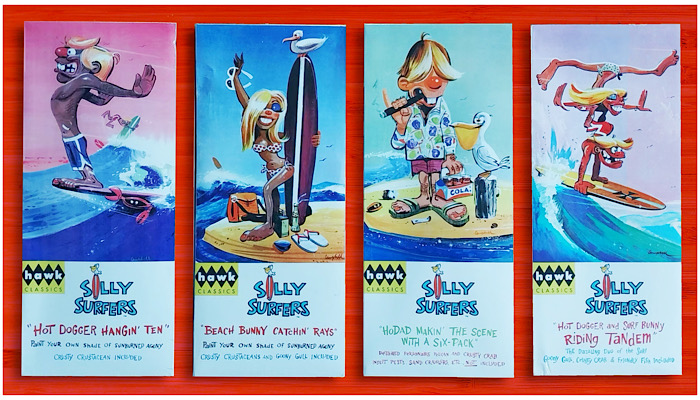
Jonny: There was another big game that he did called Summit. There’s some debate as to whether or not Summit influenced the game Risk, which is – of course – a huge hit. Summit was a pretty big hit back in the day too. I’ll just mention one toy that gives you an example of how dad would get an idea, tie it into something else and expand it into more than just a toy… He had a line called Silly Surfers, which were models of caricatured versions of surfers. And you know, in the 1960s that surf culture was a huge craze…
When you say models, do you mean collectible figures? Or more model kits?
Pam: Model kits that kids would put together and paint. There were different characters: Beach Bunny, Hot Dogger, Hodad – an older drunk guy who used to hang out with the surfers and a six pack of beer! All these crazy cartoon-like characters. Somebody else now owns the rights, we think, but – beyond the model kits – dad produced a record that went with this line! All the Silly Surfers had their own songs – my mum actually sang on it; she was Beach Bunny! So dad didn’t just do the line as model kits – he tied them into a little universe. And weirdly enough, Pearl Jam did a cover of one of the songs…
Pearl Jam covered a song from an album that tied in with a line of model-kit surfers?!
Jonny: Ha! Yes! It’s called Gremmie out of Control… This would’ve been the late 1990s. I was in college when Pearl Jam did that as part of a fundraising campaign – Music for Our Mother Ocean, I think. Something like that. It was for the Surfrider Foundation… They’re still operational and this song was appropriate because that foundation focuses on cleaning up oceans, beaches, and coastline habitat…
I remember my dad was very happy to see that because he was also an environmentalist at heart. I recall that he wrote a letter to them, praising the cover by Pearl Jam. I’m sure we’ll find that as we go through the archives! But yes, we thought it was really cool! We told dad and he was kind of excited about it. So, you know, some of this stuff endures in ways you wouldn’t think possible!
It’s so mad! And Pam, one more invention from you?
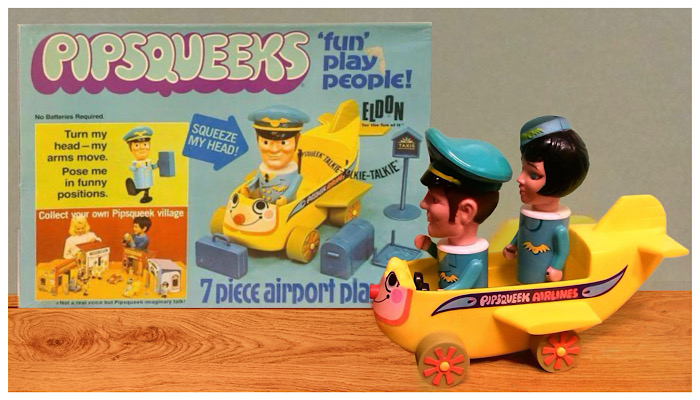
Pam: I’m going to throw in Pipsqueeks because it was named after me! That’s my favourite. Pipsqueeks were these little characters with movable hands… You squeezed their heads and they made squeaky noises. There was a fire station playset that popped open. Inside, you had two firemen and the chief and an axe and a hose. Then there was an airplane one… The Pipsqueeks could sit inside and there was a stewardess and a captain. There were little trays that the stewardess would serve you with! It was such a multi-level experience.
Jonny: One other thing I wanted to bring up to was something called the IQ90. It was the earliest version of a programmable car. It preceded Remote Control cars and worked like an old computer…
In what way?
Jonny: You know how computers from the 1950s and 1960s had a data card? A piece of card with holes punched in it? The IQ90 worked like that. We have the prototypes! We have the carved, wooden car pieces that were eventually made in plastic… What you would do was put this programmable card in sort-of data points, then insert it in the car. I’m not sure if you then pressed a button or what, but then the car would complete a pattern driving by itself.
Well, if I’ve understood you correctly, that must be the earliest coding toy…
Pam: It totally is. And nobody knew what coding was back then! There were no desktop computers; the only people with access to computers were people like NASA! So again, when dad developed that kind of technology as a toy, he was opening a whole new market because this was in something like 1962.
Mind-boggling! Quite brilliant. We do need to start wrapping this up but –before we do – tell me something about your dad that it would be nice to share…
Pam: I think it would be nice to share a little about his personal life in his later years because dad loved to be with his family, particularly experiencing life with his grandkids; my kids – Cameron and Jasmine – and Jonny’s son, Atlas. Dad loved being around kids and seeing smiling faces. It was something that brought him a lot of joy throughout his life, so having the experience of grandkids kept that joy going through to his final days. He loved to see movies with all of us, which he did frequently on visits over the years…
He also loved just sitting a watching old shows and sketch comedies on DVD. And another of his favourite pastimes was listening to music – either with us, on his own or just being driven around in his car by his trusted assistant, Roberto. Dad loved everything from Sinatra and Dean Martin to Elvis and more of the classics from his earlier years. He loved listening to Jonny’s music as well, obviously!
I was about to say! Don’t forget Jonnny Blu! Ha!
Pam: In his later years, our Dad loved to eat! He found delight in everything from hot dogs at the ballpark and ice cream at Haagen Daaz to Coconut Cream Cake at the Kahala Hotel! And what he wanted, he got. One time when we were in Japan in 1998, he ordered a slice of melon that cost around $30; he loved it so much that he ordered another, then another, then another! The waiter told him that he could get a whole melon for slightly less, but I think he just liked them bringing him each slice one at a time! Ha! But as Jonny said, Dad lived to 99 for a good reason… He was easygoing – sometimes to a fault – and tried to maintain a full life with limited stress and great appreciation for what he had.
Well, look – I’ve loved every second of this – really quickly; last question! Have you thought about doing a book?
Jonny: Yes. In fact, dad had actually written a book over the course of 30 years… Actually, this a whole separate issue because – starting in the early 2000s – he was in his eighties and wasn’t able to do a lot of things… Let’s put it that way. And one of the things he couldn’t do was to finish his book – but we do have two manuscripts that detail a lot of things in his life… We’d like to get that out at some point.
I hear you. Big job…
Pam: Yes, it’s another thing that has to be taken apart and gone through, but it might well be, truthfully, that there’re three books in there. He’d tried to pack it all into one and it was too much because he had a whole life before toys! He was a World War II Navy veteran… He witnessed a kamikaze attack that sank a ship; he was in the Philippines in one of the biggest World War II naval battles in history. I mean, his stories growing up… But we didn’t even know about most of it – he never talked about a lot of it because we were his family from his second marriage. But his personal history is really fascinating.
Jonny: There are just so many stories… One of the things we found in the warehouse was a small manila envelope. It felt like it had something lightweight inside, so I opened it and pulled out this little curly plastic shaving; like a piece of scrap. It turns out that a friend of dad’s, obviously an engineer of some sort, had been shaping something in plastic on a machine and produced this worm-like scrap… And this guy wrote to dad and said, “Reuben, this was one of the shavings that came off when I was working on something. I thought maybe it would be interesting to you.”
Oh, my days! And was it?! Was that of use to your dad?
Jonny: Well, this guy said something like, “If you touch the top of it, it moves like it’s a living creature.” And yes, it was of use to my dad because they took this little plastic shaving and mass marketed it as a little squiggly worm that you’d play with! And, of course, stuff like that you can’t really protect because it’s a plastic shaving, so it got knocked off multiple ways…
You might have seen those furry worms that crawl around your arm when you pull it by a string – Squirmels! It was like that in a way. I found it fascinating that a product started like this… But this is how these people operated back then: they weren’t necessarily sitting in an R&D department saying, “How are we going to come up with the next big thing?” You know? To me, that’s the embodiment of true invention: you’re not trying to create something. Creation comes to you, and you make it what it becomes.
“Creation comes to you, and you make it what it becomes…” Amazing! Alright! What a pleasure this has been… I think I can safely say that – with the greatest respect to the hundreds of people I’ve interviewed – very few inventors are touched by genius in the way that your dad was; so creative in so many ways. Please come back and keep me posted on any progress.
–
To stay in the loop with the latest news, interviews and features from the world of toy and game design, sign up to our weekly newsletter here
More Recent Interview

“This was the missing piece…”: Rubber Road’s Jack Fox on TUBBZ’s move into blind collectibles with Mystery Eggs
Jack Fox, Sales & Marketing Director at Rubber Road, talks TUBBZ Mystery Eggs – and why Minions were a perfect fit.

Educational Insights’ Lisa Guili on TikTok, 20 years of Kanoodle – and ten million units sold
Lisa Guili reveals how one addictive brain teaser found its audience and became a phenomenon.

“I want people to bet on themselves”: Spin Master Co-Founder Ronnen Harary discusses his new book, No Experience Necessary
Spin Master Co-Founder Ronnen Harary talks to us about his exciting new book, working with inventors – and Spin’s most underrated launch.

David Norman of Stormin’ Studios on inventors, Orchard Toys – and shaking things up!
“It’s not just a name, it’s our mission statement”: In conversation with Stormin’ Studios’ David Norman.

Carrera Revell’s Frank Tiessen on the slot-car set that buyers had to see to believe…
How Speed Arena: Race in a Case became an instant hit: in conversation with Carrera Revell’s Frank Tiessen.
Sidekick Games’ Asger Harding Granerud on Tembo, Hutan – and 10 years of Flamme Rouge
“We were looking at games we were pitching to other publishers and at some point said: ‘Maybe we can do this ourselves…’”: In conversation with Sidekick Games’ Asger Aleksandrov Granerud.
Popular Articles

Hasbro partners with Nintendo for Legend of Zelda toys
Educational Insights’ Lisa Guili on TikTok, 20 years of Kanoodle – and ten million units sold

Not All Fun and Games: In mental-health month, Deej Johnson explains the Cycle of Depression

Not All Fun and Games: Deej Johnson explains how you can start to break the Cycle of Depression
David Norman of Stormin' Studios on inventors, Orchard Toys – and shaking things up!
Upcoming Events
-
- 30th January 2026
- Spielwarenmesse, Nuremberg
International Game Inventors Convention
-

- 19th - 21st May 2026
- Mandalay Bay Convention Center, Las Vegas
Las Vegas Licensing Expo
-

- 23rd - 25th June 2026
- Stamford Bridge Stadium, Chelsea, London
Play Creators Festival
-

- Tuesday, June 23rd, 2026
- Stamford Bridge Stadium, Chelsea, London
Play Creators Awards
-
- Wednesday, June 24th, 2026
- Stamford Bridge Stadium, Chelsea, London
Play Creators Conference
-

- Thursday, June 25th, 2026
- Stamford Bridge Stadium, Chelsea, London
Mojo Pitch
-

- 6th - 8th October 2026
- Excel London
Brand Licensing Europe