A Prickly Plan for Playground Popularity…
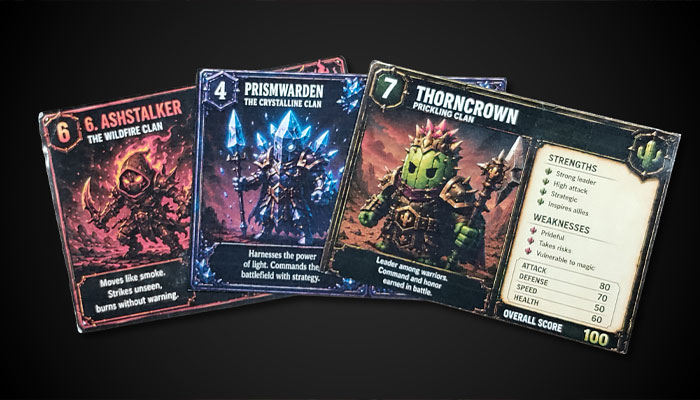
Sharp Sharp’s Steve McInerny looks at how three nine-year olds came up with a trading card craze at school.
I’m in a café before school. Three children – Felix, Leo and Sonny – bundle in with their parents, full of energy and non-stop chatter, proudly carrying large posters covered with sketches, printouts and jottings. They have come to tell me about Cactus Clans, the trading card an online game they’ve created which has become a playground craze in their south London school, Judith Kerr Primary School.
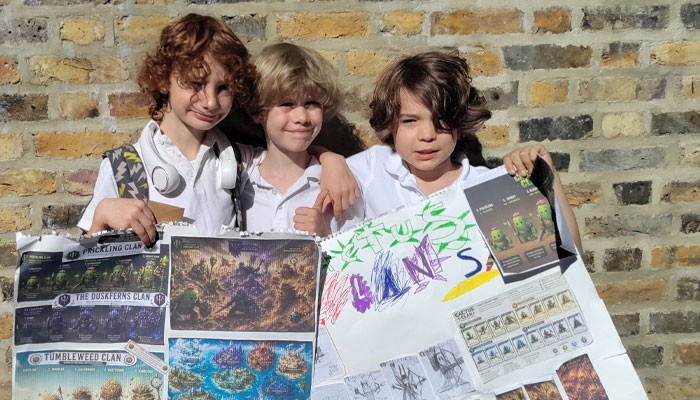
So, what’s the reaction to the Cactus Clans been like at school?
Sonny: “Well, it’s been extraordinary. Everyone’s coming to us trying to buy cards, trading… I didn’t think that anyone would even really like it but… It might even be bigger than Legami or something.” [Legami pens are another big obsession at the school at the moment].
My daughter is a big Cactus Clans fan, having heard about it at the ‘CEO Club’ – an after-school club where the trio developed their idea. Pippa Bishop, Creator and Leader of the After School Young CEO Club, told me: “The goal [of CEO Club] wasn’t just to teach business, it was to show them that their ideas can have real value.”
Since then they’ve been featured in the Mog Chronicle school newspaper and ran a sold-out stall at the school summer fair. Now there are even rumours that the trading of Cactus Clans cards has been stopped during school hours, to avoid any disagreements around swaps…
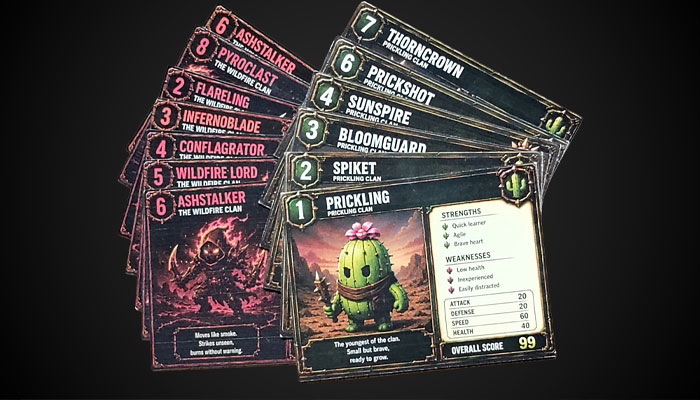
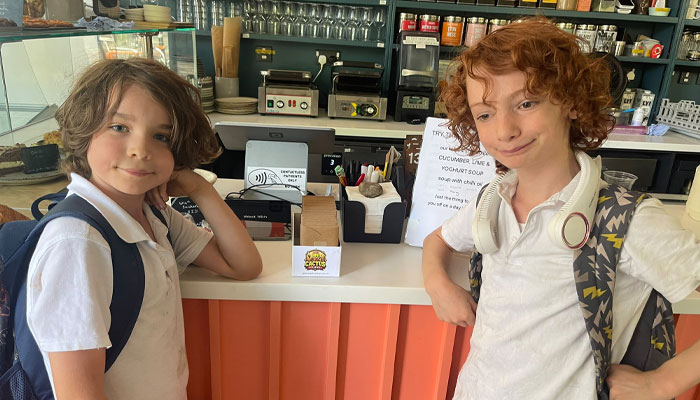
This minor setback hasn’t dented their ambitions. The boys are now planning a new range of cards to extend the game, and a local café is now selling the cards. They are giving half of the funds raised from sales back to the school. There was some debate in the interview about what to do with the rest, including whether the income could be used for a pizza party or for their next project…
I asked them: how has this made you think about what your future job might be?
Leo: “This! This is my job!”
Turning sketches into a game with AI
The project has benefitted from a supportive school and some very engaged parents. While not every parent is a software developer or marketing expert, all parents can help their kids by supporting their ideas and assisting them to stay focussed for long enough to make them real.
With the help of AI, making things real now needn’t take very long at all. AI has been instrumental in the development of Cactus Clans, as well as in increasing production values and in building the online game.
Keith (Felix’s Dad): “It’s all text-based, all LLM based. So I’m a software developer but didn’t write any code by hand.”
And which LLM did you use?
Keith: “Claude Code… We did find out about a bunch of software development tools too.”
Felix: So if you go onto the website, you can actually get the code for yourself. And there’s a link to GitHub so you can actually copy and edit your code.
Avoiding the potential pitfalls around AI
The parents are aware of the concerns around AI…
Katie (Sonny’s Mum): “My concerns were around the fact that Sonny spends his life drawing, and that if you introduce these tools it would kill that… But it hasn’t at all.”
Keith (Felix’s dad): “I think the usage of it [AI] is inevitable. So I’d rather teach that there’s still critical thinking involved – you still have to have an idea of the requirements and what you want. The “how” part and the doing part might be different now, but you still need to have the idea and be understanding of whether the output is what you want or not.”
What the kids can teach us
I asked the kids, is there anything else you want to tell the people who make games out there about Cactus Clans?
Felix: “Well, not many people like it if you just chuck a bunch of random stuff in. You should keep adding and adding and adding to the building of the game.”
The best learning often comes when you don’t feel like you’re learning at all – this has really happened with Cactus Clans. The kids are still engrossed in the details of the cards and the characters, while learning about teamwork, business skills, AI and even software development.
Pippa told us: “The developers and the players are part of the same community, so feedback is immediate and honest. If something isn’t fun, they hear about it straight away. If someone has a great idea, they can test it almost immediately.”
And I’ve learned a lot too from communicating with the kids, their parents and Pippa. Here is what’s stuck with me:
Be open to the opportunities of AI: As a designer, I’m very aware of the threat that AI poses to my sources of work, as well as that of people in the toy and games industries. It’s been refreshing to see Cactus Clans make use of the opportunities that arise from AI, such massively speeding up the feedback loop.
Democratise the creation process: There was an infectious excitement in the kids about how others are actually playing the game they’ve made, and a desire for those players to make their own characters and clans too.
The AI-natives are here: I was struck by how the kids take AI for granted. They weren’t amazed by it, but took it in their stride. They use it to help them with offline play, and as a tool for their game development rather than the central element, which so many adults are prone to doing.
You can find out more about Cactus Clans here: https://www.cactusclans.co.uk/
Steve McInerny is a board game fan, creative director and designer with extensive experience working on kids and entertainment brands, and in brand licensing. He’s among the current crop of the Brands Untapped 100, and works independently as well as with his Sharp Sharp associates: https://sharpsharp.co.uk/work
–
To stay in the loop with the latest news, interviews and features from the world of toy and game design, sign up to our weekly newsletter here
More Recent Opinion


Play-Doh at 70
Deej Johnson on the amazing origins of the world’s favourite compound.

From Creator to Checkout: SituAction’s Nic Jones on how social commerce is empowering the next generation of innovators
SituAction’s Nic Jones looks at how the next great toy success story could begin not with a pitch, but with a post.

Making Things Studio’s Fi Murray sheds light on how she tackles that all important sizzle video
Making Things Studio’s Fi Murray on why today’s sizzle reels need to do much more than dazzle…

The Plan A Group’s Lee Allentuck on how to build your creative muscle
The Plan A Group’s Lee Allentuck shares his top tips for staying ‘creatively fit’.

Dream Teams
David Blanchard – Director of Party & Family Games at The Op Games – looks at why engaging with inventors beyond the licensing moment can really pay off.

Prolific inventor Richard C. Levy offers new inventors advice on starting a royalty stream
Calling new inventors! Richard C. Levy gives simple Do’s and Don’t on becoming an inventor.


Popular Articles

David Norman of Stormin' Studios on inventors, Orchard Toys – and shaking things up!

“I want people to bet on themselves”: Spin Master Co-Founder Ronnen Harary discusses his new book, No Experience Necessary

Olivia DeLorenzo joins Inventor Relations team at Mattel

Hasbro launches adult-focused Blooms by Play-Doh range

Open 2 Design’s founder, Matt Burtonwood, on creative partnerships – and the joy of collaboration

Upcoming Events
-

- 30th January 2026
- Spielwarenmesse, Nuremberg
International Game Inventors Convention
-

- 19th - 21st May 2026
- Mandalay Bay Convention Center, Las Vegas
Las Vegas Licensing Expo
-

- 23rd - 25th June 2026
- Stamford Bridge Stadium, Chelsea, London
Play Creators Festival
-

- Tuesday, June 23rd, 2026
- Stamford Bridge Stadium, Chelsea, London
Play Creators Awards
-

- Wednesday, June 24th, 2026
- Stamford Bridge Stadium, Chelsea, London
Play Creators Conference
-

- Thursday, June 25th, 2026
- Stamford Bridge Stadium, Chelsea, London
Mojo Pitch
-

- 6th - 8th October 2026
- Excel London
Brand Licensing Europe