EAP Toy & Games’ Chrissy Fagerholt talks inventing, self-publishing – and Jackpot Roll!
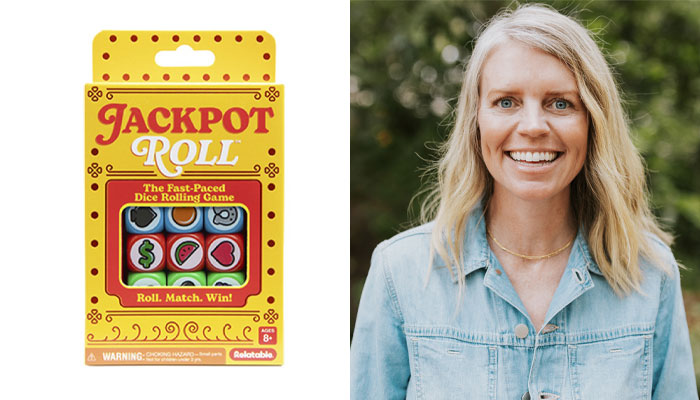
Chrissy, it’s great to catch up. To kick us off, how did you get into game design? Was it always part of the plan?
Games were never part of the plan until I was probably in my late thirties! It really fell into my lap. That being said, a lot of the things I did culminated in me creating games.
I got a degree in communications in college and then, when I graduated, I took a job in the corporate world – but this wasn’t for me! Then I got a job designing at a flower shop and was a cocktail server in a cabaret theatre to make up for the fact that I wasn’t making a lot of money. And I did that for a very long time – and I loved what I did. I was creative, I got to work for a small business, and I was surrounded by creative people in both jobs. As my kids got older, I couldn’t really work as much on the weekend, so I dabbled in greeting card design, invitations and things like that.
Then the game situation happened when I met up with friends of mine and we made up a game to entertain ourselves. The next day I was like: “Yeah, let’s turn this into an actual game!” And none of us had any right to be making that decision!
Ha!
One was in school to be a PA, one was a dental assistant and the other one had her career in marketing – but I had the time and the gumption to go forward with it. There’s a quote: ‘Never trust a drunken idea unless it survives the hangover.’ And this idea survived the hangover! It merged my experiences doing flowers, serving, designing greetings cards and having a degree in communications. I didn’t go to school for this in a traditional sense, but I felt I had the experience to make it.
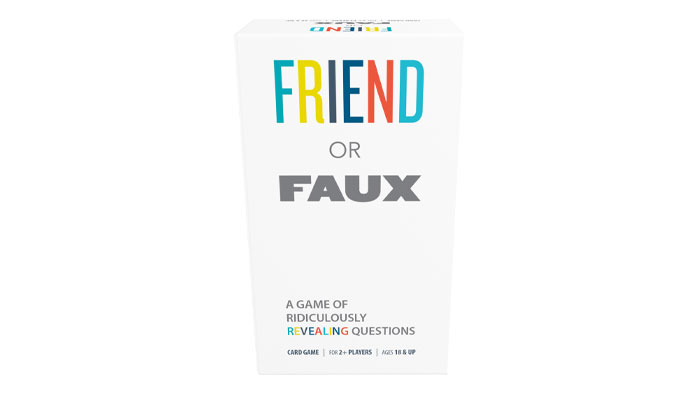
And this was Friend or Faux?
Yes! It took two years – which it sounds insane for this 250-question card game – but we wanted to respect that process, right? We had to do our due diligence. We took it to ChiTAG back in 2017, pitched it to some companies, had some interest and ended up adjusting a few bits and launching it via Kickstarter.
How did that go?
It was successful – but not without a lot of effort, I’ll tell you that! The stars aligned and we connected with Goliath, who were starting to bring adult games into their line-up. So we got it licensed. It was lightning in a bottle.
Amazing. So did that steer your thoughts around licensing games versus self-publishing?
Well, after we licensed the game to Goliath, we kept getting requests for a family-friendly version. So I worked on that – then COVID hit and that allowed a little bit more time to engage with the development process across different ideas. So then started pitching The Lunch Room Game, but it wasn’t getting any traction. Ego got the best of me, so I decided to self-publish it. What do I have to lose except for my mind, time and money?
Ha! When you put it like that it’s a no-brainer!
Exactly! I had the support of my family so I just dove in – and suddenly I had thousands of games to sell. I was flying by the seat of my pants, doing shows, connecting with different people – it was like paying for an additional education that I didn’t go to school for. A crash course in manufacturing, selling, advertising, social media, marketing… All of the things! And all the while, I had more ideas, and I knew I couldn’t self-publish them all. So that’s when I decided to do both – self-publish, but also pitch ideas too.
How did the The Lunch Room Game come about?
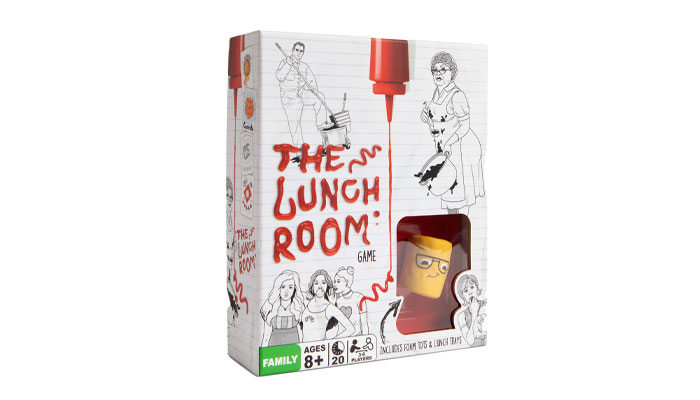
Well, I worked as a lunch lady at an elementary school for a year and I thought: ‘There’s a game here!’ My little squishy tater tots started life as a card and then they became a key part of the game… The tray clearly had to be the board…I wanted it to look like someone was in detention, doodling on their notebook… I thought, who can’t relate to this?
And speaking as a Brit, it feels familiar purely thanks to films from the 80s and 90s!
Yes! Every teen movie has a lunchroom scene and I wanted it to have that nostalgic feel. Everything came out so perfect. And it sells the best for me on Amazon, but it has a harder time translating on shelf.
Why do you think that is?
Online, you get to see all the parts of the game. It’s such a good, fun, easy game. Aesthetically speaking, it’s my favourite game. How can you resist squishy – or real! – tater tots?
Exactly! And how do you decide what to pitch and what to self-publish?
Sometimes pitching the concepts helped steer that decision – if there’s interest from publishers, but not enough to get it signed, maybe it’s something I should self-publish. And let’s be honest, self-publishing is really hard. If I was equally successful in self-publishing and licensing but could only choose one, I would pick licensing because what really fills my bucket is being creative. Having these new ideas and then going to the experts and saying: “Now you do the part that I don’t love!”
On that, you licensed Girls in Bar Bathrooms to Mattel back in 2024. What was the origin story there?
So, I’ll be the first to tell you that I am not the queen of mechanics. When I see somebody’s strategy game, my mind is blown. People have tried to teach me, and I’m like: “My brain does not work that way!” I focus on simple, fast gameplay, five rules or less, and I want the ideas to be relatable, with some humour in there.
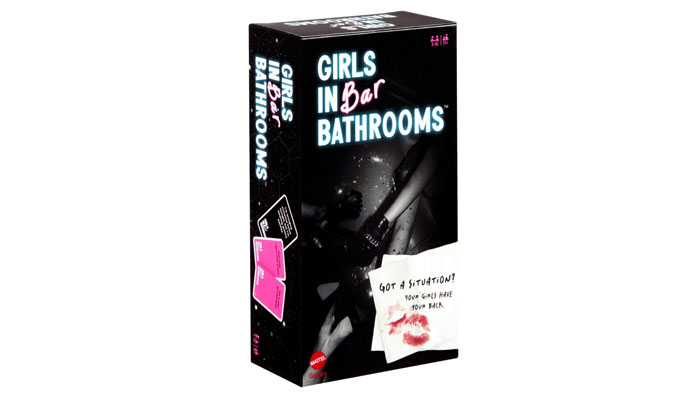
Girls in Bar Bathrooms spawned from a meme that I shared with my friends. It was about girls in bar bathrooms and how you basically become their best friend in a matter of minutes. We were all laughing about it and I thought: Could I take this weird concept and make it into a game? I took the meme and posted it to socials asking: ‘Yes or no, please answer this poll – can you relate to this meme?’ I left it up there for two hours and more than 90% people said yes. And then they started sharing their stories! That’s when I knew the idea had legs.
I worked on it for a long time and playtested, playtested, playtested it. And I kept wanting to make it harder! It has this judging mechanic – which I know gets trashed on – so I twisted it enough so that it had a little more meat on the bones. But I thought: ‘who am I trying to design this for? Am I trying to impress hobby gamers, or the people who will actually play this game? So I decided to keep it simple. And then I pitched that game, Billy, to everybody! I had a killer sizzle reel and everyone loved the name, but some felt it was too steered towards females… I thought ‘Yes!’ At the time, Taylor Swift’s tour was killing, Beyonce’s tour was killing, the Barbie movie was the biggest thing. I thought: people – specifically women – want to spend money on this kind of concept.
But I loved it so much that I started thinking that I should self-publish it. And then I went to ChiTAG and pitched to Mattel – and I put myself under no pressure because I thought I might do the game at that point. I had some jokes with Audrey and Nick, we played a quick round and they said: “This is exactly what we’re looking for.” And then it all happened so fast.
Amazing. And from a pitch that you weren’t 100% ‘invested’ in.
I thought it might be a pitch that provides some useful feedback. I definitely didn’t think Mattel would be the company to take it – and it’s such a long shot with these huge companies – but it happened, which was amazing.
And did it have a knock-on effect in terms of your reputation as an inventor?
People have been very supportive and think it’s awesome that I’ve got something with Mattel. And it does give me a little bit of clout, but I think all deals made with companies big or small, It’s a case of right game, right time, right company. Those three things still have to align.
You do a terrific job on social media, both in terms of promoting your games, but also shining a spotlight on inventor life.
I like to put it out there because I think: ‘Well, I have to make fun of this, right? Other people have to find this funny?!’ And people have been really nice about the posts and hopefully the right people see it. And it helps to get the word out about my games. And I do it for both my self-published games and my licensed games. When licensing a game, some people are done once they’ve licensed it, but for me, I still want to get the word out there that this game exists. So I’m gonna post about it!
And I imagine it’s a fun way for people to get to know you more too.
Yes – and putting myself out there and showing a bit of my personality is helpful because people might think: ‘That’s funny, maybe her games are fun’. It’s also a creative outlet for me. I hate feeling like I have to do it, so I’m focusing more now on quality over quantity these days.
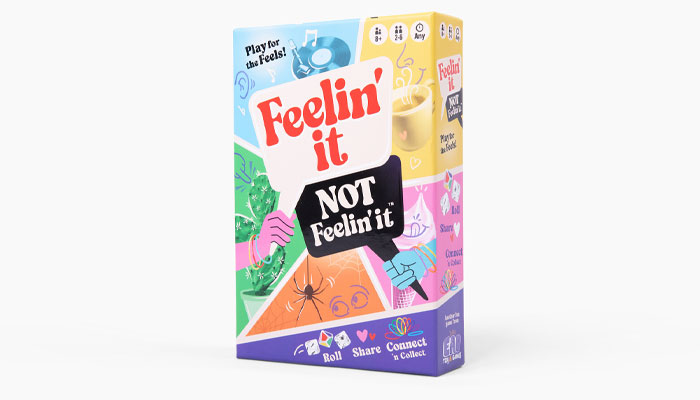
I also wanted to ask about one of your recent games, Feelin’ It Not Feelin’ It – a game that invites ‘connection and conversation’.
I made this with a friend of mine, fellow inventor Jillian Lakritz, and we were very intentional of not saying game because we know it was a bit of a stretch. You’re gonna have the purists say: ‘Well, is this really a game?’ Well, there’s pieces and there’s a dice!
Ha! So in what way could it be seen as something other than a game?
We wanted to push ourselves to create a game that involves feelings. Most of the time, you see ‘feelings games’ designed for a much younger audience – ones that teach them how to recognize happy or sad. But we wanted to explore something for an older audience. So we decided to focus on human senses, colours and different emotions, throw them together and see what people are feeling – or not feeling. It’s really fun and silly – and proves these types of products don’t have to be an emotional roller coaster!
And has that conundrum of ‘it’s a game, but not a game’ proven a tough sell?
I was really concerned about that, because it is so different. But when I bring it to shows, I get teachers and therapists coming over saying: “What’s this? This is great!” It wasn’t designed with them in mind, and that’s exactly why they like it!
Terrific! And you also worked with Jillian on your latest game, Jackpot Roll – published by Relatable. What’s the origin story here?
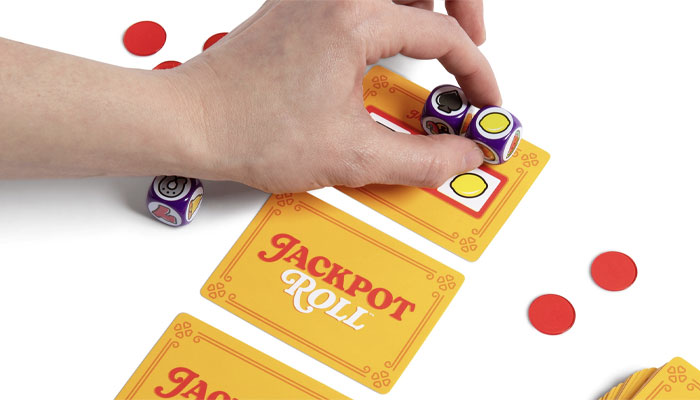
Jillian was inspired by what would be a great name for a dice game – which shall remain top secret in case we ever use it! We were hanging out at the hotel about to attend the ASTRA Toy Show and simply started playing around with the dice. We had a few different themes in mind, but landed on slot machines because they are, simply, addictive. We wanted something fast, an easy get that was quick to learn and fun to play.
And how do you and Jillian work together? What does that collaborative design process look like?
I am lucky because Jillian is local to me here in Colorado, which is great because we can get together in person to work on ideas together or help each other out on our own endeavours. We have our own strengths that translate well into our collaborative process. She is the left brain and I am the right brain when are working together, ha!
More generally, what helps you have ideas? What fuels your creativity?
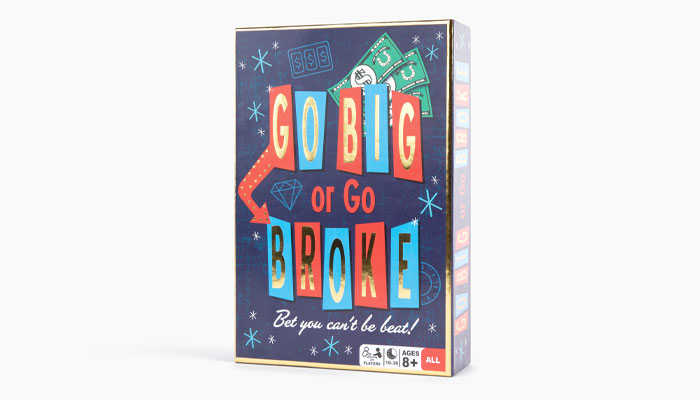
Life! As mentioned above, working as a lunch lady inspired The Lunch Room Game, my friends and nights out inspired Girls in Bar Bathrooms, Go Big or Go Broke was inspired by my kids always betting they can beat each other at everything. I will do almost anything to give or get a laugh – laughing and humour are such a connector for people. Knowing a game I created can be a tool for that brings me a lot of joy.
Last question! What is your most underrated game? We’ll give it some love here!
Go Big or Go Broke, it is a light-hearted betting game that puts big effort into simple actions. It sells out for me at every consumer show I bring it to. Kids love it because it gives them a chance to be silly and when they play it with adults they get to see them let loose and be silly too. It is very funny, and while designed for ages 8+, give it to a group of drinking adults and it takes on a life of its own that is not to be missed.
–
To stay in the loop with the latest news, interviews and features from the world of toy and game design, sign up to our weekly newsletter here
More Recent Interview


Gregory Benassar on Khadou, kidults – and why Pop Mart and B&M have more in common than you might think
“We are not here to push a lot of volume into the market and move onto the next thing”: In conversation with Gregory Benassar – CEO at Heathside and Co-Founder of Saga Alliance.

Inventor Mandela Fernández-Grandon on design, collaboration and the joy of playtesting
“Working with others offers a list of benefits…” In conversation with Mandela Fernández-Grandon.

Dina Al Rifai – Creative Director at The Loyal Subjects – on how being a collector shapes her approach to design
“I usually start with the emotional hook – what is this product supposed to make someone feel?” In conversation with The Loyal Subjects’ Dina Al Rifai.

“Play is evolving…”: Hasbro’s Tim Kilpin talks kids, Kidults and KPop Demon Hunters
Tim Kilpin, Hasbro’s President of Toys, Board Games, Licensing and Entertainment, on recent highlights – and things to get excited about.

Spin Master’s Angus Walker on bringing classic horror brands into TCGs with Hellbreak
“Faithfully representing these beloved characters was our design team’s top priority”: Angus Walker – VP, Marketing & GBU Lead, Games & Outdoor at Spin Master – talks Hellbreak.

As he retires, Make It Real’s Dominique Roy reflects on career highlights, mentors and lessons
“Even though you design something once, the injection machine will produce one unit every 30 seconds – that’s a serious responsibility”: In conversation with Dominique Roy.

Popular Articles

Invisible Typewriter's Jon Gracey on designing You Know It! – a trivia game for people who are rubbish at trivia
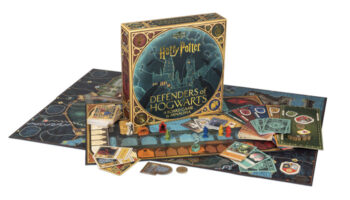
MinaLima readies Harry Potter board game, Defenders of Hogwarts
PhatMojo to launch Steal a Brainrot toys later this year

Refreshing Orchard Toys: Creative Manager Kevin Dobson discusses updating the company’s packaging
Mini Brands Really Works Vinyl represents "major step forward for the brand", says Zuru
Upcoming Events
-

- 30th January 2026
- Spielwarenmesse, Nuremberg
International Game Inventors Convention
-

- 19th - 21st May 2026
- Mandalay Bay Convention Center, Las Vegas
Las Vegas Licensing Expo
-

- 23rd - 25th June 2026
- Stamford Bridge Stadium, Chelsea, London
Play Creators Festival
-

- Tuesday, June 23rd, 2026
- Stamford Bridge Stadium, Chelsea, London
Play Creators Awards
-
- Wednesday, June 24th, 2026
- Stamford Bridge Stadium, Chelsea, London
Play Creators Conference
-

- Thursday, June 25th, 2026
- Stamford Bridge Stadium, Chelsea, London
Mojo Pitch
-

- 6th - 8th October 2026
- Excel London
Brand Licensing Europe