Tony and Taia Morley discuss invention, design – and two rarely explored creative techniques
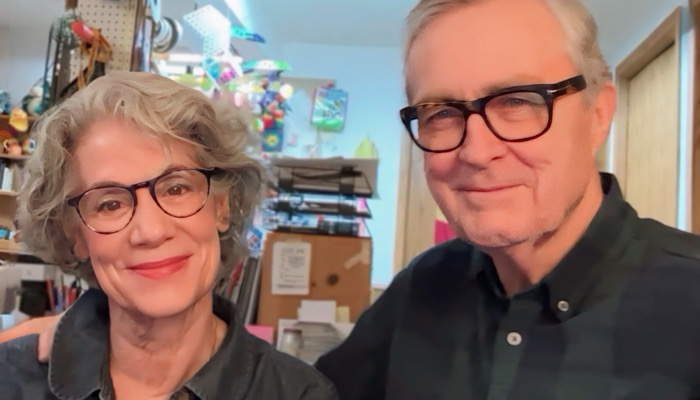
Tony, let me see… Kenner, Milton Bradley, Hasbro, Mattel, Fat Brain, Fisher Price. The list of people for whom you’ve done work is like a who’s who of the industry!
Tony: Well, I wasn’t employed by all of those; to some I just licensed ideas. But when I started in this industry, it was with a company in Minnesota called Lakeside Games. They’ve long-since disappeared, but they did Perfection and Barrel of Monkeys among other things. After that, I went to Kenner, then Milton Bradley… From there, I got invited to join a former boss back in Minnesota to do this very risky, un-recommended line of work!
Fantastic! And Taia, you’re now a children’s book illustrator! Again, you’ve worked for the crème de la crème: among others Penguin Random House and Harper Collins… But you started out in the toy industry?
Taia: Yes – in fact, Tony and I met while we were both working at Milton Bradley. I was a designer, but I was always a better illustrator than a designer. So after a stint at Tonka, I just did illustration full time. I did a lot of work for Mattel – especially the Barbie line – and a lot of licensing stuff. And then I just migrated over to children’s books and non-licensed work.
I’m not sure if you picked up on it, Taia, but when you said you were a better illustrator than you were a designer, Tony shook his head as if he disagreed…
Tony: Taia’s a far better designer than I am, Deej; she’s a terrific toy designer. She has a wonderful gift; the gift of a good eye – and real design sense. That’s better than what I have. She also draws very well.
Well, Taia returned the compliment there, Tony… When you were deprecating yourself, Taia shook her head as if to say, ‘No, no, no!’
Taia: But Tony is a tinkerer, Deej. He has a gift that a lot of people don’t have… The ability to just tinker, figure things out and make inventions that work…
Tony: But I’m not deprecating myself just to make you like me! I’ve worked with a lot of very good toy designers in different companies… I personally proved to be very good at being a mediocre designer. So over the years, I’ve gotten away from designing and now I just invent. And, of course, when a company licenses what I’ve invented, they redesign it anyway.
So what’s the difference between invention and design as you see it?
Tony: Well, I’m not an engineer and I’m not really a very good designer. When I’ve been surrounded by terrific designers, as I was at Kenner, for example, I felt they all had a good eye. As well as that, they could really put their vision down on paper. It was clear to me that I was not in their league in that way. With inventing, I find a lot of my work involves me just sitting in a chair and staring at the wall! It’s just my mind trying to make things work. So I invent like that, then design just enough to communicate the concept.
Is it a little like a relay race? Inventing is having the idea. Passing the baton is just communicating the idea to start the design… And then design is making that idea a reality in every practical way?
Tony: That’s an interesting way to see it, yes! You used the right word for sure: communicating. There was a time when Taia and I worked a little more together with toys. I would ask Taia to draw something for me, to help me interpret a concept. Obviously, I had to draw somewhat to get out of college with a design degree, but I soon discovered that that wasn’t my strength. Then, falling into toy invention was almost like divine intervention! I was very fortunate to have Tony Miller mentor me and invite me to join him and his wife back in 1986.
And Tony Miller was the former boss you mentioned?
Tony: Yes, he had a lot of experience in the toy business. He was my first boss; he hired me at Lakeside in Minneapolis – my first toy business experience. Toward the end, the company started contracting severely and the layoffs finally got to me, but I was there for two years. After that, I went to work for Kenner for a year, then Milton Bradley for maybe a couple years – and that’s where I met Taia.
And Taia, how did you get into the industry?
Taia: I’d just graduated from college… I was working in New York City doing the window displays for Macy’s – visual merchandising. That was a great experience, but I realised it wasn’t a life plan. I went to the Pratt Institute, and they had a job posting for what I guess you’d call a ‘think tank’ at Milton Bradley. They were looking for entry-level designers, so I applied and was interviewed – but didn’t get the job.
Did NOT get the job?
Taia: Did not! But then the woman who DID get the job didn’t show up the first day – so they needed to fill the position quickly. This would’ve been 1985 or 1986, something like that. I got very lucky because it led to a career.
Tony: I first met Taia just after she’d shown her portfolio and done the interview. She was going to take the train from Milton Bradley’s office in Springfield, Massachusetts, back to New York City. So they called me and asked if I could take this young woman back to the train station. I said yes and went to meet her. I just walked in the room where she was waiting… I took one look at her and my immediate thought was: ‘How come I never get to know the good ones?’
Awww! This is lovely! You were that affected?
Tony: Yes, because I knew I was taking her to the train station and would never see her again. But then, by happenstance – as you heard – she showed up again because she got hired as part of our little sequestered group. Taia was a rookie among veterans, but she had a big impact that first year she was there. She got two of her original ideas in the line – which was a coup.
Do you remember what the two games were, Taia?
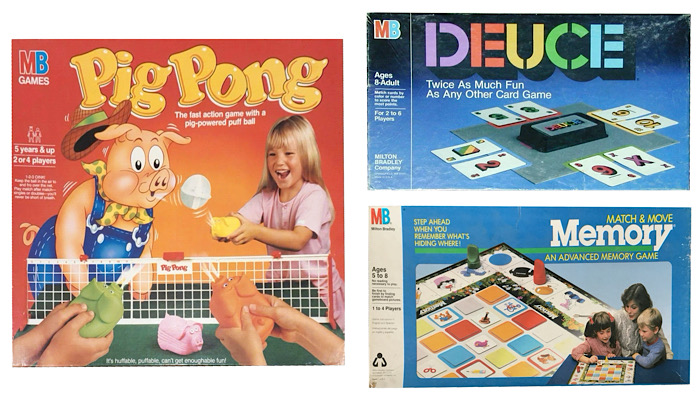
Taia: One was called Pig Pong, which was a simple little game. You had to squeeze these pig-shaped bellows to make a floating piece go over a sort of ping-pong net. The other was a match-and-move memory game.
Tony: So Taia soon showed that she could not only design and draw, but also do it quickly.
And show up…
Tony: And show up! Ha! So she had all the ingredients for being a good designer.
I’m reminded of the Woody Allen quote: 80% of success in life is just showing up! But I love this story… Taia, do you remember your first thoughts on Tony?
Taia: I thought he was a nice guy, but I wasn’t very impressed by his transportation. He had a red Chevette… When I went to get in, there was a banana peel on the passenger side. He had to throw it out of the car! But really, I was mostly concerned about finding a job, getting home on the train, not getting home too late. You know? I was fizzed up with trying to figure out my life. Then – after I got the job – I was quite intimidated by everyone on this think tank because there were designers, engineers, electronics guys, model makers… It was a small group, but I had no experience at all.
And back then, I guess it must have been incredibly rare to have a young, female designer as part of the team?
Taia: Yes. For a while, I think I was the only female designer. There was a female model maker, and the secretary was female. I think that was about it. But you know, back then, that was the world we grew up in. You just kind of learned to navigate as a woman: okay, the guys are in charge. Here’s what I’m doing… But it was a nice group of clever, congenial people.
Tony: When Taia says it was a small group, it’s worth noting that we were in a building across town from the rest of the company. It was basically a separate incubator.
And Tony, can you tell us about an invention of yours in that group?
Tony: I think I got one thing in the line – a card game that came and went very quickly and is now lost in the obscurity of toy history. It was called Deuce – although that’s not what I wanted to call it. I wanted to call it Putz. Ha! But I did always feel the pressure of coming up with new ideas in a group like that. I think that’s something that’s difficult for a company to manage… Because if they have an internal group that comes up with good ideas, then it’s cost effective because they don’t have to forever pay royalties. But if the people in that group are good at it, why would they stay?!
Ha! Yes! I think companies struggle with that to this day. You referred earlier to your creative process, Tony – sitting in a chair staring at a wall. Apart from that, where do your ideas come from?
Tony: I wish I knew! My pattern has often been around seeing a shape, or a relationship between random objects… It could be a piece of paper lying on the floor. It could be the emblem of a car brand. It could be something I see in the grocery store… My thinking is: what could that do if it was bigger? Or tiny? What if it did something else? You know? So I start to go through these mental gymnastics of how I could change the shape or size or a part of what something is or could do… And I ask: ‘How could it be fun?’
So that’s how it starts. What the final idea is, how it comes, I don’t know – but I do work at it. And there are some exercises you can do for creativity enhancement, and I have a lot of those things to do. I don’t know exactly how effective they are, but I do think creativity can be learned to some extent. Anyway, when I look back at ideas of mine that’ve been produced and been successful, I often wonder: how did that start? And I don’t have a good answer.
This is fascinating to me!
Taia: To that, I should add that Tony collects a lot of different toys and interesting things… Bits from a kitchen store, say, or a hardware store. It might be just some odd little object, but he’s always wondering how it could be fun… What could this do?
Tony: Yes. I pick things up here and there and sometimes get inspired by an object that looks interesting or clever. I love clever things! For me, for an invention to be successful, I think it has to be feasible – you’ve got to be able to make it at the right price – but I also think it’s got to be clever and, most of all, fun. So while there’re a lot of clever devices out there that are fascinating, they wouldn’t necessarily be fun over and over again.
Wow. You’ve said quite a lot there. And I don’t know if you have a name for your process, but I call it Factor Nudging… You see something and ask yourself: ‘What if that was bigger? Smaller? What if it was a different shape? Wooden? Transparent? What if it was reversed? What if it was upside down? What if it was under water?’ You’re looking at objects from new angles and asking how it could be useful to you.
Tony: That’s it exactly! You’re right on there.
Is there a specific toy or game we can discuss that’s come about like that?
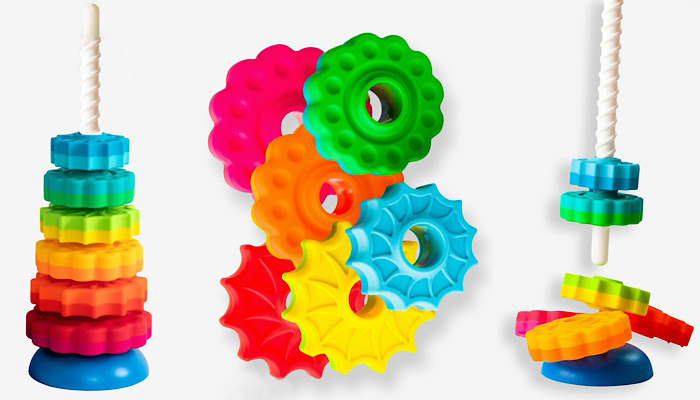
Tony: I guess the most visible one is a toy that I created, pitched, couldn’t license – then put away for a long time. Now, though, it’s with Fat Brain. It’s called Spin Again. It’s a stacking toy where you have rings that you put on a rod, and they spin down. I’ve got the original here somewhere… Taia, would you mind grabbing it? I made the prototype maybe 15 years ago, but it only got to market around five years back. So you take these chunky rings and put them on this spindle… As they go down, they spin around and around! It’s that simple.
Oh, that’s mesmerising! I could watch that all day!
Tony: This is the prototype, so the rings are big and clumsy. Fat Brain did a great job designing the final product. But the reason I show you that is because the idea of stacking rings around a shaft is SO old… It must’ve been around since the Stone Age! Ha! But I felt like there was something else to do with the action. What if you had something come down differently? What if it just turned as it went down? So I just added a thread to the shaft.
I love that! And you’re saying that took about ten years to get to market?
Tony: Yes, I originally showed it to Fisher-Price, Hasbro – everybody. They all passed on it. That’s okay; it happens. I just move on to the next thing; Then it sat in a closet for five or six years until I thought: ‘What the heck! Nothing to lose… I’ll bring it out again.’ When I showed it to Fat Brain, it was an immediate yes: “We want to do that!” And it’s been very successful for them, largely because of their design staff. They have good designers there.
It’s beautiful! And you said earlier that you think creativity can be learned?
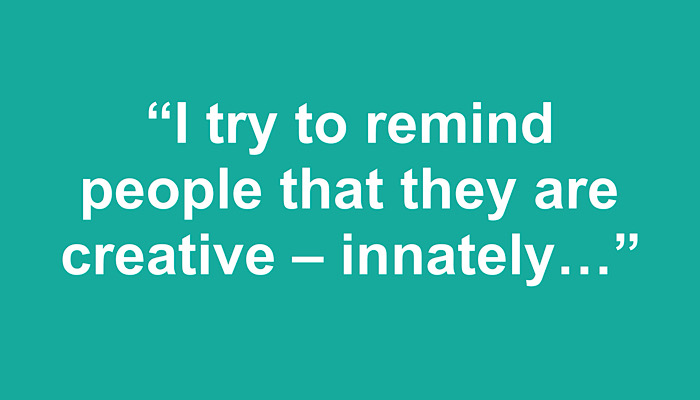
Tony: To some extent, I think… Yes. Every once in a while, I’ll give a creativity seminar to a business or a school class. We do little activities exercises for about an hour and I give examples to emphasise that I believe how everybody – with a few exceptions – has built-in creativity. It’s innate, it’s automatic. But what happens is at about age eight, nine or ten, a lot of people get discouraged by seeing others do things they can’t do…
So you might see a girl in your class that knows how to draw horses, say. And you might end up saying to yourself: ‘She must be an artist.’ And that can be discouraging if you can’t draw horses! So you start to think that other people are creative and that you’re not. Occasionally, other people even discourage you from trying to be creative thinking. So I try to get people to re-engage with that; to remind them that they are creative – innately – they’ve just forgotten.
Agreed! It would be amazing if every child left school knowing how to have ideas and problem solve; how to be habitually creative – which is what you and Taia seem to be. Do you have a specific process, Taia?
Taia: Something that Tony and I have in common is that I was a tinkerer growing up as well. I would have an idea in my head and try to figure out how to make it come to life… Mostly for my own satisfaction. But I’m a very hands-on thinker. I still like to sew and sculpt or whatever. I need to use these hands while they still work!
Oh, you sculpt? What’s your medium?
Taia: Oh, it’s not fine art; I just make little goofy things in Sculpey … It’s a polymer clay that you bake in your oven at home. So if I need to make a goat or I need to – ha! – make Christmas ornaments or whatever, its quick and easy.
Ha! Sorry – I’m not laughing at you, Taia – I’m just tickled at the idea that you need to make a goat rather than want to! It made me chuckle!
Taia: Ha! Well, I also find that – when you’re creating things and making stuff – you never know what you’re going to discover. There’s a lot of creativity in running into little problems and working out how you’re going to do things, and I think there’s creativity in happy accidents. You know? If I’ve cut something by mistake, I’ll look at what I’ve done because it might give me an idea that I actually like better.
Wow! You’re not going to believe this, Taia… I’ve been waiting for an inventor to discuss making mistakes for ten years! But it’s never come up, so I’ve just this week done two features on it. One is about the questions you can ask yourself when you made a mistake… The other is about toy inventions that came from mistakes! People can read those here and here. Accidental invention has been described to me as “A deviation from the route of intention.”
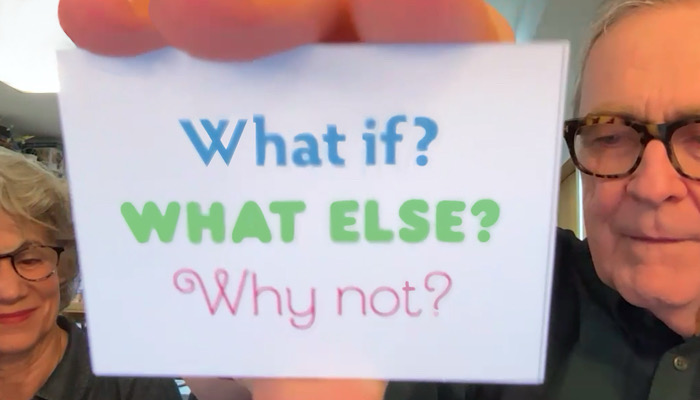
Tony: Ha! You’ve reminded me of a phrase that I ran across. I don’t know who put it together, but they were inspired… I have it printed on a little card here:
‘What if? What else? Why not?’ I can’t take credit for it, but I’d love to.
‘What if? What else? Why not?’ – I love that. So when you’ve had the spark of an idea and tinkered around, at what point do you measure an idea against the reality of cost, say? Or playtesting?
Taia: Tony doesn’t! Ha! Our house is actually full of ‘What if, why not and why bother?’ Ha!
Ha! Very good! Ha!
Tony: Ha! It’s true! But there’s an answer to that… I’ve often been halfway into a project and thought – for example – there’s way too much plastic here for this category. It’s not going to work… So we end up with a lot of half-finished projects in closets. But at other times, I don’t care if it’ll never see the light of day: I like it and want to finish it. So we have closets full of items that’ll never be made, let alone licensed. I mean, if I get one out of 30 things over the line I’d be surprised. That’s the nature of the work… If we don’t do the 90% of things that don’t get made, the 10% that do wouldn’t get made either!
That being the case, how do you know when an idea’s ready to pitch?
Taia: Well, Tony makes full-blown prototypes that he can demonstrate or let you play. I think if it wasn’t for his model-building abilities, a lot of the stuff that has got there wouldn’t have. You need a physical working model for a lot of Tony’s ideas, even if it doesn’t look exactly like what it ends up looking like.
Tony: Yes, I tend to fabricate things myself by putting together plastic pieces… I usually work in white, high-impact polystyrene sheets – an eighth or a sixteenth of an inch thick. I cut them up, glue them together and machine, drill and shape them to build things up. But, to answer your question, I never know for sure if something’s ready to pitch… Partly because I don’t really want to finish a prototype to the point where it looks completely finished. I don’t want it to look like I’m saying, ‘This is how it should look when it’s manufactured.’
Why not?
Tony: Because every company has a certain style or line look – and, at some companies, the decision maker’s vision is locked into what you put in front of them. They can’t always see past your theme to think, ‘It could be this, it could be that, it could look so much different…’ So I try to present things that are very generic in appearance.
Great answer! I love how your thinking dovetails with how I see things… What a pleasure to chat. I’m so glad you could make time! My final question – for each of you – is this: what’s the most interesting object in the room?
Tony: Gosh! In the room? Other than Taia?
Oh, Tony! You old smoothie! Yes, other than Taia…
Taia: Gosh, that’s really hard. I mean, the room is just chock full of stimulation…
Tony: You know, I’m going to show you this tiny, rubbery little moose. It’s not glued down, but it sits on this wooden cube. And I fiddle with this moose most days… Some days I think his antlers need to be a little further forward. Other days, I think that’s too much… I’ll move them back! Some days, I turn it a little more one way to change the angle… It sits over there on our printer; I look at it almost every day. I just love it!
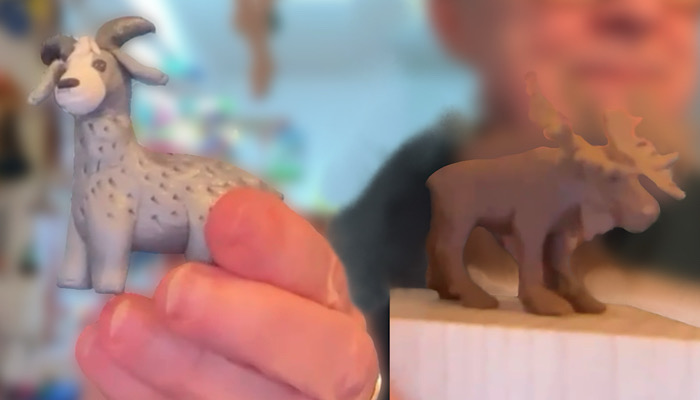
Taia: Well, this is not the most inspiring thing but it’s interesting because you’re interested in it! This is the clay goat I made!
Ha! Brilliant!
Taia: It’s not the most inspiring thing – I can’t remember why I wanted to make it…
Needed to make it!
Taia: Ha! Needed to make it! It might have been a Christmas thing. I don’t know if it started out as a lamb and maybe the legs were too short. I don’t think so because it’s not an ornament. I think I just felt like making a goat at some point.
Gosh and golly… A goat and a moose! Thank you so much – this has been fabulous!
–
To stay in the loop with the latest news, interviews and features from the world of toy and game design, sign up to our weekly newsletter here
More Recent Interview

BOTI’s Nico Blauw talks Pembe the Pink Cat, innovation – and the International Toy Board
“The look, the design, the audience, the messaging… It all appealed”: Nico Blauw reveals what made Pembe the Pink Cat a winner for BOTI.
“This was the missing piece…”: Rubber Road’s Jack Fox on TUBBZ’s move into blind collectibles with Mystery Eggs
Jack Fox, Sales & Marketing Director at Rubber Road, talks TUBBZ Mystery Eggs – and why Minions were a perfect fit.

Educational Insights’ Lisa Guili on TikTok, 20 years of Kanoodle – and ten million units sold
Lisa Guili reveals how one addictive brain teaser found its audience and became a phenomenon.
“I want people to bet on themselves”: Spin Master Co-Founder Ronnen Harary discusses his new book, No Experience Necessary
Spin Master Co-Founder Ronnen Harary talks to us about his exciting new book, working with inventors – and Spin’s most underrated launch.

David Norman of Stormin’ Studios on inventors, Orchard Toys – and shaking things up!
“It’s not just a name, it’s our mission statement”: In conversation with Stormin’ Studios’ David Norman.

Carrera Revell’s Frank Tiessen on the slot-car set that buyers had to see to believe…
How Speed Arena: Race in a Case became an instant hit: in conversation with Carrera Revell’s Frank Tiessen.
Popular Articles
DSTLRY launches card game based on its award-winning Somna comic

Hasbro's Angus Walker on creativity, pitching and the key to successful inventor relations
BOTI’s Nico Blauw talks Pembe the Pink Cat, innovation – and the International Toy Board
A Prickly Plan for Playground Popularity...
Zuru's Starbox collectibles brings together "elevated design, strong storytelling and trend-led play patterns"
Upcoming Events
-
- 30th January 2026
- Spielwarenmesse, Nuremberg
International Game Inventors Convention
-

- 19th - 21st May 2026
- Mandalay Bay Convention Center, Las Vegas
Las Vegas Licensing Expo
-

- 23rd - 25th June 2026
- Stamford Bridge Stadium, Chelsea, London
Play Creators Festival
-

- Tuesday, June 23rd, 2026
- Stamford Bridge Stadium, Chelsea, London
Play Creators Awards
-
- Wednesday, June 24th, 2026
- Stamford Bridge Stadium, Chelsea, London
Play Creators Conference
-

- Thursday, June 25th, 2026
- Stamford Bridge Stadium, Chelsea, London
Mojo Pitch
-

- 6th - 8th October 2026
- Excel London
Brand Licensing Europe